Website for Midwives: Service Area, Availability and Trust
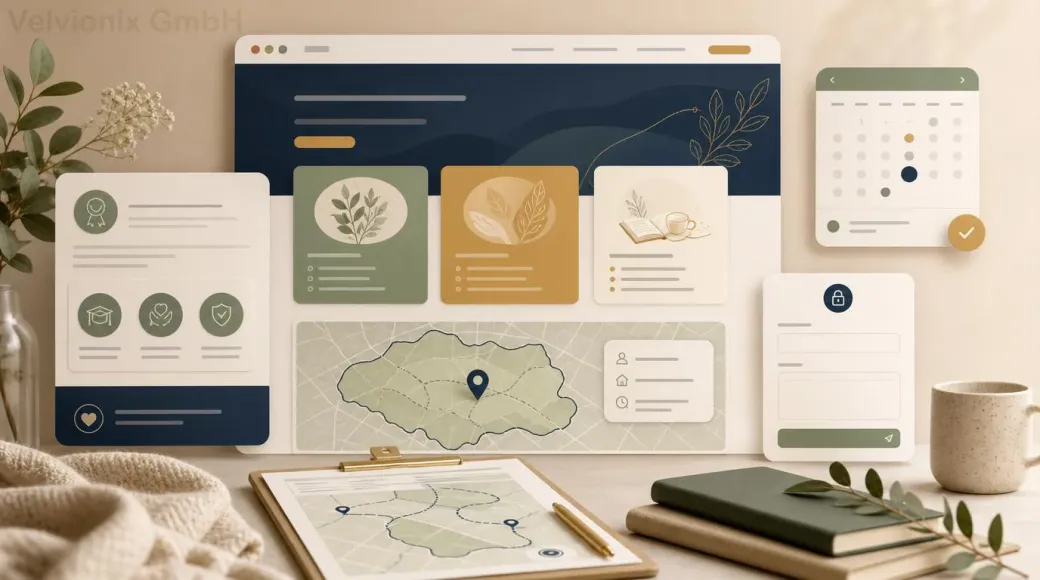
What a midwife website should do: explain services, show the service area, clarify availability and offer a suitable contact channel.
Published: · Updated:
 © Velvionix
 Important notice Legal, tax and industry-specific information concerns Germany and expressly identified EU law. It is provided for general orientation and does not replace individual advice. Last review of the cited legal situation: July 2026 Show the full notice
Unless stated otherwise, the legal, tax or industry-specific information on this page reflects the law applicable in Germany and German official and professional practice. Directly applicable EU law and references to other jurisdictions are identified separately. The information was researched with due diligence using sources available as of the stated review date. For binding guidance on your specific project, please contact the competent chamber or a qualified specialist, such as a lawyer or tax adviser. The current statutes and official regulations always prevail.
The essentials for midwife websites
Why a Midwife Website Needs Its Own Logic
Midwives work in a deeply personal but also highly organisational setting. Expecting parents are not simply looking for a service. They are looking for a person they can trust during a sensitive phase of life. At the same time, very practical questions matter: home address, due date, travel area, capacity and response path.
A strong website for midwives does not have to be technically more complex than a website for naturopaths, physiotherapy or other health services. It does need its own order of priorities. Not effects first, not a large system first, but orientation: Am I in the service area? Is there any capacity? Which services are offered? How can I make contact without sharing too much sensitive information?
Freelance midwives and small midwifery teams benefit especially from this. If you receive many enquiries but have little time for mismatched follow-up calls, you need a website that filters before first contact.
The Service Area Matters More Than a Nice General Sentence
Many websites start with a friendly welcome sentence. For midwives, another piece of information is often more important: Where do you actually support families? A midwife cannot travel indefinitely when home visits, postpartum care and courses need to fit into a tight working day.
The service area should therefore be clear on the website. It can be described through towns, districts, postcodes or a radius. If individual places are possible only depending on workload or travel route, that should also be visible. This helps avoid enquiries that do not fit from the beginning.
This clarity also helps search engines. Someone searching for a midwife in a specific region does not need an abstract practice description. A website that connects locations, services and contact paths clearly is easier for both visitors and search systems to understand.
Availability Does Not Need to Be Perfect, But It Should Be Honest
Many midwives are fully booked. A website does not have to turn this into a public calendar. But it should provide honest orientation: enquiries possible from a certain month, postpartum care currently limited, courses with fixed start dates or response within a few working days.
The important point is that the section remains maintainable. If an availability calendar is never updated, it loses trust. A short note that can be changed quickly is often better than a large booking system that does not fit daily work.
Imagine a midwife who serves only a few postcodes and cannot take new postpartum care enquiries for three months. If that information appears on the homepage, fewer unsuitable families enquire. The remaining enquiries are more concrete and easier to answer.
Services Need Structure, Not Just a List
Pregnancy support, prenatal care, postpartum care, breastfeeding counselling, birth preparation, postnatal exercise and courses sound self-evident to professionals. For parents, it is often unclear what exactly is included, when they should enquire and which parts may be covered by health insurance.
A good service page explains the offer factually. It places services in context: which services happen at home, which happen in course rooms or external rooms, which conditions matter and how contact works. The website does not replace individual advice, but it can clarify the most important expectations.
Not every midwife offers everything. That should be visible. Clear boundaries look more professional than a long list that promises more than can be handled in daily work.
The About Page Builds Trust
With midwives, the person matters. Parents want to know who will accompany them, how the midwife works and whether communication feels right. The About page should therefore be more than a short biography.
Useful information includes training, professional experience, additional qualifications, focus areas, languages, course formats, way of working and a personal approach. This can be warm without becoming vague. General phrases such as “with heart and competence” do not replace real information.
Trust comes from clarity. A website that shows how you work, where your boundaries are and how first contact happens feels calmer and more reliable.
Offer the right contact channel
The contact channel should suit the purpose of the enquiry. We can link to an existing appointment or contact service from a suitable specialist provider or add a supported embedding option. A standard form implemented by Velvionix is intended for general administrative questions without health or care-related details.
For most small midwife websites, a custom course portal, payment system or patient account is not the right first step. It creates costs, maintenance work and responsibility before the website has fulfilled its main task: provide understandable information and enable suitable enquiries.
What Often Weakens Midwife Websites
Common weaknesses
Frequently Asked Questions About Midwife Websites
Does a midwife immediately need a large website?
No. For launch, a lean website with services, service area, availability, About section, contact and required legal pages is often enough. The important point is that it can be maintained.
Should the service area be on the homepage?
Yes. Many parents need to know immediately whether their address is covered at all. Towns, districts, postcodes or a clear radius help a lot.
Is an online calendar required?
Not necessarily. A simple, current note on capacity is often better than a calendar that is not maintained. We can link to an existing service from a suitable specialist provider or add a supported embedding option.
Which information should a contact form request?
The details needed depend on the purpose of the enquiry and the chosen contact service. A suitable specialist system can be used for pregnancy and care enquiries. Our standard form is intended for general administrative questions without health or care-related details.
What does a website for midwives cost?
It depends on scope: number of pages, copywriting, imagery, form, course overview, languages and ongoing care. A clear start is often more affordable and sustainable than a large system that is not maintained later.
Plan a Calm Midwife Website
If you want to build your own website, the website for midwives page shows the relevant industry offer with building blocks for services, service area, availability, courses and data-minimising contact paths.
Sources
Notice: The respective providers or operators are solely responsible for the content of external links.
- [1] GKV-Spitzenverband : "Hebammenhilfe-Vertrag"
https://www.gkv-spitzenverband.de/krankenversicherung/ambulante_leistungen/hebammen_geburtshaeuser/hebammenhilfevertrag/hebammenhilfevertrag.jsp - [2] Deutscher Hebammenverband : "Aktuelles zum Hebammenhilfevertrag"
https://hebammenverband.de/aktuelles-zum-hebammenhilfevertrag - [3] Deutscher Hebammenverband : "Wie arbeiten Hebammen?"
https://hebammenverband.de/hebamme-werden-und-sein/wie-arbeiten-hebammen - [4] AOK : "AOK-Hebammensuche: Geburtshilfe in Ihrer Nähe finden"
https://www.aok.de/pk/hebamme-in-der-naehe/ - [5] Google Business Profile Help : "Tips to improve your local ranking on Google"
https://support.google.com/business/answer/7091 - [6] W3C Web Accessibility Initiative : "The Business Case for Digital Accessibility"
https://www.w3.org/WAI/business-case/ - [7] Nielsen Norman Group : "Trustworthiness in Web Design: 4 Credibility Factors"
https://www.nngroup.com/articles/trustworthy-design/

Comments
No comments yet.
Comments disabled
Comments are disabled for this article because the topic may involve sensitive legal, professional or personal information.