Website for Hair Salons: Which Pages Actually Bring Clients
Which pages a hair salon website needs: services, prices, photos, trust, local search and an easy appointment path.
Published: · Updated:
 © Velvionix
 The Essentials for Hair Salons
Why Hair Salon Websites Work Differently
A hair salon does not sell an abstract service. People decide with their eyes, their instincts and their trust: Does this style fit me? Does the salon feel clean and approachable? Can I imagine getting my color, cut or consultation there? How easy is it to book?
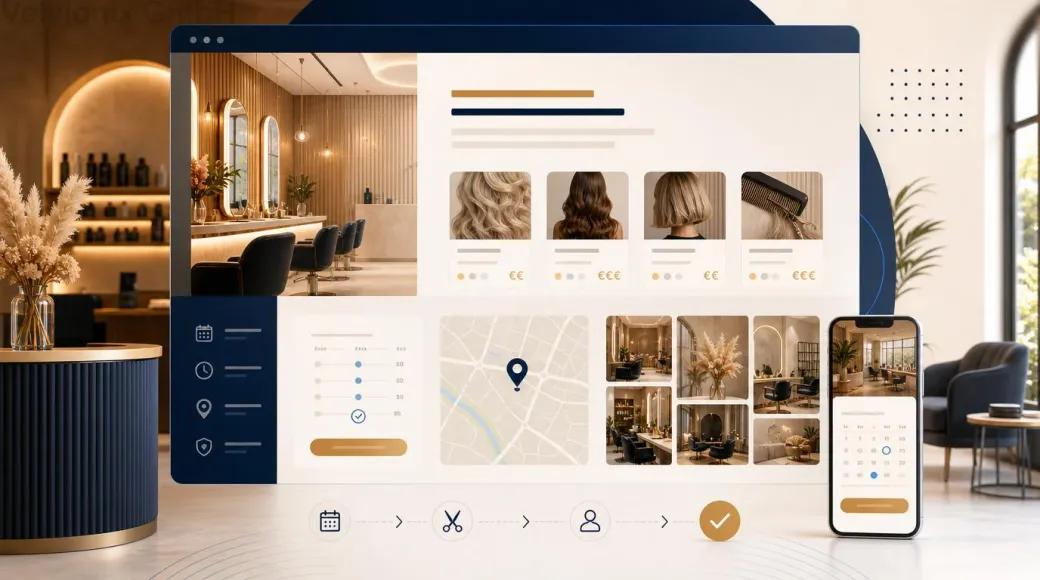
That is why a generic small-business website rarely fits hair salons. A strong hair salon website must feel like a digital shop window while staying practical. It shows atmosphere, organizes services, answers typical questions and makes the next step easy.
If your salon relies heavily on recommendations, the website should support those recommendations. When someone hears your name from a friend, they often still look online for photos, opening hours, location and prices. If they only find an old profile, an empty directory listing or an incomplete social media presence, the recommendation loses strength.
The Homepage Must Sort Visitors Quickly
The homepage is not the place for a long salon philosophy. It has to answer quickly who the salon is right for. A strong opening names the location, salon type and main strength: color and balayage, men and barber services, family haircuts, modern short styles, bridal styling or calm consultation.
If new clients are looking for inspiration, they need photos early. If they mainly want a quick appointment, opening hours, phone number or booking path must be visible immediately. If the salon is positioned at a higher price point, the website needs to explain quality and consultation instead of only saying “modern and professional.”
For hair salons, the first screen is therefore a mix of atmosphere and orientation. A real salon photo, a clear sentence, a visible appointment path and a short service anchor are stronger than a large welcome message without substance.
Services and Prices Need Enough Clarity
Many salons avoid price information because the final cost depends on hair length, effort and technique. That is understandable. Still, orientation helps. When visitors find no price direction at all, they ask avoidable questions or choose a salon that feels more transparent.
A good services page does not need to cover every edge case. It can work with categories: women, men, color, balayage, care, styling, children, consultation or packages. If prices vary, starting prices, price ranges or a note about in-person consultation are often more honest than silence.
If a service needs explanation, the website should not only name it. Balayage, highlights, color correction or bridal styling deserve a few sentences: Who is it for? How long does it usually take? Why is consultation important? What should the client know beforehand? This is where a helpful hair salon website becomes more than a price list.
Photos Are Trust Work, Not Decoration
Hair services are visible. That makes photos on a hair salon website more than decoration. They help people decide. Good images show the salon, team, workstations, details, real work and examples. They do not need to look overproduced, but they must fit the business.
Stock photos are especially risky in this industry. A perfect model image says nothing about how the salon works. A few real, clean photos are better than a large gallery with no connection to the salon. If before-and-after examples are used, consent, image rights and personal rights should be handled carefully.
Imagine a small salon with many regular clients but very few online enquiries. The existing website shows only a logo and a phone number. Instead of launching a large campaign, the first step is a clear homepage: salon photo, three specialisms, short team introduction, price orientation and a visible appointment path. It does not become louder. It becomes more credible. New visitors see faster whether the salon fits them.
Local Search Needs Both Website and Business Profile
Many hair salon searches are local: “hair salon near me”, “hair salon in city district”, “balayage city” or “men’s haircut open now.” A maintained Google Business Profile matters here. But it should not work alone. The website is where services, photos, contact, location and trust come together in more detail.
If name, address, phone number and opening hours differ between website and profile, visitors feel uncertainty. If the Google listing has current photos, reviews and hours, but the website looks outdated, the impression is inconsistent. When both support each other, the whole presence feels calmer and more credible.
Technically, a hair salon website can also use structured data so search engines can better understand address, opening hours and business type. That is not a ranking promise, but it is a clean foundation. The visible page still has to show the same information clearly.
The Appointment Path Must Not Be Hidden
A salon rarely loses enquiries because visitors did not admire the wording enough. More often, the next step is unclear. The phone number is too small, the booking link sits only in the footer, the contact form is too long, opening hours are hard to find or there is no clear statement that new clients are welcome.
If the salon uses online booking, the direct path should be visible. If appointments are booked by phone, the phone number must be tappable on mobile. If color services require consultation, that should be stated clearly. If WhatsApp or messaging is used, the business should know whether that channel really fits its operations and privacy responsibilities.
An alternative matters. Not every client wants to book online immediately. Some have questions about color, hair length or expected effort. Others want to check whether the salon is accessible. A strong contact page therefore lists address, map, opening hours, phone, email or preferred contact path and briefly explains which details help with an appointment enquiry.
Instagram Is an Addition, Not the Foundation
Instagram can work extremely well for hair salons. Before-and-after images, reels, team moments and trends fit the industry. But social media is not a substitute for a website. Information is harder to structure, older posts disappear from attention, links are limited and visibility depends on platform rules.
The website should not compete with Instagram. It should organize it. Good social content can serve as proof. The website turns it into decisions: Which services are available? Who does what? What does it roughly cost? Where is the salon? How do I book?
If Instagram is the stage, the website is the reception desk. That is where interest turns into an appointment.
The Real Effort: Maintenance in Salon Life
A hair salon website only stays useful when it stays current. Opening hours change, team members join or leave, prices are adjusted, new services are added and promotions expire. Because salons have little office time, the website needs to be planned lean and maintainable.
If prices change often, the structure should be easy to update. If photos are added regularly, there should be clear selection rules. If the booking tool changes, an old link should not remain on every page. Maintenance is not a side issue. It is part of the website’s effect.
A good start is therefore not the largest website, but the most stable foundation: homepage, services, salon and team, gallery or examples, contact and required legal pages. Later, special pages for color, balayage, bridal styling, barber services or apprenticeships can follow when they have a real purpose.
What Weakens Hair Salon Websites
Common Questions About Hair Salon Websites
Does a hair salon really need its own website?
Yes, if the salon wants to be found and understood reliably online. A Google profile and Instagram help, but the website remains the controlled place for services, prices, photos, contact and trust.
Which pages should a hair salon website start with?
For the first version, homepage, services, salon and team, gallery or examples, contact and required legal pages are usually enough. Specialist pages make sense when services such as balayage or bridal styling raise their own questions.
Should a salon show prices on its website?
Some price orientation is usually helpful. If the final price depends on effort, starting prices, ranges or consultation notes can work better than a rigid list.
Is Instagram enough as a digital shop window?
Instagram is strong for inspiration, but weaker for structured information. The website keeps services, contact, opening hours, prices and location permanently findable.
What matters most for local search?
Complete and consistent information matters: salon name, address, phone number, opening hours, services, photos, reviews and a matching Google Business Profile.
How much does a hair salon website cost?
It depends on page count, photos, copywriting, booking paths, language, maintenance and desired extensions. A lean first version is often better than a large system that does not get maintained.
Plan a Hair Salon Website Clearly
If you are planning a website for your salon, the website for hair salons page outlines the relevant building blocks for salon presentation, services, photos and appointment paths.
Sources
Notice: The respective providers or operators are solely responsible for the content of external links.
- [1] Zentralverband des Deutschen Friseurhandwerks : "Daten & Fakten Friseurhandwerk"
https://friseurhandwerk.de/politik-wirtschaft/daten-fakten-friseurhandwerk/ - [2] Statistisches Bundesamt : "Struktur der Unternehmen im Handwerk"
https://www.destatis.de/DE/Themen/Branchen-Unternehmen/Handwerk/aktuell-struktur-handwerk.html - [3] Google Business Profile Help : "Tips to improve your local ranking on Google"
https://support.google.com/business/answer/7091 - [4] Google Search Central : "Local Business (LocalBusiness) Structured Data"
https://developers.google.com/search/docs/appearance/structured-data/local-business - [5] Nielsen Norman Group : "'Contact Us' Page Guidelines"
https://www.nngroup.com/articles/contact-us-pages/ - [6] Nielsen Norman Group : "Trustworthiness in Web Design: 4 Credibility Factors"
https://www.nngroup.com/articles/trustworthy-design/ - [7] W3C Web Accessibility Initiative : "The Business Case for Digital Accessibility"
https://www.w3.org/WAI/business-case/ - [8] BrightLocal : "Local Consumer Review Survey 2025"
https://www.brightlocal.com/research/local-consumer-review-survey-2025/

Comments
No comments yet.
Be the first to comment!
Write a comment
To write a comment, please enable the comment function in your privacy settings.
Write a comment