Website for Naturopaths: Trust and Visibility
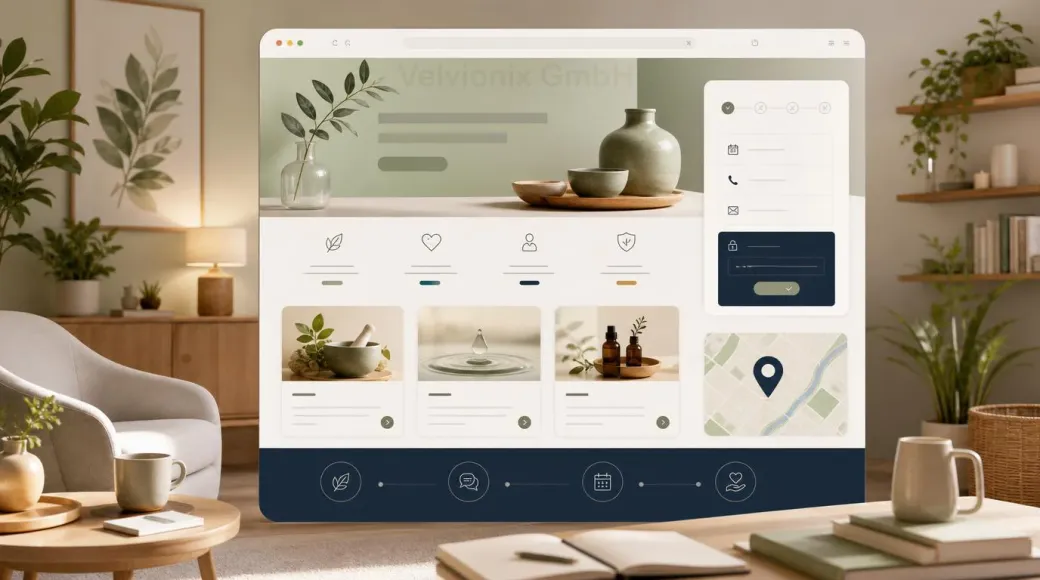
What a naturopath website should do: explain qualifications, present methods factually, support local visibility and make contact easier.
Published: · Updated:
 © Velvionix
 Important notice Legal, tax and industry-specific information concerns Germany and expressly identified EU law. It is provided for general orientation and does not replace individual advice. Last review of the cited legal situation: July 2026 Show the full notice
Unless stated otherwise, the legal, tax or industry-specific information on this page reflects the law applicable in Germany and German official and professional practice. Directly applicable EU law and references to other jurisdictions are identified separately. The information was researched with due diligence using sources available as of the stated review date. For binding guidance on your specific project, please contact the competent chamber or a qualified specialist, such as a lawyer or tax adviser. The current statutes and official regulations always prevail.
The Essentials for Naturopath Practices
Why Naturopath Websites Are Particularly Sensitive
A naturopath practice is judged differently from a hair salon, a trades business or a restaurant. Visitors often arrive with a personal concern. They are not only looking for an address. They need reassurance: Does the practice feel calm? Is the person qualified? Are the methods explained understandably? Does anything sound too good to be true?
That is why a strong website for naturopaths needs its own tone. It does not have to advertise loudly. It has to provide context. A practice working with naturopathic, complementary or holistic methods builds trust through transparency, clear limits and an easy contact path, not through large efficacy claims.
Without a website, a practice does not only lose visibility. It also lacks a controlled place where people can evaluate the practice calmly. Directories, recommendations and business profiles help, but they rarely explain enough: Which specialisms are offered? What happens in a first appointment? Which qualification exists? Which costs should self-paying patients expect?
The Homepage Must Provide Calm Orientation
The first screen should quickly answer who the practice is for. A strong opening names location, practice type and focus, for example a naturopathic practice in a city, a naturopath with a focus on phytotherapy or a practice for complementary methods. The wording should stay factual. The website should not suggest that a specific health issue will reliably be solved.
Alongside the opening sentence, the homepage needs three clear paths: understand methods, get to know the practitioner and make contact. That sounds simple, but it matters. Many visitors first want to check whether the practice feels right before they call. Others want to know immediately whether an initial consultation is possible.
A calm practice image, clear structure and a few strong statements work better here than an overloaded health website. Especially with sensitive topics, restraint creates more trust than aggressive advertising language.
The About Page Is Not Secondary
For naturopaths, the person behind the practice matters strongly. Visitors want to know who will sit across from them. A good About page therefore does more than offer a friendly sentence. It gives understandable information: permission to practise as a Heilpraktiker in Germany, training, continuing education, focus areas, experience, way of working and personal approach.
This does not have to sound dry. The important point is that statements remain concrete and verifiable. When continuing education is mentioned, it should be placed in context with institute, field or timeframe. When professional association membership is mentioned, it should not be inflated as a guarantee, but presented as part of the professional context.
A professional portrait can help if it fits the practice. It does not replace substance. Trust is built through the combination of calm impression, clear qualification, understandable language and no exaggerated claims.
Explain Methods Without Making Health Promises
Many naturopath practices have focus areas such as acupuncture, phytotherapy, homeopathy, gut health, nutrition counselling, relaxation, cupping or other complementary methods. These methods need more than a list. Visitors want to understand what is meant, how an appointment works and which questions should be clarified first.
Good method pages therefore explain the process, the direction of the method and its role in the practice. They can also state that certain claims need professional review and that acute or unclear symptoms should be medically assessed. That does not weaken the website. It makes it more credible.
It becomes risky when a website guarantees effects, promotes serious diseases with advertising language or uses testimonials as if they were generally valid evidence. A professional website should not phrase these things casually. It can prepare copy carefully, but final professional and legal review remains with the practice or specialist advisors.
Contact Paths Must Be Especially Lean
The contact area of a naturopath website is more than a technical function. It decides whether visitors can take the first step without giving away too much sensitive information. A phone number, email address, consultation hours and a clear explanation of first contact are often more important than a long form.
If a form is used, it should stay deliberately short. Name, contact path and a neutral message are often enough. Fields for diagnoses, medication, reports or detailed symptom descriptions can involve health data and should not appear casually in a standard form. The input is sent by email directly to the customer’s mailbox; permanent storage on our systems is not intended.
An external appointment or booking tool can be useful if the practice already uses it and the data protection and professional questions have been clarified. For many small practices, personal first contact by phone or email remains the better start because it builds trust and avoids misunderstandings.
Prices and Self-Payer Orientation Create Clarity
Many visitors do not know how naturopath services are billed in Germany. Statutory health insurance usually does not reimburse these services like ordinary panel-doctor services. Private insurance, supplemental tariffs or aid schemes may behave differently depending on the tariff. The German fee directory for naturopaths is also not a legally binding state fee schedule, but an orientation.
A website does not have to become billing advice. It should avoid misunderstandings, though. Useful wording can mention self-payer practice, fee based on time and scope, reimbursement depending on private tariff or billing aligned with agreed rates. The clearer the practice explains its framework, the better later enquiries will fit.
Prices do not need to cover every detail. An orientation for the first appointment, duration or typical fee range can still calm visitors. Saying nothing often creates more questions than necessary.
Local Visibility Needs More Than a Listing
Many people search locally: naturopath nearby, naturopath city, acupuncture city or naturopathic practice with a specific focus. A maintained business profile matters for this. The own website remains the place where the practice organizes the information itself.
For local visibility, name, address, phone number, opening hours and practice description should be consistent. Specialisms should not be hidden only in running text, but receive clear sections or pages. That helps visitors and search engines understand what the practice stands for.
Structured data can additionally help search engines classify practice information. This is not a ranking promise, but it is a clean technical foundation. The visible website still has to help people: Where is the practice? Who treats? Which specialisms exist? How do I make contact?
The Real Effort: Stay Current and Reviewable
A naturopath website is not finished after launch. Methods change, continuing education is added, consultation times shift, prices are adjusted or wording needs professional review. In a sensitive health context, the website should not stay untouched for years.
A good start is therefore deliberately lean: homepage, methods overview, About page, contact, required legal pages and, if needed, one or two focus pages. The website can then grow when it becomes clear which topics are actually searched for and which content the practice can professionally support.
Ongoing care should include these small updates. A website that remains calmly current feels more trustworthy than a large site with visibly outdated content.
What Weakens Trust on Naturopath Websites
Frequently Asked Questions about Naturopath Websites
Which pages does a naturopath website need at launch?
For launch, homepage, methods or focus areas, About page, contact and required legal pages are often enough. For methods that need explanation, dedicated focus pages can be useful.
Should a naturopath website explain treatment methods in detail?
Yes, but factually. Good method pages explain process, direction, duration, cost orientation and limits. They should not promise healing and should leave sensitive claims for professional review.
Is a contact form useful for naturopaths?
Yes, if it stays lean. For first contact, name, contact path and a neutral message are often enough. Detailed health information does not belong in a casual standard form.
Do prices need to appear on the website?
Not every service needs a fixed price list. Orientation around first appointment, duration, self-payer status or fee range can reduce misunderstandings and attract better-fitting enquiries.
How can a naturopath practice become easier to find locally?
Consistent practice data, clear specialisms, a maintained business profile, understandable pages for relevant methods and a clean technical website structure all help.
What does a website for naturopaths cost?
It depends on scope: number of pages, method copy, imagery, form, languages, ongoing care and later extensions. A lean start is often better than a large health guide without a maintenance plan.
Plan a Serious Naturopath Website
If you want to build a practice website, the website for naturopaths page shows the relevant industry offer with the key building blocks for qualifications, methods, contact and sensitive communication.
Sources
Notice: The respective providers or operators are solely responsible for the content of external links.
- [1] Gesetze im Internet / BMJ : "Gesetz über die berufsmäßige Ausübung der Heilkunde ohne Bestallung"
https://www.gesetze-im-internet.de/heilprg/BJNR002510939.html - [2] Bundesministerium für Gesundheit : "Rechtsgutachten zum Heilpraktikerrecht"
https://www.bundesgesundheitsministerium.de/service/publikationen/details/rechtsgutachten-zum-heilpraktikerrecht - [3] Bundesministerium für Gesundheit / Bundesanzeiger : "Leitlinien zur Überprüfung von Heilpraktikeranwärterinnen und -anwärtern"
https://www.bundesanzeiger.de/pub/publication/d6Pk1lbZta8EPCulJuE/content/d6Pk1lbZta8EPCulJuE/BAnz%20AT%2022.12.2017%20B5.pdf?inline= - [4] Gesetze im Internet / BMJ : "Heilmittelwerbegesetz"
https://www.gesetze-im-internet.de/heilmwerbg/HWG.pdf - [5] Bund Deutscher Heilpraktiker : "Gebührenverzeichnis"
https://www.bdh-online.de/heilpraktiker/praxismanagement/abrechnung/gebuehrenverzeichnis/ - [6] Google Business Profile Help : "Tips to improve your local ranking on Google"
https://support.google.com/business/answer/7091 - [7] Google Search Central : "Local Business (LocalBusiness) Structured Data"
https://developers.google.com/search/docs/appearance/structured-data/local-business - [8] Nielsen Norman Group : "Trustworthiness in Web Design: 4 Credibility Factors"
https://www.nngroup.com/articles/trustworthy-design/ - [9] Nielsen Norman Group : "'Contact Us' Page Guidelines"
https://www.nngroup.com/articles/contact-us-pages/ - [10] W3C Web Accessibility Initiative : "The Business Case for Digital Accessibility"
https://www.w3.org/WAI/business-case/
Comments
No comments yet.
Comments disabled
Comments are disabled for this article because the topic may involve sensitive legal, professional or personal information.