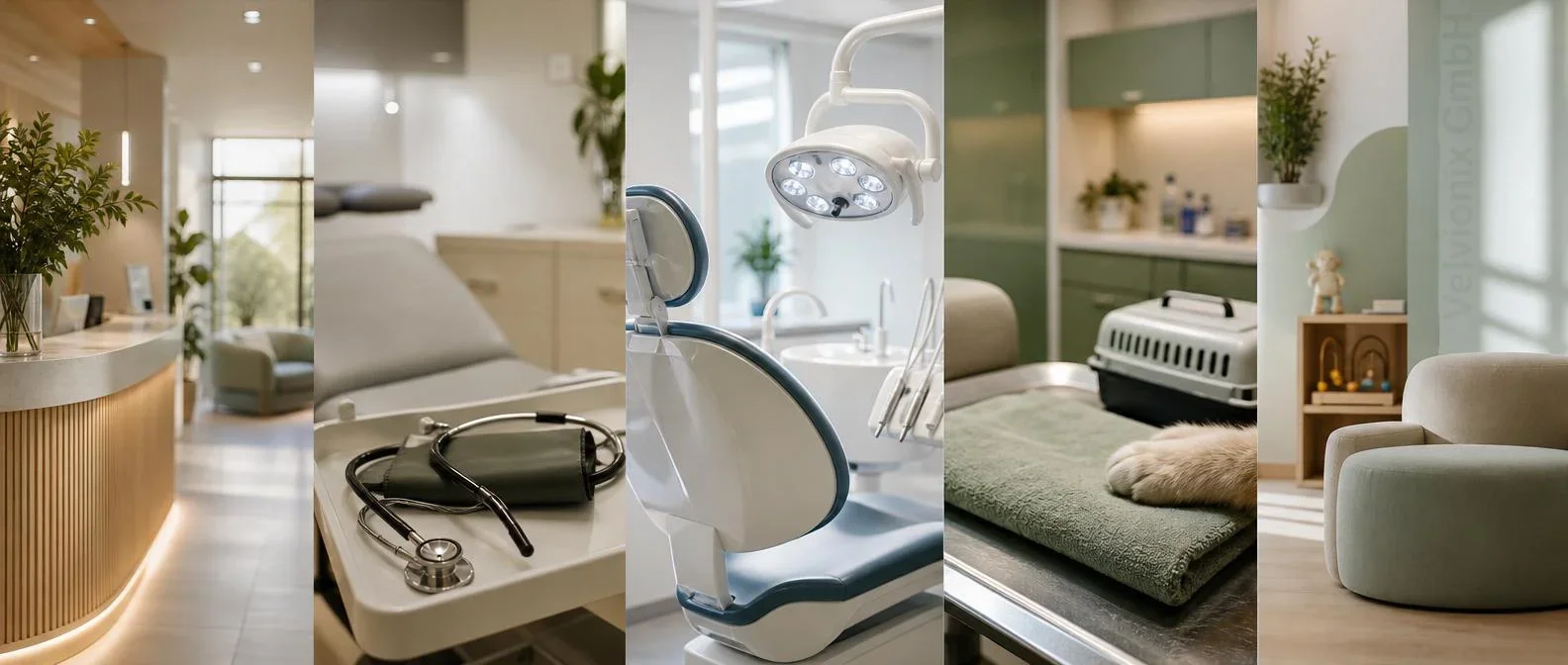
Professional Websites for Medical & Dental Practices
A modern practice website is more than a business card today - it is the first point of contact between practice and patient. We build websites for medical practices, dentists and veterinary practices that are accessible, factual and technically well structured. Patients quickly find the information they need and can make contact without obstacles.
Dedicated pages with more depth
Selected practice types get additional in-depth pages with legal notes, FAQ and concrete content recommendations.
Why medical practices need a modern, accessible website
Patients search for doctors almost exclusively online today. A well-designed practice website is the most important business card - even before review portals or directories. It decides whether patients find their way to your practice or book an appointment with the competition. This applies to family doctors as well as specialists, dentists and veterinarians.
Many practice websites are difficult to use for older people or patients with disabilities. We build websites with a WCAG-oriented structure: sufficient contrast, meaningful alt text, keyboard operability, semantic HTML and compatibility with screen readers. This improves usability, readability and findability.
Health professions communicate in a sensitive environment. This affects, among other things, advertising statements, before-and-after images, promises of healing and the presentation of qualifications. We therefore structure practice content factually and with restraint; final professional and legal review of concrete statements remains with the practice, chamber or specialist advisor.
An essential component of modern practice websites is digital appointment booking. Whether via a simple contact form, an email request or an integration with a common appointment booking widget - patients expect to be able to book appointments without a phone call. This relieves your practice hotline and increases patient satisfaction. We integrate the solution that fits your workflow.
Website for Medical Practices
A website for a medical practice must first and foremost convey trust. Patients are often in a vulnerable situation when searching for a doctor - either because of an acute reason or because they are looking for a new contact. A modern, calm design with clear structure, good photos of the practice rooms and the team creates exactly this atmosphere. A short introduction of the physician with career and specialisations helps build trust before the first appointment takes place.
The most important content includes consultation hours, emergency information, substitute arrangements, services offered, information on individual health services (IGeL) and a clear contact option. Consultation hours should be readable at a glance, especially on mobile devices - many patients search for exactly this information in urgent cases. Emergency references outside consultation hours (medical on-call service 116117) also belong prominently on the homepage.
For medical practices, the privacy policy and imprint are particularly important. Information on the medical licence, competent chamber, professional regulations and supervisory authority needs a clear place on the website. We prepare this structure and align it with the practice details provided; final legal review is handled by the practice, data protection officer or specialist advisor.
Website for Dental Practices
Dental practices have a significantly stronger visual character than family doctor practices. Modern practices invest in design, interior and technology - and the website should reflect exactly that. High-quality photos of the treatment rooms, the team and selected treatment results convey professionalism and competence. Many patients decide not purely on price for dental treatment, but on the overall impression - and that begins on the website.
Clear information on key areas such as implantology, orthodontics, aesthetic dentistry, periodontology or prophylaxis is particularly important. Each key area should have its own subpage explaining the treatment process, duration, typical questions and - where suitable after practice review - also references to costs. Sensitive topics such as before-and-after images or statements about surgical interventions are prepared with restraint; final professional and legal assessment remains with the practice, chamber or specialist advisor.
Trust-building elements such as introducing the team, qualifications, further training, materials used, laboratory partners and information on hygiene standards belong on every modern dental website. Additionally, online appointment booking, recall systems and understandable patient information on treatment processes are central components. We build websites that make your professional competence visible and at the same time make the entry as easy as possible for new patients.
Website for Family Doctor Practices
Family doctor practices form the backbone of medical care - and the requirements for the website differ significantly from those of specialised practices. Patients generally look for a reliable, easily accessible contact for everyday health questions and chronic illnesses. The website must radiate exactly this reliability: clear information on consultation hours, walk-in hours or appointment-based consultations, substitutes during holidays and telephone availability is more important than elaborate animations.
Many family doctor practices care for a broad patient clientele - from young families to older people with multiple pre-existing conditions. The website must therefore be readable for everyone: large font, sufficient contrast, simple navigation and clearly visible phone numbers are particularly important. Practical information also plays a major role: directions, parking options, barrier-free access, public transport connections. This information does not belong hidden in the footer, but on the homepage.
Typical additional content of a family doctor website includes organisational information on prescription and referral paths, DMP programmes, health checks, vaccination consultations, home visits and the on-call service outside practice hours. For sensitive requests, we preferably refer to existing practice or specialist systems; a lean contact form is only considered for clearly scoped, non-acute matters without file uploads and without permanent storage on our systems.
Website for Veterinary Practices
Veterinary practices have a special target group: animal owners who are often under stress in an emergency situation or care long-term for chronically ill animals. The website must therefore primarily provide quick orientation: Is there an emergency service? Which animal species are treated? Where is the practice located? What are the consultation hours? These questions should be answerable immediately without searching. A prominent reference to telephone availability and - if available - an emergency number for evenings and weekends belongs on the homepage.
Many veterinary practices have key areas such as small animals, horses, exotic animals or pure small animal practices specialising in cardiology, dentistry, surgery or physiotherapy. These focuses should be communicated clearly so that animal owners with specific concerns find the right contact directly. Equally important is information on typical services such as preventive examinations, vaccinations, chip registration, operations and dental treatments. A price list is legally difficult because the veterinary fee schedule (GOT) sets the framework - but general information on billing and instalment payment options is helpful.
Emotional elements play a greater role in veterinary websites than in human medicine: photos of the practice, the team and - with consent - also the animals being treated convey closeness and trust. A team area with short introductions of the veterinarians, supplemented by interests and specialisations, helps animal owners with their choice. A blog or advice area with topics such as animal health, nutrition or prevention rounds off the offering and strengthens customer loyalty beyond the individual visit.
Website for Pediatric Practices
Pediatric practices address two audiences at once: parents as decision-makers and, for older children and adolescents, the young patients themselves. The design should feel warm and welcoming without being childish. Calm colours, highly legible text and photos of the practice rooms signal to parents that their child will feel safe here. Standard content such as preventive checkups, vaccination consultations and guidance on acute infections belongs prominently on the homepage.
Equally important are clear organisational explanations of separate waiting areas for infectious and non-infectious visits, appointment consultations versus walk-in hours, telephone availability and out-of-hours emergency or acute-care paths. Medical urgency, concrete recommendations and the question of which path is appropriate in an individual case remain with the practice.
Website for Gynecological Practices
Gynecological practices fulfil a particularly sensitive role. Their website must convey trust, discretion and medical competence at the same time. Patients search for information on screening, pregnancy care, menopause, fertility and gynecological conditions in deeply personal life situations. A calm, professional presentation with clear language is more important than trendy effects. Introducing the doctors and the team helps build a personal relationship before the first appointment takes place.
Core topics for the website include preventive examinations (cancer screening), pregnancy care with ultrasound appointments, family planning and contraception counselling, hormone consultation, menopause support, HPV vaccination and, where applicable, prenatal diagnostics or fertility treatment. Private-paid services must be presented transparently, including why they are not covered by statutory insurance. The Heilmittelwerbegesetz (German law on health-related advertising) sets tight limits for surgical and aesthetic offerings, which we consider in wording and imagery.
Website for Dermatological Practices
Dermatology practices operate between classical medical care and aesthetic dermatology. Both areas have a legitimate place on the website but must be clearly separated. Classical topics such as skin cancer screening, acne, eczema, psoriasis, allergies and skin tumours belong in a medical area with factual presentation. Aesthetic services such as wrinkle treatment, laser applications, pigmentation or aesthetic procedures may be promoted within the limits of the Heilmittelwerbegesetz, but without misleading before-and-after images or claims of healing.
Dermatology practices benefit greatly from a clear appointment structure on the website. Preventive and follow-up appointments can be planned ahead, while acute concerns often require a quick assessment. A structured appointment form that distinguishes between screening, acute visits, surgery and aesthetic consultations saves the team significant time on the phone. Typical content also includes information on statutory versus private services, light therapy, allergy diagnostics and, where applicable, dermatosurgery or paediatric dermatology consultations.
Website for Ophthalmology Practices
Ophthalmology practices serve a particularly heterogeneous patient base - from children with orthoptic issues, to working-age glasses wearers, to older patients with age-related eye conditions such as cataracts, glaucoma or macular degeneration. The website must cover this range and at the same time be built so that elderly people with impaired vision can navigate comfortably. Large font sizes, high contrast and calm navigation are an especially important quality standard in this specialty.
Typical service areas include routine examinations, glaucoma screening (intraocular pressure, OCT), retinal examinations, cataract surgery, intravitreal injections for macular degeneration, driver's license assessments and orthoptic clinics. Many practices additionally offer surgical services such as refractive surgery or eyelid corrections - here statements and imagery should be prepared with particular restraint. A clear separation between statutory service, private service and aesthetic offering helps patients develop realistic expectations for their visit.
Website for Orthopedic Practices
Orthopedic practices cover a wide spectrum: from conservative orthopedics through pain therapy and sports medicine to surgical procedures and joint replacement. The website should clearly communicate the practice's focus areas so that patients with specific concerns - back pain, sports injuries, osteoarthritis, paediatric orthopedics - can immediately see whether they are in the right place. Because many orthopedic conditions are chronic and movement-limiting, easy appointment booking, clear directions and barrier-free access are particularly relevant.
Common services that should appear prominently on the website include shockwave therapy, acupuncture, manual therapy, injections, ultrasound, digital X-ray, sports medicine, osteoporosis diagnostics and, where qualified, surgical procedures including outpatient surgery. Many orthopedists additionally offer private consultations or private-paid services such as special injection therapies, chiropractic or individual insole fitting. The website should present these offerings transparently while setting realistic expectations for healing and therapy duration; concrete statements are reviewed by the practice, chamber or specialist advisor.
More industries
What We Have Already Delivered
Our reference project shows a custom website with a multilingual structure, animated landing page, interactive map and automatic contact form - built from scratch instead of a website-builder template.
View reference project →Full details on scope, packages and prices can be found on our Web Development services page.
View packages and prices →Ready for your new practice website?
Whether medical practice, dental practice or veterinary practice - we build your website accessible, factually structured and technically up to date. In the free initial consultation, we clarify together what your practice needs.
Book initial consultation (30 minutes)