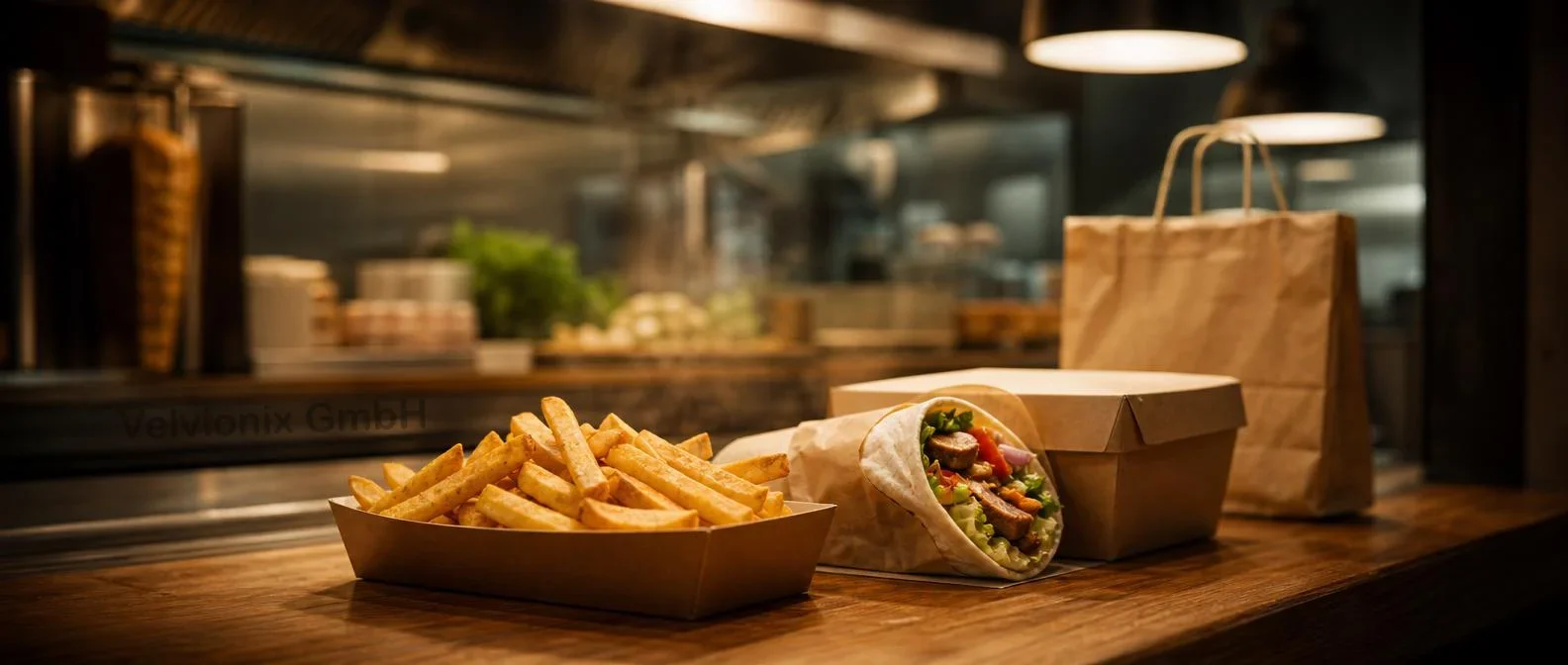
Professional website for takeaway & delivery restaurants
Takeaway and delivery are the take-away and deliver-first side of gastronomy: doner and kebab shops, Asian takeaway and wok kitchens, burger and fries outlets, sushi-to-go concepts, fish & chips shops, currywurst specialists, schnitzel and haxen takeaways, Mediterranean takeaways with falafel and shawarma - through to pure pizza-delivery operations without a dining room. The customer decides almost always from the smartphone which takeaway to order from or visit tonight, and the decision happens between a Lieferando entry, an Uber Eats list, the Wolt app, Google Maps and the operation's own website. We build websites that show the operation in its culinary DNA, structure allergens and additives aligned with Article 14 and Annex II of the EU FIC (1169/2011), embed ordering via Lieferando / Uber Eats / Wolt and a low-commission in-house widget (DISH Order, Smoothr, Resmio, orderbird) - and keep the platform commission from becoming the sole margin killer.
Why takeaway and delivery operations need their own website today
Takeaway and delivery are the backbone of everyday gastronomy in Germany and at the same time the field with the fiercest platform pressure. Unlike a classic restaurant or a pizzeria with its own wood oven, a typical takeaway does not primarily live off ambiance in the dining room but off take-away and delivery business: few or no seats, fast cadence, clear prices, short production times, a tight brand focus on one cuisine. The spectrum ranges from the classic doner and kebab shop through Asian takeaway and wok kitchens, burger and fries operations, sushi-to-go concepts, fish & chips shops, currywurst specialists, schnitzel and haxen takeaways, Mediterranean takeaways with falafel and shawarma up to pure pizza-delivery services without dining-room character. The market is huge, locally densely populated and increasingly framed by Lieferando (Just Eat Takeaway), Uber Eats and Wolt (Delivery Hero) - with commission spreads of 11 to 30 percent that, on a net margin of 18 to 25 percent after cost of goods and staff, instantly decide between a successful year and a loss year.
The purchase decision today happens almost exclusively on the smartphone and in under a minute. Search intents such as "doner near me", "Asian takeaway [city]", "burger delivery [postcode]", "sushi to go [district]", "currywurst [town]" or "delivery until 11 pm" lead first into the Google local panel, into Google Maps, into the Lieferando app or the Uber Eats list - and only then, when the decision is between two or three candidates, onto the operation's website. The website is rarely the first contact here, but almost always the trust anchor of the second click: it is supposed to confirm what the Maps thumbnail or the platform entry promised and make the difference to the competitor plausible. It only succeeds if it shows real photos from your own kitchen, names the ingredients transparently, delimits the delivery area clearly and hits the operation's tone - rather than presenting interchangeable stock photos of a burger concept that looks the same in every second takeaway.
The economically most important reason for an own website is the margin. Platform orders bring reach, but they are never really your customers - the data belongs to the platform, the terms are changed unilaterally, and every increase in commission rates hits the operation immediately. A website with clear price presentation, an EU-FIC-aligned menu, a delivery-area map and a low-commission in-house ordering widget (DISH Order, Smoothr, Resmio, Gastronovi Order, orderbird Online Shop) captures exactly the share of guests who would order directly anyway - regulars, neighbours, offices within the delivery zone, companies with a weekly lunch order. A double-digit percentage share of direct orders makes the immediate difference between a break-even year and a solid annual profit, because on precisely that share the 11-30 percent platform commission does not apply - only a 0-5 percent transaction fee at the embedded SaaS partner.
On top comes the differentiation pressure in an increasingly generic market. Many takeaway concepts have become interchangeable through franchise logic and global trends: burger stands look alike, doner signage is typographically almost identical, Asian takeaway menus repeat the same twenty dishes. At the same time niches are emerging that live off a website - Mediterranean falafel/shawarma with a regional supply chain, hand-rolled sushi from in-house production, regional burgers with beef from the local butcher, vegan fast food, halal- or kosher-certified ranges. The website is where this positioning becomes visible: cuisine, origin of the ingredients, labels for vegan/vegetarian/halal/gluten-free, team at the counter, delivery area and pickup options. Those who try to serve all twenty cuisine styles at once end up in the generic middle; those who name their niche clearly win the regular customers that no algorithm will replace.
What belongs on a modern takeaway and delivery website
The homepage clarifies in ten seconds which cuisine defines the house, where delivery goes and how to order. A strong, real photo from the rotating spit, the wok, the grill or the sushi counter - not a stock image - sets the tone. Beneath it three core actions: view the menu, order now (leading either to Lieferando/Uber Eats/Wolt, to the embedded in-house ordering widget or to WhatsApp/phone ordering) and check the delivery area. Opening hours and delivery hours are communicated strictly separately, because in most takeaways they are not identical - the kitchen often closes half an hour before last order, and delivery windows depend on weekday and weather. A precise single-line claim ("Doner and Mediterranean takeaway in western Hanover, since 2014" or "Asian delivery service for the city centre - wok, sushi-to-go, bowls") locates the operation better than ten lines of generic marketing copy.
The menu is the central product of a takeaway and delivery website and calls for a structured database rather than an embedded counter PDF. Categories follow the operation's cuisine logic: doner and wraps (doner in bread, dürüm, lahmacun, sides), Asian (soups, starters, wok, curry, rice and noodle dishes, sushi-to-go), burger (beef, chicken, veggie, vegan patties, sides), fries and sides, fish & chips and deep-fried, salads and bowls, desserts, drinks (alcohol-free, beer, wine, where licence allows). Each item carries name, a short ingredient description, allergens per Annex II of the EU FIC, additive labelling per VorlLMIEV/ZZulV (with preservative, with flavour enhancer, sulphured), country of origin for pork/sheep/goat/poultry per Regulation (EU) 1337/2013, price and image. Filters for vegetarian, vegan, gluten-free, halal or kosher are mandatory in 2026, not an extra - a falafel shop without a "vegan" filter or a doner restaurant without "halal" labelling loses revenue to competitors who communicate this naturally.
Delivery area, minimum order value and delivery logic deserve a dedicated, very concrete page. We build a map with a postcode polygon - Google Maps, OpenStreetMap/Leaflet or, commercially, Mapbox, depending on GDPR preference and budget - showing the delivery area in zones; typically two or three zones with different minimum order value and delivery fee (inner zone from 12 EUR free, middle zone from 18 EUR with a 2 EUR flat fee, outer zone from 25 EUR with 4 EUR). Added are indications on delivery time expectation (25-40 minutes, up to 60 at peak), pickup discount and cut-off times (pickup only until 30 minutes before kitchen closing). This transparency noticeably reduces enquiry and complaint workload in the operation and avoids the escalation that a disappointed platform review can trigger. For operations that work with Lieferando and Uber Eats anyway, the website shows the same zones and minimum values consistently - inconsistent numbers lead to confusion and review deductions.
The ordering path is deliberately offered in several ways, but not arbitrarily. Platform buttons (Lieferando, Uber Eats, Wolt) appear prominently as button links with the platform logo; the in-house ordering widget (DISH Order, Smoothr, Resmio, Gastronovi Order, orderbird Online Shop) is embedded via iFrame or button link and framed as "Order directly - without platform commission", which offers the customer a fair choice. For phone orders we offer WhatsApp click-to-chat and a classic tel-link icon - in many takeaways a significant share of orders still comes by phone, and a well-placed phone button is often the single most conversion-strong call-to-action. For catering and event orders (company lunches, birthdays, sports clubs, schools) we build a lean request form with date, time, headcount, menu preference and contact; its input is forwarded via a secure SMTP connection into your operation's mailbox - with automatic acknowledgement, honeypot spam protection and server-side validation. No message storage on our systems, no file uploads, no online payment.
Legal framework: EU FIC distance sale, ZZulV, Regulation 1337/2013, §§ 42/43 IfSG, § 55 GewO, GDPR, BFSG
The EU Food Information to Consumers Regulation (FIC, EU 1169/2011; in Germany LMIV) is particularly far-reaching in the takeaway and delivery context, because its Article 14 creates distance-sale duties. As soon as an order is placed via the website, an embedded widget or a platform, all mandatory information must be accessible online BEFORE the contract is concluded: name, list of ingredients with allergen emphasis per Annex II (cereals containing gluten, eggs, milk/lactose, fish, crustaceans, molluscs, nuts, peanuts, soy, mustard, celery, sesame, sulphur dioxide/sulphites, lupin), net quantity, nutrition declaration per 100 g/ml for prepacked goods, responsible food business operator. In addition, the German VorlLMIEV and the additives regulation (ZZulV) require declaration of relevant additives - with preservative, with antioxidant, with flavour enhancer, with phosphate, sulphured, waxed - as imprint, notice or, in distance sale, on the product tile. For pork, sheep, goat and poultry the origin-labelling regulation (EU) 1337/2013 applies with country of rearing and slaughter, even for loose products. We therefore build the menu aligned with Article 14 and Annex II of the EU FIC, VorlLMIEV and ZZulV as a structured database, maintained once per item and rendered identically to website, ordering widget and printable PDF counter version.
HACCP (Hazard Analysis and Critical Control Points) under Regulation (EC) 852/2004 and § 5 LMHV is a baseline requirement for any takeaway, not a distinguishing feature. The cold chain below 7 °C for cold and above 65 °C for hot food per § 2 LMHV, the time-temperature limit for lukewarm dishes (typically a maximum of two hours), the separate work surfaces for allergen-critical ingredients and the daily temperature documentation are operational obligations. The hygiene briefing under § 42 IfSG (prohibitions of activity and employment) and § 43 IfSG (initial briefing at the public health office, follow-up briefing every two years internally) applies to everyone handling unpacked food - in a takeaway typically every operational team member including auxiliary staff and riders who also do preparation. For mobile concepts (food truck, takeaway van at markets and events) the itinerant-trade licence under § 55 GewO comes into play, and for alcohol service at events § 12 GastG (temporary permission) applies as well. On the website we address these points aligned with §§ 42/43 IfSG and HACCP-aware - in a factual "quality, hygiene and deployment" area, not as sweeping marketing promises of legal invulnerability.
The labour-law side deserves a short, dedicated mention on a takeaway and delivery website, because it has become a central differentiator in the industry. § 611a BGB (the German employee definition via personal dependence and instruction-bound work) and § 7 SGB IV (the social-security boundary for dependent employment) assess whether riders are deployed as employees or as subcontractors; the Federal Labour Court case law on Gorillas, Flink and Lieferando clearly points towards employee status for riders integrated into the operation. The Minimum Wage Act (MiLoG), in § 17, requires day-accurate recording of start, end and duration of working time for marginally employed staff, retained for two years. The Working Hours Act (ArbZG) limits daily maximum working time to 10 hours in § 3 and regulates rest breaks in § 4; the gastronomy exception for Sunday work under § 10 (1) no. 4 enables typical weekend takeaway operation. For e-bikes and S-pedelecs different liability regimes apply - pedelec 25 via private or operational liability insurance, S-pedelec with insurance plate, helmet obligation and AM driving licence. We communicate this aligned with § 611a BGB / § 7 SGB IV and MiLoG § 17 in the team area, without individual legal assessment - the status question is decided by the German Pension Insurance in the status-determination procedure, not by the website.
GDPR applies to every form, every review widget, every Instagram feed, every ordering embed. We work built in line with current GDPR requirements: forms capture only necessary data and forward entries via a secure SMTP connection into your operation's mailbox - without storage on our systems, without file uploads. Platform embeds (Lieferando, Uber Eats, Wolt) and ordering SaaS (DISH Order, Smoothr, Resmio, Gastronovi, orderbird) are embedded via button link or iFrame; the data processing agreement runs directly between you and the respective provider, and our role ends at the widget boundary. The privacy policy names all embedded third-party providers; consent logic follows TTDSG / ePrivacy (active opt-in, no pre-ticked boxes). The German Accessibility Strengthening Act (BFSG), in force since 28 June 2025, covers takeaway websites insofar as they offer consumer-relevant digital services - ordering widget, contact form and delivery-area check fall under it. We therefore build BFSG-ready as a default: WCAG 2.1 AA with contrast values above 4.5:1, keyboard operability of all forms, screen-reader compatibility, real alt texts instead of empty strings, form labels instead of placeholder tricks and structured HTML menus instead of pure PDF.
Platform or in-house widget: a hybrid architecture instead of an in-house shop
The most important architectural decision for a takeaway and delivery website is the deliberate separation between the information/brand website and the ordering/payment infrastructure. We explicitly do not build a proprietary online ordering shop with shopping cart, online payment and delivery dispatching: that is a highly specialised product with a PCI-DSS environment, § 312j BGB button solution, PSD2 strong customer authentication, 3D-Secure, chargeback processes and rider coordination with GPS tracking - and it is already operationally solved by the platforms (Lieferando/Just Eat Takeaway, Uber Eats, Wolt/Delivery Hero, DoorDash) and by the industry ordering-SaaS offerings (DISH Order from the METRO world, Smoothr, Resmio, Gastronovi Order, orderbird Online Shop, Choco POS). Our task is to integrate these partners cleanly into the website: as a button link with clear platform labelling, as an iFrame widget where the provider supplies one, or as an embedded menu of the ordering SaaS. Contract, data processing agreement, payment compliance and distance-sale duties run directly between you and the respective platform.
The strategically interesting question is not "platform or in-house" but "how do we distribute the order volume between platform and in-house widget correctly". The platforms remain relevant for reach and new-customer acquisition - they provide the app traffic, the SEO visibility inside the platform, peak frequency in bad weather and the default payment infrastructure including card payments. They cost 11 to 30 percent commission plus service fees, however, and do not hand over the regular customers. A low-commission in-house ordering widget on the website (typically a 0 to 5 percent transaction fee at the SaaS partner plus a monthly base fee in the order of 29 to 99 EUR net) captures the regulars, the office-lunch segment and everyone who deliberately searches for you via Google. The strategic lever is to label the direct ordering path visibly and to use small incentives (loyalty points at the ordering SaaS, 0.50 EUR discount on direct orders, a free dip from 20 EUR up) to shift the share step by step - every additional percentage point of direct orders typically means several hundred euros per month in takeaway profit accounting.
POS system, inventory management for ingredients, rider tracking and loyalty programme deliberately do not belong on our infrastructure. The POS system (orderbird POS, Gastronovi, DISH POS, Vectron, Lightspeed Restaurant) is a product world of its own with GoBD requirements under § 146 AO, TSE obligations under the KassenSichV, daily Z-settlement and tax-office export - we do not rebuild that. Inventory management for ingredients and costing runs in industry software or simple spreadsheets - not our job. Rider dispatching and GPS tracking are handled by the platforms or by specialised tools (Stuart for logistics-only, the platform-internal dispatch systems, domain-specific delivery-management tools); we have no place there. For loyalty we recommend Joyn, the loyalty modules of the ordering SaaS or simple stamp-card processes; proprietary customer accounts with order history we deliberately do not build, because they create customer-data persistence and potentially payment context that does not fit our service scope. Our role ends at the button or the iFrame - and exactly that keeps the operation flexible and the contract clean.
Local visibility, Google Business Profile, reviews and social media
Takeaway and delivery operations are structurally hyper-local. The catchment area in delivery ranges, depending on vehicle type, from 2-4 km (bike and 25 km/h pedelec), 4-8 km (e-bike and scooter) or 8-12 km (car); the take-away segment typically comes from a radius of less than two kilometres. Google Business Profile is therefore the single most important marketing channel. We set up the profile with a primary category matching the concept - "Takeaway", "Delivery Service", "Fast Food Restaurant", "Doner Restaurant", "Sushi Restaurant", "Burger Restaurant", "Asian Restaurant" - add meaningful secondary categories, maintain complete attributes (delivery, pickup, drive-through where applicable, seating, accessible entrance, contactless delivery, card/cash acceptance, halal/vegan/gluten-free options), upload high-quality images of counter, products and team and link the GBP ordering function to your preferred ordering path (Lieferando, Uber Eats or in-house widget). Ongoing maintenance is handed over to the operation so that special hours (public holidays, summer break, delivery limitations in heavy rain) can be entered without involving an agency.
Reviews are the core purchase decision in the takeaway and delivery world - and they live in two independent algorithms. Platform reviews (Lieferando, Uber Eats, Wolt) decide the position inside the platform app and therefore the platform revenue share; Google reviews decide the GBP and Maps ranking and therefore direct search traffic. Both worlds are cultivated in parallel because they do not feed each other. We embed a discreet Google-Reviews widget on the website (GDPR-compliant with consent), recommend a pickup receipt with a QR code pointing to the Google profile (printed via the POS) and link the platform profiles in the footer. Responses to critical reviews are compulsory: factual, considerate, without a defensive tone - in a takeaway world where 4.2 vs. 4.5 stars decides the annual list position, a well-written response often has more impact than ten new five-star reviews.
Instagram and, to a smaller extent, TikTok are the strongest visual channels for takeaway content - the product is visual, smells of grill, wok or fryer and performs better in reels and short clips than in any text. We embed your Instagram feed GDPR-compliant with click-to-load on the website and recommend a lean editorial grid: one production reel per week (spit, wok flame, sushi roll, burger build), one weekly-menu recommendation as a post, occasional team views. Structured data per Schema.org (FastFoodRestaurant or Restaurant as a subtype, servesCuisine "Turkish"/"Asian"/"American"/"Japanese" etc., Menu with hasMenuSection and hasMenuItem, openingHoursSpecification, deliveryAvailable, takeaway, priceRange, acceptsReservations usually false) signal the operation type to Google and attract Maps rich results. Consistent NAP data (name, address, phone) across GBP, Lieferando, Uber Eats, Wolt and regional gastronomy directories form the SEO foundation that carries long-term - unspectacular but durable.
Frequently asked questions about websites for takeaway & delivery restaurants
Distance-sale gastronomy and Article 14 of the EU FIC: which mandatory information must be visible BEFORE the online order and how do we present this on the menu aligned with Annex II of EU FIC 1169/2011?
The EU Food Information to Consumers Regulation (FIC, EU 1169/2011; in Germany LMIV) explicitly distinguishes between sale in the shop and distance sale. Article 14 of the FIC requires that in distance sale - i.e. ordering via the website, via Lieferando, Uber Eats or Wolt - all mandatory information that would normally be on the packaging or on the in-shop notice is accessible to the consumer BEFORE the contract is concluded: name of the food, list of ingredients with allergens from Annex II highlighted in bold or otherwise emphasised, net quantity, best-before or use-by date for prepacked goods, name and address of the food business operator, nutrition declaration per 100 g or 100 ml for prepacked goods. In addition, for loose warm takeaway food the German supplementary VorlLMIEV and the additives regulation (ZZulV) require the declaration of relevant additives (with preservative, with antioxidant, with flavour enhancer, with phosphate, sulphured, waxed); for pork, sheep, goat and poultry the origin-labelling regulation (EU) 1337/2013 adds the country of rearing and slaughter, even for loose products. We therefore build the menu as a structured database: every item (doner, Asian box, burger, fries, shawarma, sushi-to-go set, wok noodles, currywurst, fish & chips, schnitzel) carries name, ingredient list, allergen list per Annex II, additives per ZZulV, country of origin for meat and - where delivered prepacked - nutrition values per 100 g. The data appears automatically on the product tile, in the embedded ordering widget and in the printable PDF counter version; the operation maintains it once centrally and delivers consistent output everywhere. This is aligned with Article 14 of the EU FIC and Annex II, not a blanket promise of legal invulnerability - concrete individual compliance is assessed by the food-control authority.
Lieferando, Uber Eats, Wolt on one side - DISH Order, Smoothr, Resmio, orderbird Online Shop on the other: what is the sensible architecture and why do you deliberately not build a proprietary ordering shop?
This is the central strategic conflict in the takeaway and delivery business. Platforms such as Lieferando (Just Eat Takeaway), Uber Eats, Wolt (Delivery Hero) and DoorDash bring reach, a ready-made ordering and payment infrastructure, an app ecosystem and rider logistics - and charge typically 11-30 percent commission per order depending on the model (marketplace only, commission, commission plus logistics). For a takeaway with an 18-25 percent net margin after cost of goods and staff, this is over time the difference between sustainable and loss-making. At the same time the regular-customer data belongs to the platform, not the operation, and the general terms are changed unilaterally. The answer is rarely "either-or" but a hybrid: the platforms remain for reach and new-customer acquisition, while a low-commission in-house ordering widget (DISH Order, Smoothr, Resmio, Gastronovi Order, orderbird Online Shop, Choco POS) is embedded as a button link or iFrame on the website and catches the regulars and everyone who would order directly anyway. We ourselves explicitly do not build a proprietary ordering shop with shopping cart, online payment and delivery dispatching: this entails PCI-DSS for the payment environment, § 312j BGB button solution, PSD2 strong customer authentication, 3D-Secure, chargeback processes, rider coordination with GPS tracking and a liability chain that ranges from the wrong address through a cold order to an allergy incident. This is a highly specialised product and belongs with DISH/Smoothr/orderbird or with Lieferando/Uber Eats/Wolt - not on our infrastructure. Our role ends at the button or the iFrame; contract, data processing agreement and payment compliance run directly between you and the respective provider.
Our riders invoice us on their own account - how large is the false-self-employment risk under § 611a BGB and § 7 SGB IV and how do we document MiLoG § 17 for 520-EUR mini-jobs?
The topic has been operational reality since the Federal Labour Court decisions on Gorillas/Flink riders and the Lieferando rider proceedings. § 611a BGB (German Civil Code) defines an employment contract via instruction-bound activity in personal dependence; § 7 SGB IV draws the parallel social-security line to dependent employment. Indications of employee status are integration into the operation, fixed shift schedules, instruction-bound time/place/type of work, assignment of delivery sequence, use of operational tools (bag, box, app) and exclusivity - exactly what typically exists in a classic takeaway delivery operation. The case-law trend is clear: riders are increasingly classified as employees, even where invoices were issued. A "rider on invoice" model is therefore operationally risky and is regularly challenged by the German Pension Insurance in the status-determination procedure. We position the website aligned with § 611a BGB / § 7 SGB IV: the team page shows the actual setup (regular riders as employees, 520-EUR mini-jobbers, part-time, auxiliary staff) without any marketing promise of legal invulnerability; in parallel we mention the Minimum Wage Act (MiLoG) with the documentation duty under § 17 for marginally employed staff (start, end and duration of working time logged daily, retained for two years) as a B2B trust signal towards company customers. E-bikes and S-pedelecs involve different liability regimes (S-pedelec: insurance plate, helmet obligation, AM driving licence, different from a 25 km/h pedelec), which we address in the text without issuing individual assessments - that is for the professional association BGN/BGHW and the tax adviser or employment-law specialist, not for the website.
Food truck, mobile takeaway van, market and event stand: from when do I need an itinerant-trade licence under § 55 GewO, and how do the hygiene briefing under § 42/§ 43 IfSG and HACCP fit in?
Anyone who offers gastronomy services as a trader at changing locations - food truck at weekly markets, takeaway van on company car parks, stand at festivals and city events, mobile point of sale without a fixed shop - falls within the scope of the itinerant-trade licence under § 55 GewO. The licence is issued by the competent district/city administration and is tied to the person; exceptions apply among other things for certain market events under § 68 GewO, for which the market management sets the arrangements. When alcohol is served at events, § 12 GastG (temporary permission) applies in addition, to be requested per event from the public order office. Alongside the itinerant-trade licence, the hygiene baseline stays the same for any takeaway, whether stationary or mobile: §§ 42/43 IfSG require the initial briefing by the public health office before the first assignment and a follow-up briefing every two years internally for everyone handling unpacked food; Regulation (EC) 852/2004 makes HACCP with hazard analysis, critical control points and temperature documentation an operational obligation, with § 5 LMHV clarifying the practical detail. Cold chain below 7 °C for cold goods, above 65 °C for hot goods (under § 2 LMHV), maximum lukewarm time roughly two hours - especially relevant for food-truck transport and event sales. We build the website area "mobile deployment and hygiene" aligned with § 55 GewO and §§ 42/43 IfSG and HACCP-aware: a factual description of the deployment types, the underlying statutes and the existing documentation (business registration, itinerant-trade licence where applicable, briefings, hygiene concept), without sweeping marketing promises of legal invulnerability.
Platform reviews on Lieferando and Google reviews on Google Business Profile - why do both review worlds have to be cultivated independently and how does the website support this?
The two review worlds follow different algorithms and buy different attention. Lieferando, Uber Eats and Wolt reviews decide the ranking within the respective platform app and therefore the share of new customers from the platform ecosystem; a platform rating below 4.3 tips the list position and often flips order volume overnight. Google reviews, on the other hand, decide the Google Business Profile ranking in local search and on Google Maps - i.e. the share of customers who search for "takeaway near me", "doner [city]", "Asian takeaway [district]", "burger delivery [postcode]" or "fish and chips [town]" and want to order or walk in directly. The two worlds cannot substitute each other: an excellent Lieferando score does not help the Google ranking, and a strong Google score does not help you when the platform customer swipes up inside the app. We support the strategy from the website in three steps: a discreet Google-Reviews widget on the homepage (GDPR-compliant, click-to-load, with consent where real names are visible), a pickup receipt with a QR code pointing to the Google profile (printed via the POS) and a short link to the Lieferando/Uber Eats profile in the footer for customers who ordered there. On the website we also explain factually that responses to critical reviews are written without a defensive tone and that operational causes (peak time, delivery delay due to weather, packaging issue) are named rather than waved away - that is the strongest trust lever in a market where the step from 4.2 to 4.5 stars directly translates into revenue.
What does a website for a takeaway and delivery restaurant cost?
Starter from 599 EUR net one-off plus maintenance from 59 EUR net per month for a website with a structured menu (doner, Asian takeaway, burger, fries, sushi-to-go, wok, fish & chips, currywurst, schnitzel, falafel/shawarma and further cuisine styles as relevant), allergen and additives labelling aligned with Article 14 and Annex II of the EU FIC and with the German VorlLMIEV/ZZulV, opening and delivery hours, delivery-area presentation, location and a blog. Optional add-ons (separate order): Contact form with automatic acknowledgement, embedding the ordering entry points to Lieferando, Uber Eats and Wolt as a button link per platform, embedding a low-commission in-house ordering widget (DISH Order, Smoothr, Resmio, Gastronovi Order, orderbird Online Shop) via iFrame, embedding a delivery-area map (Google Maps or OpenStreetMap) with postcode polygon and minimum-order display, WhatsApp click-to-chat for phone orders and a request form for catering and event deliveries. We do not build a proprietary online ordering shop with shopping cart, online payment and delivery dispatching - this infrastructure lives with Lieferando, Uber Eats, Wolt or your ordering-SaaS provider (DISH Order, Smoothr, Resmio, Gastronovi, orderbird). Also not part of our offering: POS system (orderbird POS, Gastronovi, DISH POS, Vectron), inventory management for ingredients, rider tracking or dispatching systems, customer accounts with order history or a proprietary loyalty database; for those we recommend specialised partners such as Joyn or the loyalty modules of your POS vendor. Details in the 30-minute initial consultation.
More dedicated services in this industry
Looking for a website for a related profession? These dedicated pages might also be relevant:
More relevant industries
What We Have Already Delivered
For a therapy practice, we developed a trilingual website with an animated landing page, interactive map and automatic contact form - features that are not achievable with a website builder or template.
View reference project →Full details on scope, packages and prices can be found on our Web Development services page.
View packages and prices →Ready for a website that really reflects your takeaway and delivery operation?
In the free initial consultation we discuss your concept (doner, Asian, burger, sushi-to-go, fish & chips, currywurst, Mediterranean, falafel/shawarma, pizza-delivery only or hybrid), your ordering landscape (Lieferando, Uber Eats, Wolt, DISH Order, Smoothr, Resmio, orderbird), your delivery area with postcode boundaries and minimum-order values, your rider structure (regular employees, 520-EUR mini-jobbers, part-time) and your marketing (GBP, Instagram, platform reviews). You receive a concrete offer for a website that fits your kitchen and your margin - no long-term commitment, no agency overhead.
Book initial consultation (30 minutes)