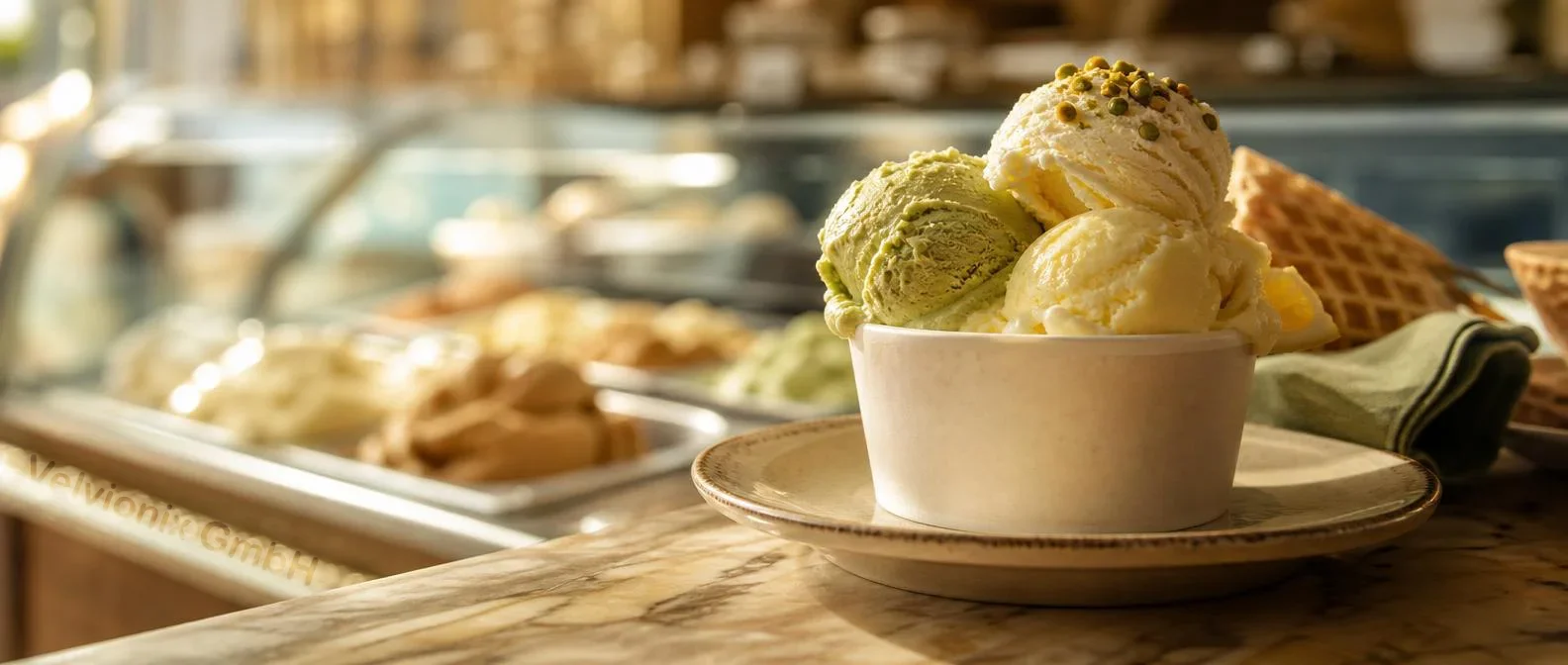
Professional website for ice-cream parlours & gelaterias
The ice-cream parlour is one of the most emotional gastronomy formats of all - childhood memory, Italian summer, the first scoop of Pistacchio after a long winter. At the same time it is one of the most weather-sensitive business models: main season from March to October, revenue peaks on sunny Saturdays, reduced or fully closed winters, and a clientele that decides afresh every day whether they want ice-cream at all - and if so, where. We build websites for classic Italian gelaterias, modern artigianale parlours with a Slow Food anchoring, frozen-yogurt bars and hybrid operations with café, waffle and crepe offerings. With a dynamic flavour board, sales designations structured to the German Food Codex guidelines for ice-cream, allergen information aligned with Annex II of the EU FIC and a seasonality mechanic that works without daily maintenance. Factual, fast, mobile - and with due respect for the craft at the pasteuriser.
Why ice-cream parlours need their own website today
The German ice-cream scene is dense and diverse: from the classic Italian family business that has been producing gelato to the grandfather\'s recipe at the same location for three generations, through the modern artigianale parlour with Slow Food anchoring, regional milk and seasonal flavours, to the frozen-yogurt bar with self-service machines and topping bar, the soft-serve-focused bar at the waterfront, and the hybrid operation bundling ice-cream, café, waffle and crepe under one roof. Each variation has its own target groups, peak times and success levers - and a website that presses all of them into a generic "ice-cream, coffee, waffles" template loses out to the next location that makes its handwriting visible.
The ice-cream parlour is one of the most emotional gastronomy formats of all. The first scoop in spring is a sensory marker of the year, the evening-walk scoop in high summer belongs to everyday culture, and the queue forming at the counter on a sunny Saturday is a social proof no marketing budget can replace. That makes the ice-cream parlour a highly emotional place - and at the same time a place with brutal weather and seasonal dependency. The main season typically runs from mid-March to mid-October; many operations close completely in winter, others reduce flavours and hours. The spring reopening is a ritual moment for regulars - and exactly this moment has to be communicated predictably by the website.
Buying behaviour is unambiguously mobile and local. Searches like "ice-cream parlour [city]", "gelateria [city]", "best ice-cream near me", "vegan ice-cream [city]", "ice-cream cake order [city]" or "gluten-free ice-cream [city]" first lead into the Google local panel and Google Maps; the website is the second contact point that has to confirm what Maps, Instagram or a friend\'s recommendation promised. If the website is missing or shows outdated season hours, generic stock photos of waffle cones against colourful backgrounds and a PDF flavour menu from last year, the decision falls against the operation before the guest even reaches the counter. The website is less the shop window than the trust anchor here: it shows that the operation is alive, that production happened today, and that the pistachios really do come from Bronte.
On top of this comes the differentiation in a market where industrial supermarket ice-cream, petrol-station self-service freezer chests and international franchise chains (Grom, Amorino, Häagen-Dazs, Ben & Jerry\'s, Baskin-Robbins, the ubiquitous "Eiscafe Venezia" name shared across many independent owners) continually push on the owner-run single operation. The distinguishing feature of a classic gelateria or a modern artigianale parlour lies in the origin of the raw materials, in daily fresh on-site production, in in-house pasteurisation and in the handwriting of the Maestro - and exactly this story is not told by industrial goods. A good website makes this story visible: with real photos from production, with transparent naming of suppliers and origin designations, with a flavour board that changes daily, and with a season communication that turns weather-dependent chaos into predictable customer loyalty.
What belongs on a modern ice-cream parlour website
The homepage clarifies in ten seconds who you are, what you produce and when you are open. A strong, real photo - ideally the mantecatore in action, the Maestra at the fresh pistachio mass, or the packed counter on a Saturday afternoon - sets the tone. Below it three core pieces of information: the current opening hours (with visible seasonal status: "open until 15 October" or "seasonal break until March - subscribe to the newsletter"), the top flavours of the week, and a clear contact path. A single-line claim that locates the operation precisely ("Hand-made gelato, since 1987 in Freiburg-Wiehre", "Artigianale parlour with regional organic milk, Slow Food Germany" or "Vegan and classic ice-cream, fresh every day in the north of Bonn") replaces ten lines of generic marketing language.
The flavour board is the centrepiece and the trickiest element at the same time, because it should change daily without becoming a daily maintenance burden. We build it as a structured database: a core set of permanent flavours (Fior di Latte, Cioccolato, Nocciola, Pistacchio, Stracciatella, Amarena, Zabaione, Limone sorbet, Fragola fruit ice) plus a pool of seasonal and experimental flavours (asparagus ice in May, basil-lemon in summer, pumpkin and chestnut in autumn, mulled-wine sorbet if you run a winter operation). Each flavour carries a name (Italian where authentic), the sales designation per the German Food Codex guidelines for ice-cream ("Cremeeis", "Fruchteis", "Sorbet", "Milcheis", "Wassereis"), a short ingredient description, origin designations for protected raw materials (Pistacchio di Bronte PDO, Nocciola Piemonte PGI, Amarena Fabbri, Fior di Latte from a regional organic dairy), allergens per Annex II of the EU FIC, flags for vegan / lactose-free / gluten-free / sugar-reduced and a seasonal time slot. The frontend shows today\'s selection - ideally updated straight from the counter via a lean editorial mask. Filters for "vegan", "lactose-free", "gluten-free" and "sugar-reduced" are no longer an add-on in a 2026 parlour but standard.
The craft story deserves its own page. Pasteurisation machine (typically Carpigiani, Bravo, Frigomat) with a short explanation of the process, mantecatore (the batch freezer that turns the mix into ice-cream), shock freezer, temperature logs, the Maestro biography (training, courses at the Carpigiani Gelato University or the MIG Academy where applicable, participation in the "Coppa del Mondo della Gelateria" where applicable), the supplier chain (regional organic dairy, fruits from the weekly market or direct from the farm, chocolate from Domori, Callebaut, Valrhona or a regional chocolatier, pistachios from Bronte PDO). This is not advertising but factual information - and in a market full of industrial ice-cream it is the most effective differentiator. Truthfulness matters: "Bronte PDO" only with actual sourcing, "Slow Food" only with membership, "organic milk" only with the EU organic seal and control-body number; the German LFGB and § 5 UWG sanction misleading claims even where nobody explicitly states something they are not.
Ice-cream cakes, catering and specialties deserve their own areas. Ice-cream-cake orders as a structured product page (sizes, base flavours, decor options, allergen notes, lead time) that forwards to a lean request form. Catering for weddings, company events, birthday parties and club celebrations as a dedicated page with headcount guidance, typical packages (ice buffet for 50 guests, mobile ice-cream cart with Maestro on site, gelato bar with topping selection) and clear lead-time communication. Children\'s birthday offers with their own pack shot, school programmes ("ice workshop" for kindergartens and classes) and CSR topics (compostable FSC-certified wooden spoons, deposit cups, regional raw materials) also have a place here. This is the highest-margin area in many parlours and deserves its own visibility, not just a line in the footer.
Legal framework: Food Codex ice-cream guidelines, EU FIC, HACCP, GDPR, BFSG
The German Food Codex (Deutsches Lebensmittelbuch) holds the Guidelines for Edible Ice and Ice Semi-Products, which define the sales designations. "Milcheis" contains at least 70 g of milk per 100 g of finished product, "Cremeeis" at least 50 percent milk and 270 g of egg yolk per litre, "Fruchteis" at least 20 percent fruit (at least 10 percent for strongly acidic fruits like lemon or passion fruit), "Sorbet" at least 25 percent fruit and "Wassereis" a maximum of three percent fat. A flavour sold on the online flavour board as "Milcheis" or "Cremeeis" therefore has to match this composition - otherwise § 5 UWG (misleading commercial practice) and § 11 LFGB (prohibition of misleading food claims) apply. We build the flavour board structured to the German Food Codex guidelines for ice-cream: a mandatory sales-designation field per flavour, shown discreetly below the flavour name in the frontend. Italian flavour names such as Stracciatella, Pistacchio, Nocciola, Fior di Latte, Bacio, Amarena, Tiramisu and Zabaione are market-typical; the term "Gelato" itself has no dedicated EU protection, but the ingredients and origin declarations used must be authentic. Protected designations under EU Regulation 1151/2012 (Pistacchio di Bronte PDO, Nocciola Piemonte PGI, Limone di Sorrento PGI) may only appear where the product is actually used.
The EU Food Information to Consumers Regulation (FIC, EU 1169/2011; in Germany LMIV) regulates the declaration of the 14 main allergens in Annex II. At the scoop counter, the German supplementary VorlLMIEV applies with simplified rules for unpacked goods (notice board, register, sign); for pre-packed ice-cream cakes, 500 ml tubs and family packs the full FIC labelling applies, including the ingredient list with allergen highlighting, nominal quantity, minimum durability and the business responsible. We implement this aligned with Annex II of the EU FIC: allergens per flavour in the database, visible on the flavour tile, in the request form and in the printable counter notice; for pre-packed products a dedicated product page with a full ingredient list in FIC format. This creates a single source of truth for counter notice, website and packaging labels, and substantially reduces the risk of divergent declarations - a divergence that can itself be judged as misleading.
HACCP under EU Hygiene Regulation (EC) 852/2004 and, for foods of animal origin, (EC) 853/2004 is a baseline requirement, not a distinguishing feature. § 43 IfSG (initial and recurring hygiene briefing every two years) applies to every team member handling unpacked food. Particularly relevant for ice-cream are pasteurisation (core step against salmonella and listeria), cold chain (storage at -18 °C or colder, sale at -12 to -14 °C), shock freezer and the separated handling of dairy and fruit bases to avoid cross-contamination. On the website we address this as an HACCP-aware build: a factual quality-and-hygiene page, without sweeping marketing promises of blanket legal invulnerability. The German Youth Protection Act applies where Coppa offerings with amaretto, grappa, coffee liqueur or rum are sold: § 9 JuSchG prohibits handing out drinks and dishes containing spirits to persons under 18. We mark such flavours and Coppa offerings clearly on the menu with an alcohol note ("contains alcohol - sale under § 9 JuSchG only from age 18") and keep the imagery youth-protection-aware (no cartoon cocktails, no youth-targeted aesthetics).
GDPR applies to every form, every review widget, every Instagram feed, every tracking pixel. We work built in line with current GDPR requirements: request forms for ice-cream cakes and catering capture only the minimum necessary data and forward entries via a secure SMTP connection into your operation\'s mailbox - without storing message content on our systems, without file uploads. Instagram and TikTok feed widgets are embedded with click-to-load so third-party data only flows after active interaction; review widgets (Google Reviews, ProvenExpert) the same. The German Accessibility Strengthening Act (BFSG), in force since 28 June 2025, covers ice-cream parlour websites insofar as they offer consumer-relevant digital services - online requests for ice-cream cakes, catering forms, embedded order widgets fall under it. We therefore build BFSG-ready as a default: WCAG 2.1 AA with contrast values above 4.5:1, keyboard operability of all forms, screen-reader compatibility, form labels instead of placeholder tricks, real alt texts, structured HTML menus instead of PDF-only.
Ice-cream cakes, catering, ordering - request forms and widgets instead of an in-house build
The most important architectural decision for an ice-cream parlour website is the deliberate separation between the website and the ordering / payment infrastructure. We explicitly do not build a proprietary online ordering system with shopping cart, online payment and cold-chain logistics: frozen shipping with dry ice is a specialised logistics operation that requires its own freight contracts and temperature-control protocols, and payment flows bring PCI-DSS, § 312j BGB button solution, PSD2 SCA, 3D-Secure and chargeback processes. For an owner-run ice-cream parlour this is neither economically nor insurance-wise sensible - and it is explicitly not part of our service scope. Instead, for ice-cream cakes and catering we build a lean request form: product details (size, flavours, decor wish, allergies in the party), date, contact, special requests. The entry is forwarded via a secure SMTP connection into your operation\'s mailbox, and the sender automatically receives an acknowledgement from the same mailbox. Fixed lead times as a note (48 hours for standard ice-cream cakes, 7 days for themed cakes, 14 days for larger catering) reduce back-and-forth. Payment and pick-up happen offline - cash, deposit by bank transfer or invoice outside of the website.
For the delivery channel we embed the established partners. Lieferando (Just Eat Takeaway), Uber Eats and Wolt have increasingly established themselves for ice-cream orders in 500 ml tubs or family packs as an add-on to restaurant orders - the cold chain over a few kilometres is workable with the standard rider transport bags, even if ice-cream as a product is logistically more demanding than pizza. We embed the order entry points as a button link or, where the provider offers one, as an iFrame widget. Contract, data processing agreement and payment compliance run directly between you and the respective platform. For operations with an own POS system (orderbird, Gastronovi, Lightspeed Restaurant, Tiller, CAKE) we embed, where applicable, the order page provided by the POS; here too the contract and data processing live between you and the POS vendor.
Loyalty cards, voucher shops and customer accounts: here lies the boundary of our offering. We do not build a proprietary loyalty-card database with points logic - this heads in the direction of customer data persistence, CRM and potentially payment handling, which does not fit our service scope. If loyalty is desired, the classic paper stamp card at the counter is entirely sufficient for many parlours; digitally inclined operations use specialised partners such as Joyn or foodchain. Integration runs via their widgets or webhooks; you sign the contract and the data processing agreement directly with the provider. Gift vouchers can be implemented as a lean request without online payment - the voucher is paid for and picked up in the shop, or bought as a paper voucher at the counter. For online vouchers with checkout we recommend specialised platforms (GiftYou, Wogibtswas, regional voucher portals); these platforms handle payment processing and distance-selling compliance (right of withdrawal under § 355 BGB, button solution under § 312j BGB). The website then links to the external voucher shop; our scope ends at the link.
Seasonality, local visibility, Instagram and Google Business Profile
Ice-cream parlours are structurally local and structurally seasonal - two properties that fully shape SEO and visibility strategy. The catchment area ranges, depending on the city type, from a few hundred metres in a city centre to ten kilometres in rural regions with little competition; the season defines the period in which the website is actively marketed at all. Google Business Profile (GBP) with the primary category "Ice Cream Shop", matching secondary categories ("Gelato Shop", "Café", "Pastry Shop", "Frozen Yogurt Shop" depending on format), complete attributes (indoor / outdoor seating, accessibility, dogs allowed, child-friendly, vegan / gluten-free offering), current photos from counter, production and outdoor area, and regular GBP posts (new flavours, seasonal announcement, special hours) is the most important local lever. We set the profile up cleanly or hand maintenance over to the operation so seasonal hours, holiday hours and weather-driven special hours can be entered without involving an agency - ideally directly from the counter via the GBP app.
Instagram and TikTok are the strongest content channels in this field. The products are highly visual (colourful scoop domes, waffle cones, ice-cream cakes, Maestro reels at the mantecatore), the stories mechanic is perfect for daily flavour updates, and TikTok reels with production in the background reach far beyond the local catchment area. We embed the Instagram feed widget GDPR-compliant with click-to-load; the feed thereby becomes the daily update channel of the website without additional maintenance. A lean editorial grid - one flavour story per day, one production reel per week, one seasonal-announcement post per month - is enough to build reach and recognition. For cooperations with food bloggers or influencers we observe the disclosure duty under § 5a (4) UWG; paid or product-based cooperations must be labelled as advertising.
Reviews are the number-one trust multiplier. Google reviews, Tripadvisor, Yelp where a franchise relationship exists - plus word-of-mouth in WhatsApp family chats. We embed a discreet review widget (Google Reviews, ProvenExpert) on the website, GDPR-compliant with active consent where real names are visible. Responses to reviews - especially critical ones - should be factual, considerate and written without a defensive tone; in an ice-cream parlour bad reviews can usually be traced to identifiable operational causes (waiting time on the hottest Saturday, perceived small scoop size, missing flavour), and a factual reply usually works better than ten new five-star reviews.
Structured data per Schema.org (IceCreamShop as a subtype of FoodEstablishment, servesCuisine "IceCream" / "Gelato", Menu with hasMenuSection and hasMenuItem, openingHoursSpecification with seasonal special entries, priceRange, acceptsReservations where catering is offered, deliveryAvailable where Lieferando / Wolt apply) signals the operation type to Google and attracts Maps rich results. Together with consistent NAP data (name, address, phone) across GBP, Tripadvisor, Lieferando, Wolt and regional gastronomy portals they form the SEO foundation that carries long-term. For the seasonal reopening we additionally recommend a newsletter sign-up with double opt-in (embedded Brevo or Mailchimp widget): regulars waiting for the first scoop in March are the most loyal group an ice-cream parlour can have - and a single well-timed reopening newsletter often replaces half of the marketing budget of the new season.
Frequently asked questions about ice-cream parlour websites
How do I present the German sales designations for ice-cream ("Milcheis", "Cremeeis", "Fruchteis", "Sorbet", "Wassereis") on the online flavour board, structured to the German Food Codex guidelines for ice-cream?
The Guidelines for Edible Ice and Ice Semi-Products in the German Food Codex (Deutsches Lebensmittelbuch, issued by the Federal Ministry of Food and Agriculture) define how each sales designation has to be composed: "Milcheis" (milk ice) contains at least 70 g of milk per 100 g of finished product, "Cremeeis" (cream ice) at least 50 percent milk plus 270 g of egg yolk per litre, "Fruchteis" (fruit ice) at least 20 percent fruit (for strongly acidic fruits such as lemon, passion fruit or blackcurrant at least 10 percent), "Sorbet" at least 25 percent fruit and "Wassereis" (water ice) a maximum of three percent fat. A flavour sold at the counter or on the menu as "Milcheis" therefore has to match this composition - otherwise the claim moves towards misleading commercial practice under § 5 UWG (Act against Unfair Competition) and § 11 LFGB (Food and Feed Code). We build the online flavour board as a structured database in which every flavour carries a field for its sales designation; in the frontend it appears discreetly below the flavour name ("Pistacchio - Cremeeis", "Limone - Sorbet", "Fragola - Fruchteis"). Marketing terms such as "Gelato", "artigianale", "hand-made" and "Slow Food" remain permitted where they match reality; they do not replace a sales designation. For Italian flavour names we insist on authenticity: "Pistacchio" with actual pistachio content (ideally Bronte PDO or comparable raw material), "Fior di Latte" without fruit additions, "Stracciatella" with chocolate shavings, "Bacio" with hazelnut-chocolate - working with pure flavouring without disclosing it risks a cease-and-desist.
How do I present LMIV allergens at the counter (unpacked scoop ice-cream) and on pre-packed goods (ice-cream cake, 500 ml tub, family pack) differently on the website, aligned with Annex II of the EU FIC?
The EU Food Information to Consumers Regulation (FIC, EU 1169/2011, in Germany known as LMIV) requires, in Annex II, the declaration of the 14 main allergens - cereals containing gluten, eggs, milk/lactose, fish, crustaceans, molluscs, nuts, peanuts, soy, mustard, celery, sesame, sulphur dioxide/sulphites and lupin. For unpacked goods as sold scoop-by-scoop at the counter, the German supplementary VorlLMIEV applies with simplified rules (notice board, register, sign at the product). For pre-packed goods (ice-cream cake in a box, 500 ml tub, 1 l family pack) the full FIC labelling applies, including the ingredient list with allergen highlighting, nominal quantity, minimum durability and the business responsible. We build the online flavour board so that each flavour has its own allergen list in the database; in the frontend the allergens appear as a compact symbol-and-text combination directly on the flavour tile. For ice-cream cakes and family packs we add a dedicated product page with a full ingredient list in FIC format (allergens in bold), nominal quantity in millilitres and grams, nutrition information per 100 g and the business responsible. The counter notice file - legally the original document - can additionally be generated as a printable PDF from the same database. This avoids duplicate maintenance and reduces the risk of counter notice and website drifting apart, a drift that can in itself be judged as misleading.
How do I mention HACCP, § 43 IfSG and our in-house pasteurisation protocols as a trust signal without promising something we cannot keep?
HACCP (Hazard Analysis and Critical Control Points) is mandatory under EU Hygiene Regulation (EC) 852/2004 for every food business; for ice-cream production, (EC) 853/2004 (foods of animal origin) applies on top, because milk and eggs are the sensitive raw materials. The initial and recurring hygiene briefing under § 43 IfSG (combined with § 42 IfSG on prohibitions of activity and employment) applies to every team member handling unpacked food - initial briefing at the public health office, follow-up briefing every two years internally. Particularly relevant for ice-cream: pasteurisation of the mix (typically 85 °C for a few seconds or 65 °C for 30 minutes) as the core step against salmonella (historically a major risk when using raw eggs) and listeria, together with the cold chain (storage at -18 °C or colder, sale at -12 to -14 °C at the counter), shock freezer, separate work surfaces and storage for dairy and fruit bases, and cross-contamination training for allergens. On the website we communicate these topics as an HACCP-aware build: a factual "quality and hygiene" page with the elements actually lived - pasteurisation machine with a short description of the process, daily temperature logs at shock freezer and counter, pest-monitoring contract with a certified provider (Anticimex, Rentokil, Desinfecta), hygiene briefings of the team under § 43 IfSG. We explicitly avoid sweeping marketing promises of blanket legal invulnerability - no serious provider could guarantee such claims, and they drift towards unauthorised legal services under the German RDG. Instead: a factual description of the production standard and the applicable legal basis. Real photos from the production - Maestro at the pasteuriser, the fruit purees on the stainless-steel surface, the mantecatore in action - are the strongest trust lever in this field.
We are only open from March to October and opening hours depend strongly on the weather - how does the website reflect this seasonality dynamically without daily manual content work?
Ice-cream parlours are one of the most weather-sensitive gastronomy formats ever - a sunny Saturday in May and a rainy Wednesday in September are two entirely different businesses. The website has to reflect that, but it must not become a maintenance burden that is neglected during the seasonal rush. We solve this in three layers. First: Google Business Profile is the operational source of truth for opening hours. The profile is maintained with regular season hours, different holiday hours, and ad-hoc "special hours" for weather-related closures; the website shows the times via the GBP widget or via regularly synchronised structured data (Schema.org openingHoursSpecification), so a change in GBP reaches the website within minutes. Second: a prominent season banner on the homepage communicates the seasonal status ("We are open from 15 March to 15 October", "Seasonal break until March 2027 - subscribe to our newsletter for the opening date"). This banner is a CMS entry and needs two to three edits per year. Third: an Instagram feed widget (GDPR-compliant with click-to-load) brings the daily reality in - today's flavour board, the "open only until 6 pm today due to rain" note, the picture of the new pumpkin sorbet. The operation runs Instagram anyway; the website becomes the secondary distribution channel. Optionally we add a newsletter sign-up with double opt-in (via an embedded Brevo or Mailchimp widget) for the spring reopening - for many regulars that is the ritual moment of the year.
Ice-cream-cake pre-orders and catering for weddings / company events - why do you build neither a shop nor an online-payment flow here but a lean request form with 48 hours lead time?
Ice-cream cakes are individual (flavour, decor, headcount, pick-up date), the cold chain at the moment of hand-over is critical, and payment in a wedding or company order is typically linked to a deposit, an invoice and cash on delivery - not to an instant online payment. A real shop with a shopping cart, Stripe/PayPal checkout, § 312j BGB button solution, PSD2 strong customer authentication, 3D-Secure and a right-of-withdrawal regime is neither required nor economically sensible for this order type; it brings costs and liability questions that do not increase the added value of an ice-cream parlour. We therefore deliberately build a lean request form: product (ice-cream cake - size, flavours, decor wish, or catering - event type, number of guests, date and location), pick-up or delivery date, contact, allergies in the party, special requests. The form states fixed lead times as a note (48 hours for standard ice-cream cakes, 7 days for themed cakes, 14 days for larger catering) and forwards the entry via a secure SMTP connection directly into your operation's mailbox. The sender automatically receives an acknowledgement from the same mailbox. Payment and pick-up happen offline - cash, deposit by bank transfer or invoice outside of the website, final payment at hand-over. No storage of message content on our systems, no file uploads, no online payment. For operations that offer real delivery within three to six kilometres we additionally embed a Lieferando or Wolt button (typical for 500 ml tubs as an add-on to the restaurant order run); dry-ice shipping to end customers is deliberately not part of our offering, as it requires specialised logistics and freight contracts outside of our infrastructure.
What does a website for an ice-cream parlour cost?
Starter from 599 EUR net one-off plus maintenance from 59 EUR net per month for a website with a dynamic flavour board, sales designations structured to the German Food Codex guidelines for ice-cream, allergen labelling aligned with Annex II of the EU FIC, a season banner, opening hours bound to Google Business Profile, location and a blog. Optional add-ons (separate order): Contact form with automatic acknowledgement, embedding of an Instagram / TikTok feed widget for the daily flavours (GDPR-compliant with click-to-load), a newsletter sign-up with double opt-in for the seasonal reopening (Brevo / Mailchimp widget), a lean request form for ice-cream cakes and catering with 48 hours lead time, order entry to Lieferando / Uber Eats / Wolt as a button link, and embedding of a Google reviews widget. We do not build a proprietary online shop with frozen shipping and dry-ice logistics - this requires specialised freight providers; for mail-order ice-cream, platforms such as Gelatissimo-Versand or specialised partners are more suitable. Also not part of our offering: proprietary online payment for ice-cream cakes, proprietary gift-voucher shops with checkout or proprietary loyalty databases; for these we recommend external voucher platforms (GiftYou, Wogibtswas), loyalty partners (Joyn, foodchain) or the classic paper stamp card at the counter. Details in the 30-minute initial consultation.
More dedicated services in this industry
Looking for a website for a related profession? These dedicated pages might also be relevant:
More relevant industries
What We Have Already Delivered
For a therapy practice, we developed a trilingual website with an animated landing page, interactive map and automatic contact form - features that are not achievable with a website builder or template.
View reference project →Full details on scope, packages and prices can be found on our Web Development services page.
View packages and prices →Ready for a website that carries your ice-cream parlour through the entire season?
In a free initial consultation we discuss your operation type (classic gelateria, artigianale parlour, frozen-yogurt bar, hybrid with café / waffle / crepe), your seasonal rhythm, your flavour rotation, your raw-material suppliers (regional milk, Bronte PDO pistachios, Amarena Fabbri, Nocciola Piemonte PGI), your catering and ice-cream-cake needs and your marketing channels (Instagram, TikTok, Google Business Profile). You receive a concrete offer for a website that fits your counter and your season - no long-term commitment, no agency overhead.
Book initial consultation (30 minutes)