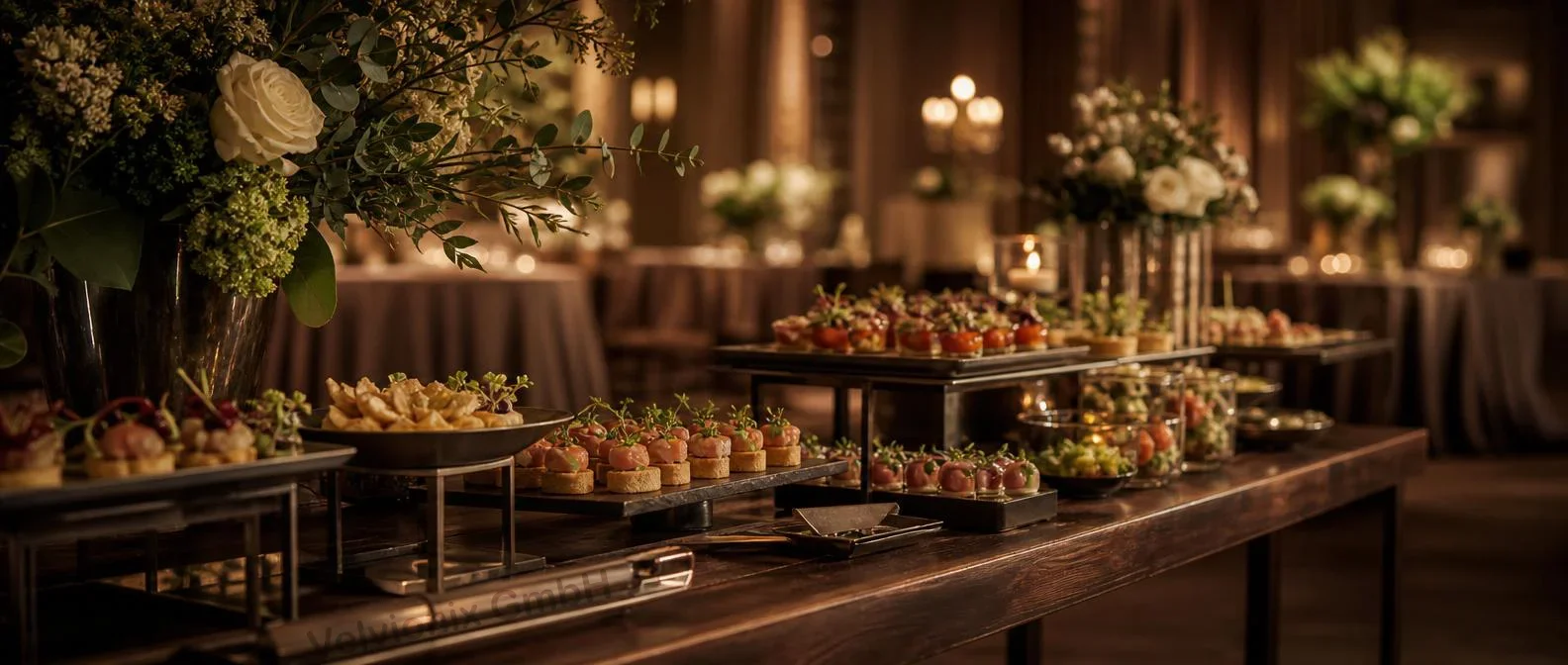
Professional website for Catering & Event Services
Catering and event services are the mobile variant of hospitality - no fixed venue, no walk-in trade, but highly individual single commissions with a long lead and calculation phase. The customer base is dual: B2B clients (corporate events, conferences, trade fairs, staff feeding, company parties, anniversaries) with compliance and process questions, and B2C clients (weddings, milestone birthdays, funeral receptions, christenings, club celebrations) with emotional one-off events where every mistake is remembered. Here the website is less the ordering channel than the trust anchor that makes event portfolio, references, pricing logic and compliance signals visible at a glance and structures the enquiry cleanly. We build websites for classic party services, full-service event caterers, delivery caterers, community feeding operations (school/kindergarten/staff catering), trade-fair caterers, wedding specialists and food-truck services - aligned with Annex II of the EU FIC, HACCP-aware, aligned with § 8/§ 12 GastG, with a clear signal structured to the German Working Time and Minimum Wage Acts for B2B clients and a structured RFQ form instead of an in-house shop.
Why catering operations need their own website today
Catering and event services differ structurally from restaurant, pizzeria, bakery or ice-cream parlour: there is no fixed venue, no walk-in trade, no counter and no menu that gets refreshed once a year. Every order is a single event with its own date, location, guest count, menu profile, equipment need and pricing calculation. The hospitality service moves to the customer or into an external event venue - bringing everything along, from pre-production in the home kitchen through transport and set-up to on-site service, execution and teardown. This makes catering one of the most complex hospitality formats and one of the few where the website is not the shop window of a physical space but the shop window of a service portfolio and a way of working.
The customer base splits into two worlds that the website must address together, without one crowding out the other. B2B clients - corporates with internal events, conferences, trade fairs, staff feeding, company parties, anniversaries and client evenings, plus public bodies, associations, agencies and event venues with framework-caterer agreements - look for reliability, process transparency and compliance signals. Response time on the enquiry, structured quotes, invoicing and contractual capability, staff scheduling in line with the Working Time Act, records under § 42/§ 43 IfSG and liability insurance are base expectations here, not extras. B2C clients - couples planning weddings, families planning milestone birthdays or anniversaries, relatives arranging a funeral reception, club boards planning a summer party - look for emotional references (photos, reviews, recommendations), understanding of the unique nature of the occasion and a simple, friendly enquiry path. The website has to serve both: factual enough for the procurement team of a corporate subsidiary, warm enough for a bride-to-be.
Catering buying behaviour is slower than in other hospitality formats and heavily research-driven. A wedding research phase runs six to twelve months, a corporate event is firmed up eight to twelve weeks in advance, even a spontaneous birthday enquiry typically sits two to three weeks before the event. During this time the prospect compares three to seven providers - partly via wedding portals (hochzeitsportal24, weddybird, Hochzeitsplaza, eventmanagement.de), partly via recommendations from the network, partly directly via Google searches such as "wedding catering [city]", "corporate catering [city]", "order buffet [city]", "finger-food catering [city]" or "conference catering [city]". The website is the point at which a recommendation or a search turns into a qualified lead: if it is lean, mobile-fast and substantively rich, the prospect stays and fills in the enquiry form; if it shows up with generic imagery and interchangeable copy, the prospect moves on.
Add to that the margin. Catering orders move in per-head bands of roughly 15 to 80 EUR net depending on format, single events quickly reach mid four- to five-figure volumes, and larger company annual parties or weddings from 150 guests upwards hit six-figure ranges. A single successfully closed enquiry often carries the cost of a professional website many times over - and the same applies to a single B2B framework agreement in which an event venue refers the catering partner exclusively. Conversely, the opportunity-cost calculation is clear: every qualified enquiry lost through an unclear website or a poorly structured form is a three- to five-figure revenue loss. For exactly this reason, website investment in catering is one of the clearest ROI cases in mid-sized hospitality.
What belongs on a modern catering website
The homepage clarifies in ten seconds who you are, which event types you serve and how contact works. A strong, real photo from an actual event - a set wedding table, a flying buffet at a company gala, a food truck at a summer party, a live-cooking station at a trade-fair booth - sets the tone. Below it a precise claim ("Full-service catering for weddings and corporate events in [region] since 2011", "Vegan finger-food and flying-buffet specialists in Berlin", "Regional party service for [county] district"), three core actions (view event portfolio, see sample menus, submit enquiry) and a clear note on catchment area and typical minimum lead times. The homepage positions the operation regionally and substantively and replaces ten lines of generic marketing language.
Event-type pages are the most important content area of a catering website - and at the same time the most frequently neglected. A B2C prospect does not search for "catering [city]" but for "wedding catering [city]", "birthday catering [city]", "funeral-reception catering [city]", "kids birthday catering [city]". A B2B prospect searches for "corporate catering", "conference catering", "trade-fair catering", "Christmas party catering", "summer party catering", "staff canteen catering". Each of these search intents deserves its own landing page with event-specific packages, typical headcount ranges, matching imagery and the right tone. Wedding pages are emotional, reference-rich and visual (sweetheart table, candy bar, champagne reception, three- or four-course wedding menu, midnight snack). Corporate-event pages are factual, package-oriented and compliance-adjacent (standing reception, flying buffet, conference lunch, break catering, Christmas gala). Funeral-reception pages are quiet, dignified and clear (coffee and cake for the mourners, platters of cold cuts, a silent buffet - without intrusive wedding promotion in the sidebar).
Transparent sample menus with allergen information are the second centrepiece. We structure them as a database by format - finger food (classic, modern, vegan, vegetarian, gluten-free), flying buffet, seated served menu (three to five courses), grill buffet and BBQ, brunch, fondue/raclette evening, sushi catering, Mediterranean buffet, Asian buffet, regional buffet, show-cooking station, children menu. Each dish carries name, a short ingredient description, allergen codes aligned with Annex II of the EU FIC and optionally a photo; in addition labels for vegan, vegetarian, lactose-free, gluten-free, halal, kosher. The menus are explicitly examples, not a fixed catalogue - the actual composition happens per event. Filters for dietary needs are no longer an add-on in 2026 but standard; coeliac guests, vegans, Muslim guests and allergy sufferers get a clear overview right at the source document.
Equipment and service model deserve a dedicated page because this is where the most frequent misunderstandings happen. "Delivery catering" brings pre-arranged cold platters, finger-food trays or buffet components - tableware and service remain with the customer. "Partial service" additionally brings rented tableware and glasses and leaves the customer to serve on their own. "Full-service catering" brings chef, service staff, furniture (standing tables, seating groups, benches), tents and pavilions, chafing dishes and gas burners, refrigerated vehicles or cooling cubes, bar trolley, decoration (tablecloths, napkins, candles, floral arrangements) and handles set-up, service, execution and teardown in full. We build these service tiers as clearly named packages with a visual comparison grid so the prospect knows before enquiring which world they are in and which lead time and price band that implies.
Team and craft deserve their own authentic page. The chef with vocational training (cook IHK, master craftsman, sommelier qualification, pastry-chef training), the service team with restaurant-service or hospitality training, bar staff and baristas, the freelancer network for peaks and a clear note on which assignments run with casual staff and minijob workers. In a market saturated with dumping offers and Instagram-led pop-up providers, this is a strong differentiator - especially for B2B clients who want to know who works for them. References and case studies with explicit consent (B2B logos with sign-off, B2C anonymised with image and location) make the claim verifiable.
Legal framework: § 8/§ 12 GastG, EU FIC, HACCP, ArbZG, MiLoG, GDPR, BFSG
§ 8 GastG regulates the hospitality licence for operating a bar or restaurant - a pure catering operation without its own hospitality premises often does not fall directly under § 2 GastG, but does fall under the temporary permission under § 12 GastG once open alcohol is served at an event. The permission is applied for per event at the responsible municipal authority (Ordnungsamt), typically by the event host and, in certain constellations, by the catering operation as executing provider. In parallel the itinerant trade licence under § 55 GewO may become relevant if the operation regularly provides hospitality services commercially at changing locations - the delimitation depends on the individual case. When using large event venues, the state-level Assembly Venue Ordinance (VStättVO) additionally applies with a fire-safety concept, escape routes and operator duties; the operator is usually the venue, not the catering provider. On the website we communicate this aligned with § 8/§ 12 GastG in a "process and contractual" area: a factual note that permission questions are clarified per event between client, Ordnungsamt and - where applicable - the venue, and that the operation supplies the required documents (hygiene concept, trade registration, business liability insurance).
The EU Food Information to Consumers Regulation (FIC, 1169/2011; in Germany LMIV) with the 14 main allergens in Annex II and the national VorlLMIEV for loose food is the central frame for menu communication in catering. At an open on-site buffet, labelling happens via table signs or an allergen card per position; at a seated served menu the service team additionally provides active information; for pre-packed delivery catering full LMIV labelling applies with ingredient list, allergens in bold, net quantity, best-before date and responsible party. We implement this aligned with Annex II of the EU FIC on the website: sample menus with allergen codes per dish, a short explanation of the labelling logic for the three scenarios, and a database structure in which each recipe is maintained exactly once - the output for website, venue signage and packaging labels draws from the same source. HACCP under (EC) 852/2004 is a baseline requirement and is addressed as HACCP-aware: daily temperature documentation in the production kitchen, in transport and at the venue (below 7 °C cold, above 65 °C hot per § 2 LMHV), cold chain and thermolog, shock freezer, separated work surfaces for allergen-critical ingredients, § 42/§ 43 IfSG initial and follow-up briefings for staff - initial briefing at the public health office before first deployment, follow-up every two years internally.
The Working Time Act (ArbZG) and the Minimum Wage Act (MiLoG) are more than formalities in catering - they are operational reality and at the same time a B2B compliance signal that may be made visible on the website. ArbZG governs maximum working time in § 3 (10 hours per day), breaks in § 4, rest periods in § 5 (11 hours between shifts) and Sunday/holiday work in § 9/§ 10, for which hospitality holds an explicit exception via § 10 para. 1 no. 4. MiLoG sets the prevailing minimum wage and, in § 17 MiLoG, obligates daily documentation of start, end and duration of working time for minor employment (520 EUR base), kept for two years. We present this structured to the German Working Time and Minimum Wage Acts in a B2B block "team and staff deployment": core staff with vocational training, freelancer network under framework contracts, casual staff and working students with clean scheduling, and the § 42/§ 43 IfSG hygiene briefings before every first deployment. That is exactly the information a procurement team at a mid-sized corporate or a public tendering office wants to see.
GDPR applies to every form, every review widget, every Instagram feed. We work built in line with current GDPR requirements: the RFQ form only captures the data needed for a quote and forwards the input via a secure SMTP connection into your operation mailbox - without storing message content on our systems and without file uploads. Calendly and Cal.com buttons, review widgets (Google reviews, ProvenExpert), Instagram and Pinterest feed widgets are embedded with click-to-load so third-party data flows only after active interaction; the data processing agreement with the respective provider runs directly between you and them. § 9 JuSchG (beer/wine from 16, spirits from 18) is noted on the event-type pages for wedding, corporate and club events as an operational guardrail of the service team for ID checks, together with § 20 No. 2 GastG (no service to visibly intoxicated guests). The German Accessibility Strengthening Act (BFSG), in force since 28 June 2025, covers catering websites insofar as they offer consumer-relevant digital services - RFQ form, appointment booking widget and contact workflows fall under it. We therefore build BFSG-ready as a default: WCAG 2.1 AA with contrast values above 4.5:1, keyboard operability of all forms, screen-reader compatibility, form labels instead of placeholder tricks, alt texts for images and structured sample menus in HTML rather than plain PDF.
RFQ form instead of an online ordering shop: workflow and external industry tools
The most important architectural decision for a catering website is the deliberate separation between the information/brand website and the ordering/payment infrastructure. We explicitly do not build a proprietary online ordering shop with shopping cart, Stripe/PayPal checkout and a standard buffet catalogue: the typical catering order is individual (menu per event, equipment tailoring, access logistics, payment terms with deposit and final invoice), so a cart flow with § 312j BGB button solution, PCI-DSS, PSD2 SCA, 3D-Secure and withdrawal-right regimes creates neither value nor economics. Instead we build a structured RFQ form (request for quotation) capturing the key parameters of an event enquiry: event date and time, event location (own premises, external venue, open-air), number of guests as a range, event type, budget expectation, preferred food format (buffet, menu, finger food, BBQ, show cooking), equipment needs (all-inclusive, delivery-only, partial service), special requirements (vegan, vegetarian, gluten-free, lactose-free, kosher, halal) and optionally access, power and water data. Server-side validation (required fields, email regex, honeypot, rate limit) and delivery via a secure SMTP connection into your operation mailbox ensure spam protection and a cleanly filled inbox; the sender automatically receives an acknowledgement email from the same mailbox with a note on typical response times and lead times. No message content stored on our systems, no file uploads, no online payment.
Where an operation wants to run a clearly delimited delivery-catering area with a standard catalogue (breakfast platters, finger-food trays, lunch boxes, conference break packages) and online payment, the right place for that is a specialised industry platform. FoodNotify, Catermate, CaterGo, Order2Dine or comparable solutions bring the order workflow, production planning, payment processing, customer history and distance-selling compliance (right of withdrawal, button solution, PCI-DSS) in one integrated system. We embed these platforms via subdomain, iFrame or button link into the website - the website stays the information and brand layer with event portfolio, references and RFQ entry point for individual orders, while the industry shop handles the standardised order part. Contract, data processing, payment compliance and distance-selling duties run directly between you and the respective provider; our role ends at the iFrame or the subdomain link.
Customer and lead management is likewise not on the website. We do not build proprietary CRM functionality with lead history, email sequences, quote versions and payment status - for that you use Pipedrive, HubSpot, CentralStationCRM or industry tools such as FoodNotify and Catermate which already integrate CRM functions. Staff-scheduling software (who works on 14.06. at which event, which qualification, which § 43 IfSG briefing, which working-time entry) is handled by specialised systems such as Timly, Workhub, Clockshark or hospitality-specific personnel software. Invoice and customer-account databases must be retained for ten years under § 147 AO and the German GoBD principles - that belongs in your ERP or accounting software (DATEV, lexoffice, sevDesk, POS-vendor industry modules), not on our infrastructure. The website links cleanly to these specialist systems at the interfaces; contract and data processing agreement run directly between you and the provider.
Local visibility, B2B network, Instagram and Pinterest
Catering operations are structurally local-regional and at the same time fed supra-regionally through B2B networks. The catchment area in full service sits at 30 to 80 kilometres depending on the operation, in delivery catering at 15 to 30 kilometres, and for specialised wedding caterers at 150 kilometres and more. Google Business Profile with the primary category "Caterer", matching secondary categories ("Event catering", "Party service", "Wedding catering service", "Trade-fair catering" depending on focus), complete attributes, fresh event photos and regular GBP posts is the most important local lever. Search terms such as "catering [city]", "party service [city]", "wedding catering [city]", "corporate catering [city]", "buffet order [city]", "finger food [city]", "conference catering [city]" or "funeral reception catering [city]" are the main entry points; each of these intents deserves its own event-type page with a matching heading structure and consistent internal linking.
B2B network building is the underappreciated growth lever in catering. Event venues (cultural houses, castle hotels, industrial event spaces, restaurants with event side rooms, museums, conference centres) often have one or more exclusive catering partners; getting on that list brings planning certainty and predictable annual turnover. In this acquisition process the website is often the hygiene filter: the venue operator checks whether the provider appears serious, whether compliance signals (HACCP, § 42/§ 43 IfSG, ArbZG, MiLoG, liability insurance) are visible and whether the reference list shows events of comparable scale. A dedicated "location partner" page that explains the cooperation logic and names the B2B contact is therefore worthwhile. Wedding platforms (hochzeitsportal24, weddybird, Hochzeitsplaza, eventmanagement.de, Catering.de) are the parallel B2C reach; maintaining a presence there with consistent NAP data and links back to the own website is mandatory.
Instagram and Pinterest are the strongest visual channels in catering - especially for the wedding market. Instagram reels of setup processes, finished buffets, live-cooking stations and happy hosts reach far beyond the classic catchment area; Pinterest boards on "wedding menu ideas", "finger-food inspiration", "winter-garden catering" or "vegan wedding buffet" are often the first touchpoint of a bridal research. We embed Instagram feed and, where appropriate, Pinterest widgets GDPR-compliantly with click-to-load on the website; the website thus becomes the secondary distributor of the social content that gets maintained anyway. Structured data per Schema.org (FoodEstablishment as a superclass, Caterer or CateringService as the specific type, Service with hasOfferCatalog, openingHoursSpecification, areaServed, priceRange, acceptsReservations and aggregateRating) signal the operation type and the catchment area to Google. Consistent NAP data across GBP, wedding portals, B2B procurement databases and regional directories form the SEO foundation that carries long-term together with the event-type pages and case studies - unspectacular, but effective.
Frequently asked questions about catering and event-service websites
We serve alcohol at events - how do we handle § 8 GastG, § 12 GastG temporary permission and § 55 GewO (itinerant trade licence) on the catering website?
A catering operation without its own licensed bar/restaurant does not necessarily need a permanent hospitality licence under § 2 GastG - it becomes relevant once open alcohol is served at an event. § 12 GastG regulates the temporary permission (Gestattung) for the individual event: application at the responsible municipal authority (Ordnungsamt), typically filed by the event host or, in some constellations, by the catering operation as executing provider. Anyone regularly providing hospitality services at changing locations and acting as publican can fall within the scope of the itinerant trade licence under § 55 GewO; the delimitation depends on the individual case. On the website we communicate this aligned with § 8/§ 12 GastG: no blanket promises about the permission situation, but a factual note in the "process and contractual" section stating that permission questions are clarified per event between client, Ordnungsamt and - where applicable - the location, and that the catering operation supplies the required documents (hygiene concept, liability insurance, trade registration). § 9 JuSchG (beer/wine from 16, spirits from 18) and § 20 No. 2 GastG (no service to visibly intoxicated guests) are mentioned as operational guardrails of the service team - an important trust signal for wedding and corporate clients, not just a footnote.
LMIV Annex II allergens and HACCP for on-site buffets, delivery catering and community feeding - how does the website create transparency without sweeping promises?
The EU Food Information to Consumers Regulation (FIC, 1169/2011; in Germany LMIV) requires in Annex II the declaration of the 14 main allergens - cereals containing gluten, eggs, milk/lactose, fish, crustaceans, molluscs, nuts, peanuts, soy, mustard, celery, sesame, sulphur dioxide/sulphites and lupin. In catering, implementation splits into three scenarios: first, the open on-site buffet, where each position (bowl, platter, chafing dish) must be labelled at the event venue via table signs or an allergen card; in Germany the supplementary VorlLMIEV applies for loose food with simplified rules (display notice, sign at the product, state-specific letter-coding). Second, the seated served menu, where the service team must additionally be able to inform actively about allergens per course. Third, delivery catering with pre-packed buffet platters, finger-food trays or single portions - here the full LMIV labelling applies including the ingredient list with allergens in bold, net quantity, best-before date and the responsible party. HACCP under (EC) 852/2004 is especially relevant in transport: cold chain below 7 °C for cold items, above 65 °C for hot items per § 2 LMHV, thermolog documentation before departure and at the venue, and typical maximum transit times of about two hours for critical lukewarm foods. On the website we build an "allergens and hygiene" area aligned with Annex II of the EU FIC and HACCP-aware: sample menus with allergen codes per item, short explanation of the labelling logic for each scenario, a note on § 42/§ 43 IfSG briefings of the staff, and no sweeping marketing promises about blanket legal invulnerability.
We use casual staff, minijob workers (520 EUR) and working students - how do we communicate ArbZG and MiLoG as a compliance signal for B2B clients on the website?
Larger B2B clients - corporates, trade-fair organisers, agencies, public bodies - increasingly check how a catering provider deploys event staff. The basis is the German Working Time Act (ArbZG) with § 3 maximum working time (10 hours per day), § 4 breaks, § 5 rest periods (11 hours between shifts) and § 9/§ 10 Sunday/holiday work - the hospitality trade has an explicit exception under § 10 para. 1 no. 4, which makes work on typical catering days (weddings on Saturdays, company events also on Sundays) possible in the first place. In parallel the Minimum Wage Act (MiLoG) sets the respective minimum wage and obligates in § 17 MiLoG, for minor employment (520-EUR base), daily documentation of start, end and duration of working time, kept for two years. For working students additional rules apply (20-hour limit in lecture periods for social insurance, working-student flat rate). On the website we cover this structured to the German Working Time and Minimum Wage Acts in a B2B-oriented section "team and staff deployment": core staff with vocational training (chef, cook, hospitality specialist, restaurant service specialist), freelancer network for peaks, clear documentation of scheduling, and § 42/§ 43 IfSG briefings before first deployment. This is not a legal opinion - it is the signal that the operation knows how its staff deployment works and that a client need not fear awkward compliance questions.
Per-head prices, minimum headcounts, lead times - why do you deliberately not build a ready-made online calculator on the catering website?
An online calculator that spits out "50 guests x 45 EUR per head = 2,250 EUR" via a slider looks modern at first glance - in catering practice it regularly leads to miscalibrated expectations rather than better leads. The per-head price depends on menu depth (finger food, flying buffet, seated served menu, 5-course gala), service level (self-service, partial service, full service with on-site chef), equipment package (delivery-only, rented tableware and glasses, furniture, tent, bar trolley, decoration), location (own kitchen on site, external event kitchen, mobile field kitchen), travel and logistics (distance, load-in window, overnight for staff) and timing (Sundays and holidays come with a surcharge). A serious figure emerges only from conversation or after quote calculation - a freely computed website number either sets too low an expectation that has to be corrected upwards in the quote (loss of trust) or sets it too high and scares the lead away. Instead we build a transparent pricing logic as content: typical per-head bands by service package (delivery finger-food catering from X EUR net, full-service buffet from Y EUR net per person, seated wedding menu from Z EUR net), minimum headcounts per format (typically 10-30 persons for full service, 6 persons for delivery catering), lead times (7-14 days for standard, 3-6 weeks for weddings and complex logistics) and a clear "individual quote after enquiry" note. The prospect gets orientation, the operation keeps control over the calculation, and the enquiry form becomes a qualitatively filled conversation opener rather than a pure price query.
Structured RFQ form instead of an online ordering shop - what does the workflow look like and where does the scope boundary to external industry tools lie?
The core of a catering website is a structured request-for-quotation (RFQ) form that captures the key parameters of an event enquiry and routes them directly into your operation mailbox. It asks for event date and time, event location (own premises, external venue, open-air), number of guests (indicative range), event type (wedding, corporate event, birthday, funeral reception, conference, trade fair, summer party, Christmas party), budget range (per-head expectation), preferred food format (buffet, menu, finger food, BBQ, show cooking), equipment needs (all-inclusive, delivery-only, partial service), special requirements (vegan, vegetarian, gluten-free, lactose-free, kosher, halal, allergen-sensitive group) and optionally access, power and water data for the site. The input is validated server-side (required fields, email regex, honeypot against bots, rate limit) and forwarded via a secure SMTP connection into your operation mailbox; the sender automatically receives an acknowledgement email from the same mailbox, with a note on typical response times and lead times. No message content stored on our systems, no file uploads, no online payment. Optionally we embed a Calendly or Cal.com button for on-site consultation appointments; the contract runs directly between you and the provider. We deliberately do not build an online ordering shop with shopping cart, Stripe/PayPal checkout and a standard buffet catalogue - that brings § 312j BGB button solution, PCI-DSS, PSD2 SCA, 3D-Secure and withdrawal-right regimes which add no value in the individual logic of catering (menu per event, deposit, invoice, cash payment on handover). If you need a clearly delimited delivery-catering area with a standard catalogue and online payment, we recommend industry tools such as FoodNotify, Catermate, CaterGo or Order2Dine; these platforms handle the order workflow, payment and distance-selling compliance, the website links to or embeds the widget, and the contract runs directly between you and the provider.
What does a website for a catering operation cost?
Starter from 599 EUR net one-off plus maintenance from 59 EUR net per month for a website with event-type pages (wedding, corporate event, birthday, conference, funeral reception, summer party, Christmas party), sample menus with allergen labelling aligned with Annex II of the EU FIC, an equipment and team page, a reference section with case studies and a blog. Optional add-ons (separate order): Contact form with automatic acknowledgement, a structured RFQ form (event date, location, number of guests, event type, budget, food preference, equipment, allergies/special requirements), embedding Calendly / Cal.com for on-site consultation appointments as a button link or widget, embedding a delivery-catering shop via an industry tool (FoodNotify, Catermate, CaterGo, Order2Dine) as a subdomain or widget, embedding a Google reviews widget and an Instagram feed widget (GDPR-compliant with click-to-load) for event photos. We do not build a custom online ordering shop with shopping cart, online payment and a standard buffet catalogue - for that you use industry tools such as FoodNotify, Catermate, CaterGo or Order2Dine. Also not part of our offering: proprietary CRM functionality on the website, proprietary event-staff scheduling software or proprietary invoicing/customer-account databases; here we recommend specialised partners (Pipedrive, HubSpot, Timly, Workhub, Clockshark) or your existing industry software. Details in the 30-minute initial consultation.
More dedicated services in this industry
Looking for a website for a related profession? These dedicated pages might also be relevant:
More relevant industries
What We Have Already Delivered
For a therapy practice, we developed a trilingual website with an animated landing page, interactive map and automatic contact form - features that are not achievable with a website builder or template.
View reference project →Full details on scope, packages and prices can be found on our Web Development services page.
View packages and prices →Ready for a website that really captures your catering operation?
In the free initial consultation we discuss your operation type (party service, full-service event catering, delivery catering, community feeding, trade-fair/film/festival catering, food truck), your event types (wedding, corporate event, conference, funeral reception, summer party, Christmas party), your typical package sizes and per-head bands, your staffing model (core, freelancers, casual) and your cooperation landscape (event venues, wedding platforms, B2B tenders). You receive a concrete offer for a website that fits your event density and your pricing logic - without long-term commitment, without agency overhead.
Book initial consultation (30 minutes)