Professional website for pizzerias

Pizza is the most-ordered out-of-home dish in Germany - and at the same time the field with the fiercest local competition. From the classic Italian family business with a wood or stone oven, through the Neapolitan social pizza in the AVPN style, to the pure delivery pizzeria and the hybrid operation combining in-house, pick-up and delivery: today the customer almost always decides online which pizzeria to visit or order from - and the decision takes less than a minute. We build websites for pizzerias that show the operation as it really is, integrate allergen and origin information structured to Annex II of the EU FIC (1169/2011), and embed ordering and reservation via specialised partners (Lieferando, Uber Eats, Wolt, OpenTable, Quandoo, resmio) rather than via an in-house build. Factual, fast, mobile - and with due respect for the craft at the oven.

EU FIC Annex II JuSchG-aware HACCP-aware Lieferando embedding BFSG-ready

Why pizzerias need their own website today

The German pizza market is huge and at the same time fragmented. According to DEHOGA and industry data, pizza has for years been the most ordered out-of-home dish; the density of Italian gastronomy is especially high in urban areas, and there is hardly a town between 5,000 and 500,000 inhabitants without at least one pizzeria. The field is differentiated in three ways: the classic Italian trattoria with evening business and a base of regulars, the Neapolitan social pizza with AVPN certification, Metodo Caputo flour, 60-70 percent hydration and 400-485 °C in the wood oven, the delivery pizzeria with tightly scheduled time slots and a rider fleet, and the hybrid operation that merges in-house, pick-up and delivery into a single service concept. Each variation has its own target groups, peak times and success levers - and a website that presses all three into a generic "pizza, pasta, dolci" template pushes the operation into interchangeability.

The decision "where do we eat tonight" or "who do I order from" is now made almost exclusively on the smartphone. Searches such as "pizzeria [city]", "pizza delivery [city]", "Neapolitan pizza [city]" or "pizza near me" lead into the Google local panel, Google Maps, the Lieferando app - and only then, when trust needs to be built, onto the pizzeria\'s own website. The website is less the first contact than the second: it should confirm what the Maps thumbnail or the Lieferando entry promised, and it should give a reason for choosing you over the competitor. It achieves that only if it shows real photos from the actual oven, names the origin of key ingredients and hits the kitchen\'s tone - rather than stock photos with circle-perfect margheritas on a marble surface.

On top of this comes the margin. Lieferando, Uber Eats and Wolt typically take 13-30 percent commission per order plus service fees; for an operation with a 22-28 percent net margin after cost of goods and staff, this is the difference between sustainable and loss-making. A proper website will not replace the platforms - but it captures the share of guests who would order or reserve directly anyway, and it builds, via Google Business Profile, local SEO and Instagram food content, a direct relationship that Lieferando structurally does not allow. A double-digit percentage share of direct orders or direct reservations makes the immediate difference between an annual profit and an annual loss in a pizzeria.

What belongs on a modern pizzeria website

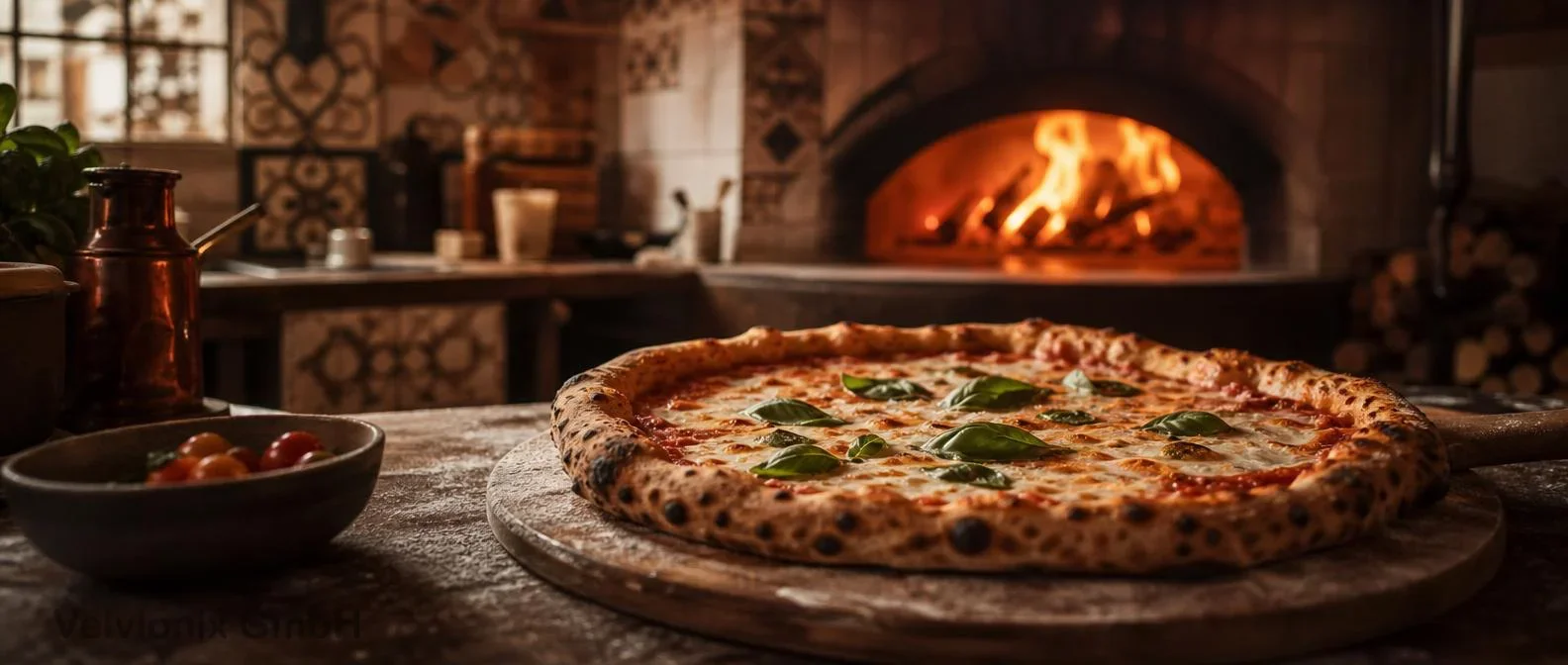
The homepage clarifies in ten seconds who you are, what you cook and how the guest reaches you. A strong, real photo from your own kitchen - ideally from the oven, with the pizza in the flames - sets the tone. Beneath it three core actions: view the menu, reserve a table, order now (the last one leads to Lieferando/Uber Eats/Wolt or to the industry POS ordering widget, depending on your setup). Opening and delivery hours sit prominently and are communicated strictly separately because the kitchen opening time and the delivery window are not identical in most pizzerias. A single-line claim that locates the operation precisely ("Neapolitan pizza in the wood oven, in Munich-Haidhausen since 2011" or "Roman-style crisp pizza and delivery service for western Berlin") replaces ten lines of generic marketing language.

The menu is the centrepiece. We build it as a structured database - not as an embedded PDF that nobody reads on mobile. Categories follow the Italian logic: antipasti, insalate, pizze rosse, pizze bianche, pizze speciali / della casa, pasta, forno (if oven dishes beyond pizza), dolci, bevande, vini, birre, spiriti. Each item carries name, a brief ingredient description in Italian order (base - cheese - proteins - vegetables - oil/herbs), price and allergens per Annex II of the EU FIC. Filters for "vegetarian", "vegan" and "gluten-free" are no longer an add-on in a 2026 pizzeria but standard - and "gluten-free" is communicated fairly: with a note on preparation on a separate work surface or in a separate pan-oven where this is actually practiced, or with the honest note "kitchen without a separate gluten-free work surface - cross-contamination possible" where it is not. This protects coeliac guests and the pizzeria alike.

The oven and craft story deserves its own page. Wood vs. stone oven, 400-485 °C, flour type (Caputo Cuoco, Caputo Pizzeria, San Felice), dough management (24, 48, 72 hours at what temperature), hydration, AVPN or APN affiliation if held, origin of the tomatoes (San Marzano PDO from the Agro Sarnese-Nocerino), the mozzarella (di Bufala Campana PDO vs. fior di latte), the Parmigiano or Grana Padano, the Prosciutto di Parma PDO, the olive oil. This is not advertising but factual information - and in a market full of generic frozen pizza it is the most effective differentiator. Truthfulness matters: "authentic AVPN" only with an AVPN certificate, "Metodo Caputo" only with an actual Caputo supply chain; the German LFGB sanctions misleading claims even where nobody explicitly states something they are not.

Team, pizzaiolo and catering deserve brief, dedicated areas. The pizzaiolo (with a real photo at the oven, training, stations, an APN/AVPN course in Naples where applicable) is a trust anchor in an artisanal pizzeria; in a delivery pizzeria the team of cooks and rider coordination takes that role. Catering and events (buffet for company parties, pizza catering with a mobile oven, pizza evenings with a set menu) are the highest-margin segment in many pizzerias and deserve visibility - with lead times, indicative headcounts and a request form whose input is forwarded via a secure SMTP connection directly into your operation\'s mailbox, including an automatic acknowledgement for the requester.

Legal framework: EU FIC, HACCP, youth protection, GDPR, BFSG

The EU Food Information to Consumers Regulation (FIC, 1169/2011; in Germany LMIV) is the central frame for everything on the online menu. Annex II lists the 14 main allergens that must be declared - cereals containing gluten, eggs, milk/lactose, fish, crustaceans, molluscs, nuts, peanuts, soy, mustard, celery, sesame, sulphur dioxide/sulphites, lupin. For loose food, as typical in pizzerias, the German supplementary VorlLMIEV adds the declaration of additives and certain processing characteristics. We build the menu aligned with Annex II of the EU FIC: allergens per item in a database, visible on the product tile, in the request/order form and in the printable PDF version. Origin designations for PDO / g.U. products per Regulation (EU) 1151/2012 are applied correctly - Mozzarella di Bufala Campana PDO, San Marzano PDO, Parmigiano Reggiano PDO, Grana Padano PDO, Prosciutto di Parma PDO, Gorgonzola PDO - and only where the product is actually used.

HACCP (Hazard Analysis and Critical Control Points) is a baseline requirement under EU Hygiene Regulation (EC) 852/2004, not a distinguishing feature. The initial and recurring hygiene briefing under § 43 IfSG (combined with § 42 IfSG) concerns everyone handling unpacked food - initial briefing at the public health office, follow-up briefings every two years internally. On the website we address this as an HACCP-aware build: a short, factual "quality and hygiene" page (temperature logs at the oven, cold-chain documentation, pest-monitoring contract, hygiene briefings for the team), without sweeping marketing promises about blanket legal invulnerability. The Youth Protection Act (§ 9 JuSchG) regulates the sale of alcoholic drinks: beer, wine, wine-like drinks from age 16, spirits from age 18. We communicate this factually on the drinks menu as a note ("Sale under § 9 JuSchG ..."); the operational age check happens at the delivery or pick-up point anyway or via the workflow logic of the order-processing platform.

GDPR applies to every form, every review widget, every tracking pixel. We work built in line with current GDPR requirements: request forms for table reservations and catering capture only the minimum necessary data (name, contact, date, number of guests, special request) and forward the entries via a secure SMTP connection into your operation\'s mailbox - without storing the message content on our systems and without file uploads. Reservation widgets (OpenTable, Quandoo, resmio) and ordering widgets (Lieferando, Uber Eats, Wolt, Gastronovi, orderbird) are embedded via iFrame or button link; the data processing agreement runs directly between you and the respective provider, and our role ends at the widget boundary. The privacy policy names all embedded third-party providers, and consent logic follows TTDSG / ePrivacy (active opt-in, no pre-ticked boxes).

The German Accessibility Strengthening Act (BFSG), in force since 28 June 2025, covers pizzeria websites insofar as they offer consumer-relevant digital services - online reservation, online ordering via embedded widgets and contact workflows fall under it. We therefore build BFSG-ready as a default: WCAG 2.1 AA with contrast values above 4.5:1, keyboard operability of all forms, screen-reader compatibility, form labels instead of placeholder tricks, images with real alt texts instead of empty strings, and PDF menus (where kept) in parallel as structured HTML. This is simultaneously a quality and SEO benefit and spares retroactive audit rounds.

Ordering, delivery, reservation - widgets instead of an in-house build

The most important architectural decision for a pizzeria website is the deliberate separation between the website and the ordering / delivery infrastructure. We explicitly do not build a proprietary online ordering system with shopping cart, payment processing and delivery logistics: that is a highly specialised product with a PCI-DSS environment, § 312j BGB button solution, PSD2 SCA, 3D-Secure, chargeback processes and rider dispatching - and it is already operationally solved by Lieferando (Just Eat Takeaway), Uber Eats, Wolt and the industry POS systems (Gastronovi, orderbird, CAKE, Tiller, Lightspeed Restaurant, pizza.de as part of Lieferando). Our task is to integrate these partners elegantly into the website: as a button link with clear labelling, as an order widget via iFrame where the provider supplies one, or as an embedded card of your industry POS. Contract, data processing and payment compliance run directly between you and the respective platform.

For reservations the same logic applies with specialised tools: OpenTable, Quandoo, resmio, DISH Reservation, Formitable and SevenRooms cover the sit-in world and provide table management, waitlists, guest profiles and no-show handling where desired. We embed the relevant widget via iFrame or button link; the decision on the provider you make based on price, integration depth with your POS and regional recognition. For very small operations we alternatively build a lean request form (date, time, number of guests, special request) whose input is forwarded via a secure SMTP connection into your mailbox - with automatic acknowledgement for the guest, honeypot spam protection and server-side validation. This form does not replace a reservation system with a real table calendar; it is the lightweight variant for operations that keep reservations manually in a reservation book anyway.

Loyalty programme, customer account, gift voucher dispatch: here lies the boundary of our offering. We do not build proprietary customer accounts with order history or a proprietary loyalty database - this heads in the direction of customer data persistence, CRM and potentially payment handling, which does not fit our service scope. If loyalty is desired, we recommend specialised partners such as Joyn, foodchain or the loyalty modules of your POS vendor; integration runs via their widgets or webhooks. Gift vouchers we can implement as a lean request/pre-order with pick-up and payment in the restaurant - without online payment and without storing payment data on our systems.

Local visibility, Google Business Profile and Instagram

Pizzerias are structurally local. The catchment area in the delivery segment ranges from 3-6 km (bike), 6-10 km (e-bike/scooter) or 10-15 km (car) depending on rider logistics, and in the sit-in segment a few kilometres in big cities, up to 20-30 km in rural regions with little competition. Google Business Profile with the primary category "Pizzeria", matching secondary categories ("Italian Restaurant", "Delivery Service", "Takeaway Restaurant"), complete attributes (seating, accessible entrance, reservations possible, pickup, delivery, happy hour, child-friendly), current menu highlights and high-quality images from the oven and the room is the most important local lever. We set up the profile cleanly or hand maintenance over to the operation so special hours (public holidays, summer break, delivery limitations in severe weather) can be entered at any time without involving an agency.

Reviews are the most important social proof in the pizza world - Google, TripAdvisor and, for delivery pizzerias, the Lieferando reviews are effectively the purchase decision. We embed a discreet review widget (Google Reviews widget, ProvenExpert) on the website, GDPR-compliant and with the necessary consent of reviewers where real names are visible. Responses to reviews - especially critical ones - should be factual, considerate and written without a defensive tone; in a pizzeria bad reviews can usually be traced to identifiable operational causes (peak time, rider delay, changed recipe), and a factual reply often works better than ten new five-star reviews.

Instagram is the strongest channel for pizza content - the product is visual, smells of the oven and performs better in reels than in any text. We embed your Instagram feed widget discreetly on the website (GDPR-compliant with click-to-load, without initial third-party data) and recommend a lean editorial grid: one oven reel per week, one new pizza from the weekly menu as a post, a look into team or catering activity. Structured data per Schema.org (Restaurant as a subtype, servesCuisine "Italian" / "Pizza", Menu with hasMenuSection and hasMenuItem, openingHoursSpecification, priceRange, acceptsReservations, deliveryAvailable) signals the operation type to Google and attracts Maps rich results. Together with consistent NAP data (name, address, phone) across GBP, TripAdvisor, Lieferando and regional gastronomy portals they form the SEO foundation that carries long-term - unspectacular but effective.

Frequently asked questions about pizzeria websites

How do I present allergens and the origin of protected products (DOP/PDO) on the online menu, structured to Annex II of the EU FIC?

The EU Food Information to Consumers Regulation (FIC, EU 1169/2011, in Germany known as LMIV) requires, in Annex II, the declaration of the 14 main allergens - cereals containing gluten, eggs, milk/lactose, fish, crustaceans, molluscs, nuts, peanuts, soy, mustard, celery, sesame, sulphur dioxide/sulphites and lupin. For loose foods (as typical in a pizzeria) the German supplementary VorlLMIEV adds the declaration of additives ("with preservative", "with antioxidant", "waxed" and similar). We build the menu as a structured database in which every pizza, pasta, antipasto, insalata and dolce carries an allergen list per item - the list appears automatically on the product tile, in the optional request/order form and in a printable PDF version for the operation. For protected products we carefully apply the origin designations per EU Regulation 1151/2012: Mozzarella di Bufala Campana PDO, Pomodoro San Marzano dell'Agro Sarnese-Nocerino PDO, Parmigiano Reggiano PDO, Grana Padano PDO, Prosciutto di Parma PDO, Gorgonzola PDO - with correct spelling and only where the respective product is actually used. Wording for "salami" or "ham" additionally follows the German meat-declaration rules (state the animal species, avoid misleading imagery). Marketing terms such as "authentic Neapolitan", "stone oven" or "wood-fired" are used only when they reflect reality - the German LFGB prohibits misleading advertising online just as strictly as at the counter.

We deliver via Lieferando and Uber Eats - why no own online ordering system on the website?

A real online ordering system with shopping cart, online payment and delivery logistics is a highly specialised product. It brings PCI-DSS requirements for the payment environment, § 312j BGB (button solution) confirmation mechanics, PSD2 strong customer authentication, 3D-Secure, chargeback processes, rider coordination with GPS tracking, and a liability chain that ranges from the wrong address to a cold pizza to an allergy incident. For a single operation, this is neither economically nor insurance-wise sensible - and it is explicitly not part of our service scope. Instead, we embed on your website the partners that already operate this infrastructure: Lieferando (Just Eat Takeaway), Uber Eats, Wolt - as prominent button links per platform or, where provided by the vendor, as an order widget. Alternatively many pizzerias use an industry POS/online solution such as Gastronovi, orderbird, pizza.de (part of Lieferando), Tiller or CAKE; these systems handle order intake, kitchen printing, rider dispatch and payment. The website links to or embeds the relevant order entry point - contract, data processing agreement and payment compliance run directly between you and the platform or POS vendor. Our role ends at the button or the iFrame.

We sell beer and wine - how do we implement § 9 JuSchG (Youth Protection Act) on the online menu?

Section 9 of the German Youth Protection Act (JuSchG) regulates the sale of alcoholic drinks: beer, wine, sparkling wine and wine-like drinks must not be handed over to children and adolescents under 16, while spirits and drinks containing spirits only from the age of 18. In an online context this creates two duties - informational on the menu and operational at the point of handover. We implement this on the website in a way aligned with § 9 JuSchG: alcoholic drinks receive a clear category on the drinks menu ("beer & wine", "spirits") with a short, factual note ("Sale under § 9 JuSchG: beer and wine from age 16, spirits from age 18. Age verification takes place at pick-up or delivery."). The operational age check lies with the order-processing platform anyway - Lieferando, Uber Eats and Wolt run their own age-verification workflows, and the actual check is performed by the delivery rider or at the pick-up counter. We communicate this transparently and avoid marketing imagery that deliberately targets minors (no cartoons, no cocktail campaigns with youth-oriented aesthetics). Equally required: no advertising of alcoholic drinks in a way that trivialises misuse or suggests health benefits - both German LFGB and the voluntary commitment of the German alcohol industry apply.

How do I mention HACCP and the hygiene briefing under § 43 IfSG as a trust signal without promising something I cannot keep?

HACCP (Hazard Analysis and Critical Control Points) is mandatory under EU Hygiene Regulation (EC) 852/2004 for every food business - it is therefore a baseline requirement, not a distinguishing feature. The initial and recurring hygiene briefing under § 43 IfSG (in combination with § 42 IfSG on prohibitions of activity and employment) applies to everyone handling unpacked food; the initial briefing is held by the public health office, follow-up briefings internally by the operation every two years. On the website we communicate these topics as an HACCP-aware quality narrative, not as a marketing promise. Concretely: a short, factual "quality and hygiene" page with the elements actually lived - daily temperature logs at the wood or stone oven (the 400-485 °C of Neapolitan preparation is a real selling argument when it is real), cold-chain documentation, a pest-monitoring contract with a certified provider (Anticimex, Rentokil, Desinfecta), hygiene briefings for all team members under § 43 IfSG. We explicitly avoid sweeping marketing promises that suggest blanket legal invulnerability - no serious provider could guarantee such claims, and they drift towards unauthorised legal services under the German RDG. Instead: a factual description of the production standard and the applicable legal basis. Photos from the pizza kitchen - real, not staged - are the strongest trust lever in this field.

Reservation or ordering widget - which fits my operation?

The two worlds follow different logics and should not be mixed. Reservation widgets (OpenTable, Quandoo, resmio, DISH Reservation, Formitable) block a table for a specific time - typical for sit-in pizzerias with evening business, wood/stone-oven experience and larger groups. Ordering widgets (Lieferando, Uber Eats, Wolt, Gastronovi, orderbird) take orders with payment and forward them to your kitchen and, where applicable, to the delivery rider. A classic trattoria with evening business and catering focus needs a reservation. A delivery pizzeria needs ordering. A hybrid operation with in-house, pickup and delivery needs both, ideally visually separated on the website ("reserve a table" vs. "order now") and with clear communication of the respective hours (kitchen opening vs. delivery window - these are usually not identical). We embed the relevant widgets via iFrame or button link; the contract runs directly between you and the provider, including the data processing agreement. For very small operations a lean request form for table reservations (date, time, number of guests, phone, special request such as high chair or gluten-free need) is often enough; its input is forwarded via a secure SMTP connection into your business mailbox - without storage on our systems and with an automatic acknowledgement email for the guest.

What does a website for a pizzeria cost?

Starter from 599 EUR net one-off plus maintenance from 59 EUR net per month for a website with a menu (pizza, pasta, antipasti, dolci, drinks), allergen labelling aligned with Annex II of the EU FIC, opening and delivery hours, location and a blog. Optional add-ons (separate order): Contact form with automatic acknowledgement, embedding a reservation widget (OpenTable, Quandoo, resmio and similar) via iFrame or button link, order entry to Lieferando / Uber Eats / Wolt as a button link or widget, integration with your industry POS (Gastronovi, orderbird, CAKE, Tiller) and a request form for table reservations and catering enquiries. We do not build a custom online ordering system with shopping cart, online payment and delivery logistics - this infrastructure lives with Lieferando, Uber Eats, Wolt or your industry POS. Also not part of our offering: proprietary customer accounts with order history or a proprietary loyalty database; for these we recommend specialised partners such as Joyn or the loyalty modules of your POS vendor. Details in the 30-minute initial consultation.

More dedicated services in this industry

Looking for a website for a related profession? These dedicated pages might also be relevant:

More relevant industries

What We Have Already Delivered

For a therapy practice, we developed a trilingual website with an animated landing page, interactive map and automatic contact form - features that are not achievable with a website builder or template.

View reference project →

Full details on scope, packages and prices can be found on our Web Development services page.

View packages and prices →

Ready for a website that really shows your pizzeria?

In the free initial consultation we discuss your operation type (sit-in, delivery pizzeria, hybrid), your oven story (Neapolitan, Roman, hybrid, wood vs. stone oven), your delivery rhythm, your partner platforms (Lieferando, Uber Eats, Wolt, POS provider) and your PDO/g.U. supply chain. You receive a concrete offer for a website that fits your kitchen and your margin - no long-term commitment, no agency overhead.

Book initial consultation (30 minutes)