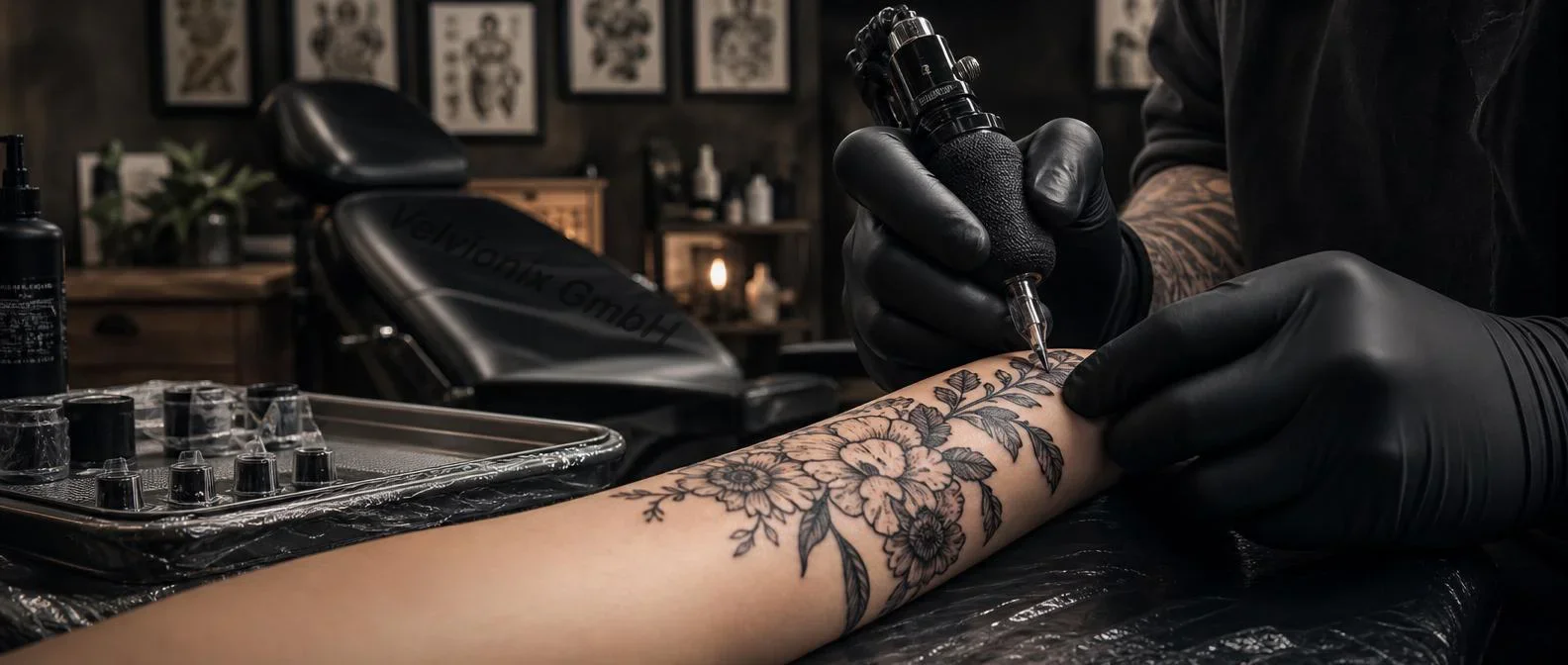
Professional website for tattoo studios
Tattoo studios thrive on portfolio, trust and clear communication. Clients don't choose the studio - they choose the artist. They want to see style, prices, appointment availability and clear information on the legal framework at a glance. We build websites for tattoo studios that place artist portfolios at the centre, enable appointment requests directly at the artist and properly implement all legal obligations (REACH, IfSG, GDPR for tattoo photos).
Website from 599 EUR net Fixed price, no hidden costs. View prices & packages →
Why tattoo studios need their own website
A tattoo is a permanent decision - clients invest weeks in choosing the right studio and artist. This research runs on Google: "tattoo studio [city]", "realistic tattoo artist Berlin", "cover-up expert Munich", "fineline tattoo where". A studio that only exists on Instagram fails at this decisive research moment. Your own website captures these searches and leads directly to the appointment request.
Instagram algorithms favour current posts - your portfolio from 2 years ago is effectively invisible, even if it's your best work. A website with structured portfolio by style makes your entire body of work searchable and combinable. Clients filter for "realistic", "Japanese" or "blackwork" and immediately find the right artist in your team. This significantly increases the conversion from interested visitor to booked client.
What belongs on a modern tattoo-studio website
The homepage immediately shows who you are: 3-5 artists with names and styles, a curated excerpt of your strongest portfolio (6-9 tattoos), a clear "Request appointment" CTA. The studio photo (interior, workstations, waiting area) conveys atmosphere - tattoo studios are heavily chosen on "vibe".
Artist profiles are the core of the website. Each artist gets a dedicated page (URL like /artists/marie-schneider/) with: bio (career, years as a tattoo artist, training with which masters), specialisations, large portfolio gallery (20-40 of their own works, lightbox-enabled), Instagram link, and an appointment request form directly on the page. This focuses the attention: clients choose the artist, not the studio.
The overall portfolio gallery is filterable by style (realistic, blackwork, Japanese, fineline, dotwork, traditional, neo-traditional, watercolour, etc.) and body region. We structure this with small thumbnails and large detail view, mobile-optimised. Anonymisation of client faces is technically solved via CSS cropping or deliberately chosen detail shots.
The appointment request form is lean: artist selection (if not already at the artist), motif description (free text), size (in cm), body location, desired style, timeframe and budget range. Images and reference motifs are exchanged directly by email between artist and customer after first contact - we deliberately exclude file uploads on the website for security reasons. The form submission is forwarded via a secure SMTP connection into your studio mailbox, with no storage on our systems. This keeps the flow lean and allows the artist a pre-qualified decision on whether, when and at what price the request is feasible.
A pricing section with per-minute or hourly rate plus minimum price creates transparency. A cover-up page with examples (difficult old tattoo becomes clean new motif) is a strong USP - this work doesn't structure well on Instagram but fantastically on a website. If you additionally want to sell aftercare products or merch, we recommend a specialized shop/payment platform on a dedicated subdomain - a full online shop with cart, online payment and distance-selling obligations is deliberately outside our scope.
Legal framework: REACH, IfSG and GDPR for tattoo photos
The EU REACH regulation (effective 04 January 2022) restricts certain pigments in tattoo inks - in particular Pigment Blue 15:3 and Pigment Green 7 were initially banned and then regulated with restrictions. A note on the website that you use REACH-aligned inks (without necessarily naming brands) is both a quality signal and legal protection. We build this reference as a dedicated section.
The Infection Protection Act (§§ 36, 37 IfSG) requires a hygiene concept, notification to the competent public health office and regular inspections. Single-use materials, CE-certified devices, disinfection protocols are part of daily operations. On the website we show a hygiene information block that communicates this diligence in customer language - without jargon but well-grounded.
GDPR for tattoo photos: Tattooed skin may be interpreted as a biometric feature, publication requires explicit consent. We build your consent template ("I consent to photos of my tattoo being published anonymised on website and Instagram") as part of the anamnesis form and document the process privacy-conscious.
Youth protection: Tattooing under-18s is sensitive and handled differently by federal state and studio policy. Many studios refuse under-18s completely; others accept from age 16 with written consent of both legal guardians. We create a clear place for your studio rule; concrete approval remains with the studio or specialist advisor.
Local visibility and community
Tattoo studios have a strong regional bond - nationwide reach is secondary except for well-known guest artists. We implement Schema.org markup (TattooParlor, LocalBusiness, Person for artists with jobTitle) - this helps search engines better understand location, opening hours and artist profiles.
The Google Business Profile and NAP consistency (Name, Address, Phone identical on website, Instagram bio and Google profile) are decisive for local rankings. Review management: a clean process for collecting reviews after the tattoo has healed (4-6 weeks after appointment), privacy-conscious integration of authentic reviews on the website.
Guest artist events (guest spots) are a strong traffic driver. We build an event module showing upcoming guest artists, their portfolio and appointment availability. This makes your website the scheduling hub of the tattoo community and drives recurring visits.
Frequently asked questions about tattoo-studio websites
Is Instagram enough for a tattoo studio?
Instagram is important for tattoo studios but not sufficient. Although portfolio presentation runs heavily on visual platforms, the actual studio selection and appointment enquiry happen differently: clients search for "tattoo studio [city]", "realistic tattoo [city]" or the name of a specific artist on Google. A studio that only exists on Instagram loses all these Google searchers. Your own website combines both worlds: Instagram for current work, website for portfolio archive, artist profiles, pricing and appointment requests.
What legal requirements must my website communicate?
Three main areas: (1) EU REACH regulation (since 2022) restricts certain pigments in tattoo inks - studios should indicate REACH-aligned inks (brand names not mandatory but credibility matters). (2) The German Infection Protection Act (§§ 36/37 IfSG) requires a hygiene concept and notification to the public health office. A hygiene note on the website (single-use materials, CE-certified devices, disinfection protocol) creates trust. (3) Youth protection: tattooing under-18s only with parental consent; many studios refuse completely - this belongs clearly on the website.
How do I present my artists on the website?
Artist profiles are the centrepiece. Each artist gets a dedicated page with: bio (career, years in profession, training), specialisations (e.g. realistic, blackwork, Japanese, fineline, dotwork), portfolio gallery (20-40 of their own works, not Pinterest inspiration), Instagram link, appointment request button directly at the artist. This makes booking direct and transparent - clients choose the artist, not the studio.
How do I handle image rights for client tattoos?
Tattooed skin is potentially a biometric feature - publication requires privacy-conscious explicit consent. We recommend a clear consent declaration in the anamnesis form with opt-in for: (a) Instagram post, (b) website portfolio, (c) anonymised detail shots without face. You may not use photos without this consent, even if no person is recognisable - the motif itself is protected by copyright. We clarify these templates during the project.
Should I display prices?
Partially. A fixed per-minute rate or hourly rate (typically 120-180 EUR, depending on region and artist reputation) plus minimum price (typically 80-150 EUR) creates transparency and filters out unsuitable enquiries. Motif-based flat rates rather not (too many variables). We build a clearly structured price section with reference to individual calculation for large projects and cover-ups - this is industry standard.
What does a tattoo-studio website cost?
We offer compact Starter packages for professional websites. All packages, care tiers and optional extensions are listed transparently on our Website pricing & packages page - so you can compare scope and pricing at your own pace, with no obligation. In a no-obligation conversation we clarify which setup fits your online presence.
More dedicated services in this industry
Looking for a website for a related profession? These dedicated pages might also be relevant:
Website for Hair Salons
Present services, prices, team, salon photos, opening hours and appointment enquiries clearly - for hair salons that want a professional online presence and better local visibility.
View hair salon website →Website for Beauty Studios
Present treatments, prices, duration, care notes, photos and enquiry paths clearly - for beauty studios with services that need explanation and high trust requirements.
View beauty studio website →Website for Nail Salons
Make designs, services, prices, photo gallery, care notes and booking paths visible - for nail studios that want to present their work convincingly.
View nail salon website →Website for Barbershops
Show haircuts, beard care, prices, atmosphere, team and booking paths clearly - for barbershops that want to combine style, craft and local visibility.
View barbershop website →Website for hair removal studios
Explain methods, treatment areas, process, prices, notes and consultation options clearly - for studios that want to build trust before the first appointment.
View hair removal studio website →More relevant industries
What We Have Already Delivered
Our reference project shows a custom website with a multilingual structure, animated landing page, interactive map and automatic contact form - built from scratch instead of a website-builder template.
View reference project →Full details on scope, packages, prices and optional extensions can be found on our Web Development services page.
View packages and extensions →Ready for your new tattoo-studio website?
In a free initial consultation we discuss your artist team, your styles and your positioning. You receive a concrete offer that puts your artists in the spotlight and communicates content aligned with IfSG, REACH and GDPR.
Discuss your tattoo studio website