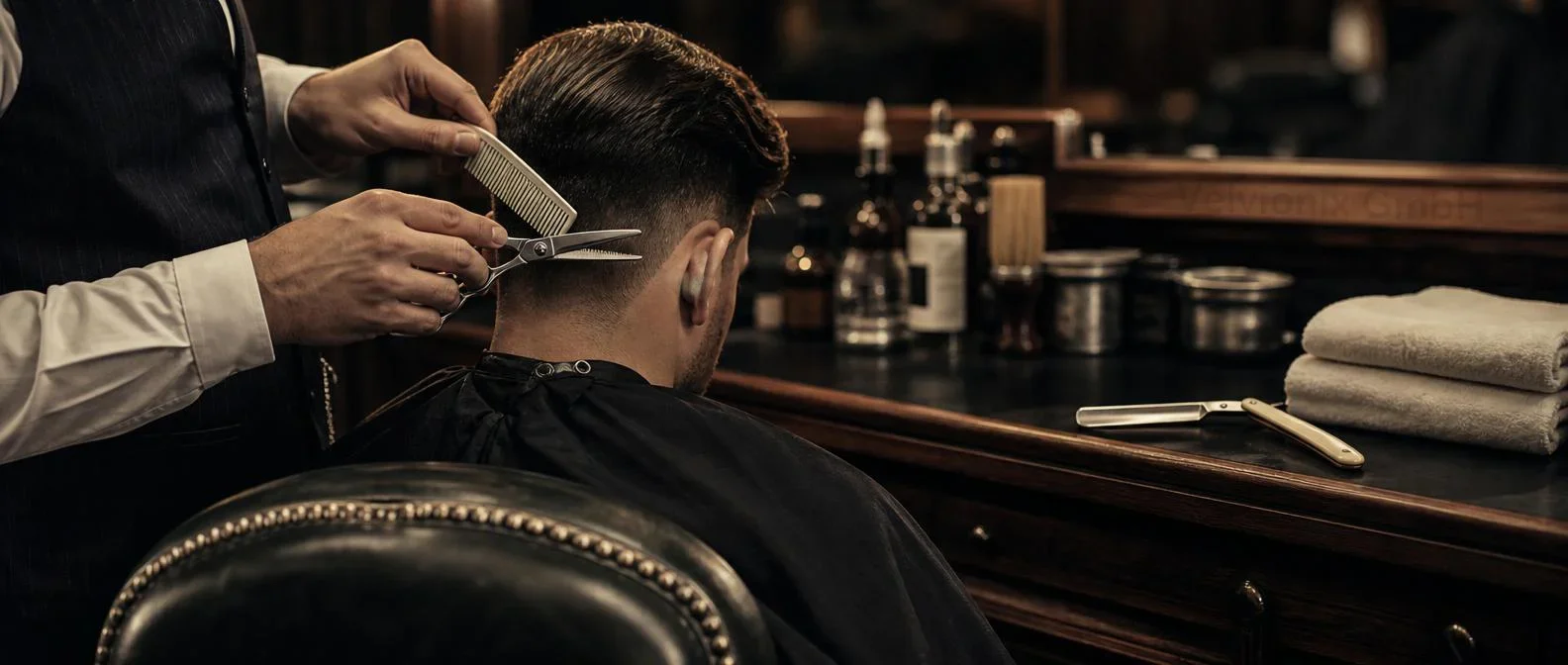
Professional website for barbershops
Barbershops have grown in the past ten years from a niche category into one of the defining beauty branches of German city centres and neighbourhoods - specialised in male grooming, beard care as a core service, the straight-razor shave as a ritual and a deliberately crafted community atmosphere. Velvionix develops barbershop websites digitally across Germany where new customers grasp style, team and prices within seconds, the ritual of the shave is explained calmly, and booking through a common appointment booking widget is possible in a few steps. The website operates in a regulatorily defined field - HwO Annex A No. 38, RKI hygiene guidance, the EU Cosmetics Regulation (EC) No 1223/2009 for care products, § 22 KUG for customer photos - and communicates this frame factually rather than promotionally.
Website from 599 EUR net Fixed price, no hidden costs. View prices & packages →
Why barbershops need their own website today
The German barbershop market has become visible in every medium-sized and large city over the past ten years - from high-end concept shops with whiskey-bar corners and vintage barber chairs to walk-in-oriented Turkish, Kurdish, Greek or Italian barbershops that offer hair and beard services at fixed prices without long lead times. The customer base is predominantly male, between 18 and 45, often with a pronounced urban style focus and a strong willingness to return on a regular basis for a clean fade, a precise beard line or a quiet hot-towel shave ritual. The initial contact almost always happens online: "barbershop [city]", "Turkish barber [city]", "fade haircut [district]", "beard trim [city]", "hot towel shave [city]" are the most common search queries. Those present there only with a Google listing and no website lose against every shop in the same neighbourhood that carries its own site with atmosphere photos, service menu and direct booking path.
Barbershops differ from classic hair salons in one central point: the decision is often strongly visual and atmospheric. Customers compare interior photos (leather, brass, warm wood tones, vintage details, plants, barber poles), barber portraits, portfolio reels and Google reviews within minutes and then decide - frequently without ever calling. A website that serves this decision layer cleanly acts like a second shop window: it shows style, team, prices and ritual as clearly as the facade of the shop on the street - only around the clock and well beyond the neighbourhood. Instagram and TikTok remain important reach channels, but your own domain is the place where the brand actually belongs to you and does not depend on the algorithm of a single platform operator.
The third layer is regulatory. Since the HwO amendment of 2020, the hairdressing trade - and therefore also the barbershop business that commercially provides hair and beard cuts - is once again a licensed trade under Annex A No. 38 of the German Trade Code. The business setup requires a master craftsman certificate, an exercise permit under § 8 HwO, an entry under the experienced-journeyman rule under § 7b HwO, or an employed master craftsman as shop manager. Many barbershops in Germany are run by entrepreneurs with foreign qualifications - in particular from Turkey, Syria, Iran, Greece and Italy, whose professional tradition in male grooming in many cases reaches well beyond German training standards. For them, the recognition procedure under § 50a HwO through the competent Chamber of Crafts applies in addition. A website that communicates this frame calmly and transparently (without inflating it into an advertising promise) creates trust with customers and with a potential inspection by the Chamber of Crafts or the municipal regulatory office.
The fourth factor is economic. Barbershops typically work with shorter treatment times than classic hair salons (a modern fade takes 30-45 minutes, a Royal Shave with hot-towel ritual 30-50 minutes, a hair-plus-beard combo 45-75 minutes), a high appointment frequency and a high rebooking share on a 2-4 week rhythm. A website that explains price and duration of each service itself, delegates booking directly to a common appointment booking widget and shows walk-in windows transparently can reduce phone and DM follow-up - and frees the team at the chair for what economically actually matters: the work on the customer.
What sets a barbershop apart from a classic hair salon - and how the website shows it
Classic hair salons work predominantly unisex with a broad service portfolio: women, men, children, colouring and highlights, extensions, updos for weddings, extensive product advice and often a focus on female customers. A barbershop positions itself deliberately in the opposite direction: focus on male grooming, beard care as a stand-alone core service rather than an add-on to a men\'s cut, modern men\'s cuts (fade in all its variations - low, mid, high, skin-fade, drop-fade, taper-fade, burst-fade; crop with fringe; pompadour classic and modern; quiff; undercut; buzz cut; mullet as the current trend cut; slick-back; textured top), the straight-razor shave as a ritual, scalp massage during the wash and a deliberately staged atmosphere. This positioning is the most effective single differentiator of the website - and we build it into the first 300 pixels of the homepage.
The service menu of a barbershop website is the most concrete expression of this positioning. We structure it in clearly delimited categories: haircut (with a technique description for fade, crop, pompadour, buzz and their variations), beard trim as a separate block (beard line-up, full beard shaping, three-day-stubble line, beard wash and care), hair-plus-beard combo as a package price, Royal Shave or Hot-Towel Shave as a ritual with its own page and description (pre-shave oil, hot towel, lathering with brush, shave in two passes, compresses, after-shave balm), eyebrow trim, ear/nose hair trim, children\'s haircut (where offered, with age range), senior prices (where offered) and optionally membership or flat-rate models - which are settled in the booking provider\'s specialist system, not on our website.
The ritual of the Royal Shave deserves its own subpage. In 500-800 words we calmly describe, without superlatives, what distinguishes a 5-minute electric beard trim from a classic hot-towel shave: the analysis of face shape and beard structure, the hot towel to open the pores, lathering with a brush and high-quality shaving soap or cream, the first pass with the grain, the intermediate compress, the second pass against the grain if desired, the cold towel to close the pores and the closing with after-shave balm. The language is professional and ceremonial, without slipping into healing claims - a shave is not a medical procedure but a well-groomed break. Images from the shop itself (real barber hands, real customers with consent, real steaming towel) beat any stock photo.
Atmosphere is the second major difference from a hair salon website. We build a dedicated section with 8-16 interior photos: barber chairs, mirror stations, leather sofas or armchairs in the waiting area, wood and brass details, beard-care products on open shelves, plants, the barber pole at the entrance, warm evening lighting. These images are conversion levers: they sell not the service but the experience - and in the barber scene the experience is precisely the reason customers return and bring friends along. In parallel we show, where relevant, the heritage and tradition of the shop: "Turkish Traditional" with a reference to the Turkish barber tradition, "Old-School American" with a reference to the US barbershop culture, "Italian Heritage" with a reference to the Italian coiffeur tradition. These heritage anchors are not advertising buzzwords but professional signals about technique, tools and ritual.
What belongs on a modern barbershop website
The homepage delivers the answers to three questions within the first seconds: What kind of shop is this (Turkish Traditional, Modern Urban, High-End Concept, Old-School American)? What are the core services and what does the standard hair + beard combination cost? How do I get an appointment quickly - or are walk-ins possible? A large, real hero image from the shop itself, calm typography in strong weights, a deliberately reduced colour palette (often anthracite, warm brown, brass, cream) and a primary CTA ("Book appointment", "Check walk-in status", "View prices") set the tone. Opening hours and address sit prominently - ideally with a walk-in note ("walk-ins welcome up to 30 minutes before closing") for shops with a hybrid model.
The barber team is a stand-alone trust anchor. For each barber, a short profile card with a real portrait, name or artist name, heritage or tradition (Turkey, Kurdistan, Syria, Greece, Italy, Germany - or explicitly no heritage note if the team works deliberately international), training and continuing education (barber-specific schools and manufacturer trainings) and specialisation (fade specialist, Royal Shave expert, beard sculpting, traditional Turkish shave with flame and cotton, classic scissor-cut technique). The tone is calm and professional. Where the shop philosophy fits, the training team can also be shown transparently: apprentices in the three-year hairdressing apprenticeship under the HwO training regulation, with clearly marked services and adjusted prices, are a quality signal for the training culture and a sign that the shop invests in the profession.
The price and duration list is complete and structured. Each service with price, time required and - where relevant - age- or length-based gradations. Package prices (hair + beard, Royal Shave + haircut, father + son as a combo) sit as stand-alone blocks. Membership or flat-rate models (e.g. unlimited fade per month, 4-pack Royal Shave) are only referenced but not billed on our website - billing and member management run in your industry software, not in our infrastructure. Hidden prices are poison in the barber scene; an open, clear price list is a trust anchor and can reduce phone enquiries. Gift vouchers sit as a CTA and are redeemed on site or - where electronic delivery is desired - handled through the corresponding function in the booking system or a specialised voucher provider. Online payment does not run through our website.
The portfolio gallery is the strongest conversion lever. 30-80 high-quality photos of the shop\'s own work, structured by categories (fade variations, crop, pompadour, beard line-up work, full beard shaping, before-after sequences, Royal Shave reportage). We build the gallery image-first, fast-loading and with a mini lightbox that also works on smartphones. Every published photo needs the consent of the depicted person under § 22 KUG (German Art Copyright Act) - we provide a clean text block for the consent declaration (on a tablet in the shop or on paper) that the shop keeps itself. The consent deliberately does not belong as a side clause in the website terms because that is legally problematic and has rightly led to cease-and-desist letters in similar cases.
The booking section points to the chosen booking system. We embed a common appointment booking widget via iFrame or button link; customers see service selection, barber choice, duration and free slots directly in the system and book there - including reminder SMS, optional deposit against no-shows (more common in the barber scene than in classic salons because appointment density is higher) and customer database in the backend. For shops with a pure walk-in model or a hybrid model we build a walk-in-queue view, where the booking system provides it, or alternatively a lean request form: name, phone/email, desired barber, desired service, desired window, without file upload, without storage on our systems, with forwarding via a secure SMTP connection directly into the shop mailbox.
A blog or news area rounds off the offering. Community events are an underestimated content lever in the barbershop segment: barber battles, charity cuts for local social initiatives, Men\'s Mental Health evenings (around Movember, International Men\'s Day or shop-specific series), workshop evenings with brand partners, or pop-up collaborations with cafes, tattoo studios or streetwear shops are not only marketing anchors but build the brand as a neighbourhood institution. Alongside come seasonal care notes (beard care in winter, scalp sun protection in summer, a stubble-length guide), short product introductions and occasional team news. The language stays calm, professional and honest - no superlatives, no healing claims about beard growth or hair loss, no comparisons with competitor shops.
Legal frame: HwO Annex A, hygiene, product sales and advertising
The German Trade Code (HwO) Annex A No. 38 covers the hairdressing trade and therefore also the barbershop business that commercially provides hair and beard cuts. Since the 2020 re-regulation it is once again a licensed trade - which means: entry in the Register of Craftsmen at the competent Chamber of Crafts, either via master craftsman certificate, via an exercise permit under § 8 HwO, via the experienced-journeyman rule under § 7b HwO (six years of journeyman work, four of them in a leading position) or via an employed master craftsman as shop manager. For owners with foreign qualifications, the recognition procedure under § 50a HwO additionally applies. Our website structure is aligned with HwO Annex A requirements: we show qualification notes calmly and without promotional superlatives, link to the Chamber of Crafts record where desired and integrate barber profiles that reflect training background and specialisation professionally. We deliberately do not provide individual-case assessments (e.g. "your specific constellation is eligible for entry") - that is a matter for the competent Chamber of Crafts.
Hygiene is the most sensitive point in barbershop practice - in particular with the straight-razor shave. The Technical Rules for Biological Agents (TRBA 500 and TRBA 250 in their current version) set the basic requirements for hygiene, personal protective equipment and instrument reprocessing, and the workplace rules (ASR) regulate indoor air, lighting and workstation ergonomics. Decisive for external communication is the straight-razor shave: in the overwhelming majority of cases a shavette with a standard single-use blade is used, because the single-use blade is swapped after every customer and blood-contact risks (HIV, Hepatitis B/C) are minimised in line with RKI recommendations. Styptic sticks are used exclusively with a single-use applicator. We build a hygiene section into the website that names these core points factually - structured to RKI hygiene guidance, without blanket "guaranteed hygienic" statements and without individual-case opinions on the certification of specific devices.
The sale of cosmetic care products (beard oils, beard balms, pomades, matte pastes, styling clays, after-shaves) falls under the EU Cosmetics Regulation (EC) No 1223/2009. The obligations for CPNP notification, safety report and labelling as a rule sit with the manufacturer or the "responsible person" - as a retailer, the shop is a reselling distributor and must ensure that only correctly labelled products are sold. For an own brand with white-label production, the obligations shift: here the shop or its brand partner becomes the responsible person within the meaning of the regulation and must carry out the CPNP notification, commission the safety report and apply the labelling in full. We phrase the product section on the website built in line with the EU Cosmetics Regulation (EC) No 1223/2009: brand name, line, cosmetic function ("nourishes", "smooths", "provides matte hold") - without healing claims and without blanket alignment labels. For on-site sale, the Price Indication Regulation (PAngV) adds the base-price obligation in force since 2022 (euro per 100 ml for liquid and semi-solid products); that belongs on the product label on the shelf and on the receipt, not primarily on the website.
Advertising and communication move between the Medicinal Products Advertising Act (HWG), the Unfair Competition Act (UWG) and the specific transparency obligation under § 5a para. 4 UWG for commercial communication. Beard-care and hair-styling products are, seen purely cosmetically, not in the core scope of the HWG - but as soon as a statement sounds medical ("stops hair loss", "helps with beard dandruff", "heals skin irritations"), the communication moves into the HWG and UWG cease-and-desist zone. We phrase the website consistently cosmetically: "nourishes", "soothes the skin after shaving", "gives the beard shine and structure", "reduces split ends" (common marketing wording, but with a provable benchmark) - no therapy promises, no before-after series with medical context, no blanket quality labels without a source. Influencer cooperations (sponsored beard-oil posts, pomade test fills, barber vouchers for reach-focused creators) are labelled transparently on the website if they are embedded there - the concrete labelling logic per post remains the responsibility of the shop and its marketing partners.
GDPR applies to the classic contact and booking data: name, phone, email, appointment wish. Health data under Art. 9 GDPR does not arise in the normal barbershop operation. For photos of customers on the website, in the portfolio gallery and in social media embeddings, § 22 KUG applies: publication requires consent, and the consent expressly does not belong as a side clause in the website terms but must be documented separately in the shop\'s customer records. Our website forms forward entries via a secure SMTP connection directly into the shop mailbox; there is no persistent storage of message content on our systems and no file uploads. The privacy policy contains the mandatory information for all embedded third-party widgets (booking system, reviews widget, optional Instagram embed); the data processing agreements for these widgets are concluded directly between the shop and the respective provider - not through us.
Local visibility, community and reviews
Barbershops live off the local catchment area - in large cities two to four underground stations, in small and medium-sized towns the entire core plus the adjacent residential quarters. The most important local lever is the Google Business Profile with the primary category "barbershop", secondary categories ("men\'s hair salon", "hairdresser", "shave salon"), complete opening hours including walk-in windows and public holidays, well-maintained service categories and a consistent appearance with the website (NAP consistency: name, address, phone identical on website, GBP, booking system and industry portals). In addition, entries in industry-standard directory portals and booking marketplaces matter - depending on target customer and budget. We set up the Google Business Profile or take it over and hand the ongoing maintenance to the shop team, so that special hours, new services and current photos can be maintained quickly.
Instagram and TikTok are, in the barber scene, the strongest organic reach channel overall. Fade reels (often with slow-motion transitions from before to after), beard-sculpting reels, hot-towel-shave sequences and occasional barber-battle or event clips generate organic reach well beyond the catchment area and send interested customers directly to the website. We optionally embed the Instagram feed in a privacy-conscious click-to-load pattern, so Meta tracking is not loaded on every page view. The actual content production stays with the shop team; we deliver structure, sensible links (the Instagram post links to the service page, not only to the homepage) and the relevant regulatory orientation (§ 22 KUG for customer photos, § 5a UWG for cooperations, embedding implemented with data minimization in mind).
Reviews are a particularly strong trust signal for a male decision-maker audience. We integrate a common reviews widget discreetly into the homepage and the service pages and set up a lean process with which the shop can ask for a review after the appointment - SMS link from the booking system, QR code at the counter, automatic follow-up email 24 hours after the appointment. The embedding is implemented with data minimization in mind (click-to-load, consent logic for real-name display), and we draft the response to critical reviews together as a standing text block: factual, personable, without blame, without describing the specific shop procedure - that is in external perception the decisive difference between a professional shop brand and an emotionally reacting single account.
Community content is, in the barbershop segment, the lever that turns the brand from a service provider into a neighbourhood institution. Charity cuts for local homeless initiatives, Men\'s Mental Health evenings (around Movember, International Men\'s Day or shop-specific series), barber battles with friendly shops, workshop evenings with brand partners, pop-up collaborations with cafes, tattoo studios, streetwear or sneaker shops and occasional live-music or reading evenings in the shop rooms generate organic reach as well as a real bond with the community. We build a lean event or news section for this content that is easy to maintain (2-3 paragraphs per event, one strong image, date and time, optionally a link to an external event page) and structure the scaffolding so that the shop team can maintain the content itself - without every entry having to come back to us.
Structured data under Schema.org (a suitable LocalBusiness / beauty / hair-salon classification, openingHoursSpecification with walk-in windows and public-holiday deviations, hasOfferCatalog for services with priceRange, ImageGallery for portfolio and interior photos, FAQPage for frequently asked questions, Event for community dates) helps Google understand the shop category, opening hours, services and visible content more clearly. This can support the search result presentation and make entry easier - the difference between a generic Google hit and an entry that already conveys style, opening status and reviews in the search preview.
Frequently asked questions about barbershop websites
How do I present master craftsman qualification, the experienced-journeyman rule and recognition of foreign qualifications for a barbershop factually on the website?
The hairdressing trade is listed in Annex A No. 38 of the German Trade Code (Handwerksordnung, HwO) and, since the 2020 re-regulation, is once again a licensed trade. A barbershop that commercially offers hair and beard cuts falls squarely into this trade and needs either an entry in the Register of Craftsmen with a master craftsman certificate, an exercise permit under § 8 HwO, an entry under the experienced-journeyman rule under § 7b HwO (six years of journeyman activity, four of them in a leading position) or an employed master craftsman as shop manager. For barbershop entrepreneurs with foreign qualifications, the recognition procedure under § 50a HwO through the competent Chamber of Crafts applies additionally. On the website we do not play these points up aggressively but integrate them calmly into the shop introduction: one sentence on the qualification of the owners or on the entry in the Register of Craftsmen, linked to the Chamber of Crafts record where wanted, complemented by the profiles of the barbers with training and specialisations. We phrase the content aligned with HwO Annex A requirements and deliberately avoid individual-case assessments - the legal evaluation of specific constellations belongs to the Chamber of Crafts and the recognition body, not to a marketing page.
How do we clearly delineate a barbershop from a classic hair salon on the website without sounding dismissive?
Classic hair salons typically work unisex - women, men and children - with focus areas on colouring, highlights, extensions, updos and hair-care product advice. A barbershop positions itself deliberately differently: focus on male grooming, beard care as a stand-alone core service, modern men's cuts such as Fade, Taper, Crop, Pompadour, Skin-Fade, Undercut, Quiff, Mullet and Buzz, straight-razor shave as a ritual and a deliberately crafted community atmosphere as part of the brand. This delineation is the key trust anchor on the website, because new customers want to know immediately whether they are in the right place. We build the homepage with a clear positioning claim ("Barbershop in [city] - hair, beard, shave"), a hero image from the shop itself (barber chair, leather sofa, copper or brass details, working-class or vintage aesthetics) and a service structure that shows beard services as a stand-alone block, not as an add-on to a men's cut. Children's and senior prices, where offered, sit as their own blocks - but the main stage belongs to male grooming. This differentiation is neither exclusionary nor dismissive; it is a clear professional specialisation that gives customers orientation and sharpens the shop's brand.
How do I communicate the straight-razor shave and hygiene protocols credibly without slipping into healing claims?
The straight-razor shave - in particular the Royal Shave or Hot-Towel Shave - is the visually strongest ritual of the barbershop and at the same time the service that most deserves precise hygiene explanation. In practice, the vast majority of German barbershops use a shavette with a standard single-use blade rather than a traditional ground straight razor - precisely because the single-use blade is swapped after every customer and so any cross-transmission is ruled out. The website addresses this calmly and professionally: a dedicated section describes the shave procedure (analysis, pre-shave oil, hot towel, lathering with brush, first pass with the grain, warm intermediate compress, second pass against the grain if desired, after-shave balm), explicitly names the single-use-blade policy and references the orientation to RKI hygiene guidance and TRBA 500 for biological agents. Styptic sticks are used exclusively with a single-use applicator; surfaces and instruments are regularly disinfected. We avoid healing or therapy claims ("fights beard dandruff", "stops hair loss") and phrase purely in cosmetic and ceremonial terms. The result is a trust signal that stays factual and positions the shave for what it actually is - a well-groomed, calm, masculine break.
May I sell beard oils, pomades and beard balms in the shop, and how does that fit on the website?
Barbershops regularly sell care products on site - beard oils, beard balms, pomades (matte, shine, water-based), matte pastes, styling clays, after-shaves - because these products are bought directly after the appointment and belong to the shop's brand. Two sets of rules apply here: the EU Cosmetics Regulation (EC) No 1223/2009 with CPNP notification, safety report and labelling (the obligation as a rule sits with the manufacturer or the "responsible person"; as a retailer the shop is only a reselling distributor), and the German Price Indication Regulation (PAngV) with the base-price obligation in force since 2022 (euro per 100 ml for oils, balms and pastes). On the website we position the product section deliberately as information, not as a shop: we name the stocked brands and lines, show photos and short product descriptions without healing claims and point to purchase on site or to an external shop (e.g. a specialized shop/payment platform on a dedicated subdomain) for the online sale. On our infrastructure there is no shopping cart and no payment flow - that stays deliberately with specialized shop/payment platforms. We phrase the descriptions aligned with HWG and UWG wording: no "stops hair loss", no "heals beard dandruff", instead "nourishes", "smooths", "provides hold and a matte finish".
Which booking widget fits a barbershop and how do we handle portfolio photos under § 22 KUG?
For barbershops a range of common appointment booking widgets with walk-in-queue functionality is available, covering different price points and feature sets (POS integration, deposit handling, customer database, SMS reminders). The choice depends on the walk-in share, the desired POS functions and the commission logic. We embed the chosen widget via iFrame or button link and set up the service catalogue, duration logic and barber selection once visually - ongoing maintenance stays in the booking system, the data processing agreement is concluded directly between the shop and the provider. Portfolio photos are a central conversion lever in the barber scene (fade gradients, beard line-ups, before-after sequences). Under § 22 KUG (German Art Copyright Act), the publication of customer photos requires consent. We build the portfolio gallery so that only genuine works with obtained consent appear, deliver a GDPR-compatible text block for the consent declaration (in writing or on a tablet in the shop) and keep the consent deliberately outside the website terms - it does not belong there as a side clause but must be documented separately in the shop's customer records.
What does a website for a barbershop cost?
We offer compact Starter packages for professional websites. All packages, care tiers and optional extensions are listed transparently on our Website pricing & packages page - so you can compare scope and pricing at your own pace, with no obligation. In a no-obligation conversation we clarify which setup fits your online presence.
More dedicated services in this industry
Looking for a website for a related profession? These dedicated pages might also be relevant:
Website for Hair Salons
Present services, prices, team, salon photos, opening hours and appointment enquiries clearly - for hair salons that want a professional online presence and better local visibility.
View hair salon website →Website for Beauty Studios
Present treatments, prices, duration, care notes, photos and enquiry paths clearly - for beauty studios with services that need explanation and high trust requirements.
View beauty studio website →Website for Nail Salons
Make designs, services, prices, photo gallery, care notes and booking paths visible - for nail studios that want to present their work convincingly.
View nail salon website →Website for hair removal studios
Explain methods, treatment areas, process, prices, notes and consultation options clearly - for studios that want to build trust before the first appointment.
View hair removal studio website →Website for Tattoo Studios
Present styles, artists, portfolio, hygiene, booking process, consultation and enquiries clearly - for tattoo studios that want to show trust and visual quality.
View tattoo website →More relevant industries
What We Have Already Delivered
Our reference project shows a custom website with a multilingual structure, animated landing page, interactive map and automatic contact form - built from scratch instead of a website-builder template.
View reference project →Full details on scope, packages, prices and optional extensions can be found on our Web Development services page.
View packages and extensions →Ready for a website that makes your barbershop visible as a brand?
In the free initial consultation we clarify your positioning, service menu, preferred booking software and community levers. You receive a concrete offer for a website that positions your shop as a brand and can reduce phone or DM follow-up through better information upfront.
Discuss your barbershop website