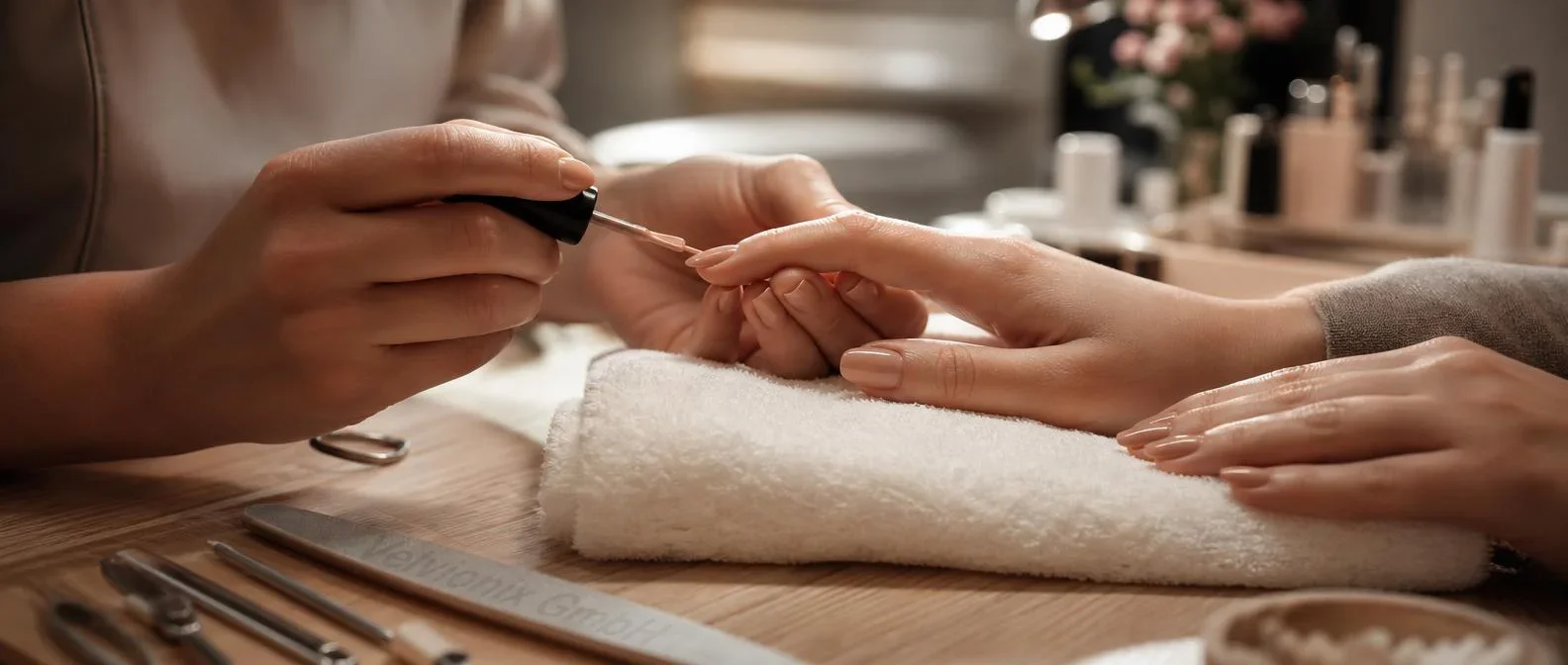
Professional website for nail salons
Nail salons operate in a strongly visual, strongly local and at the same time regulatorily dense environment: customers decide within seconds based on portfolio photos, style and transparency on price and duration, Google Business Profile and Instagram deliver the first impulses, and the salon itself moves between the EU Cosmetics Regulation (EC) No 1223/2009 with its classification of certain UV acrylates as professional-use-only products, the NiSV Annex 3 requirements for LED and UV curing, and a clear distinction from medical foot care under the German Podologengesetz. Velvionix develops nail salon websites digitally across Germany that guide interested customers from the first Google hit to a clear idea of the style, a structured price and duration list and an easy booking path - without shop overhead, without customer data on our servers and without exaggerated advertising promises.
Website from 599 EUR net Fixed price, no hidden costs. View prices & packages →
Why nail salons need their own website today
The German nail salon market has grown structurally and become highly competitive at the same time. In large cities several salons of different price and style classes compete within two street blocks - from fast walk-in salons for basic manicures to specialised nail art studios with appointment lead times of several weeks. The choice of a salon today happens almost entirely online: customers search "nail salon [city]", "gel nails [district]", "manicure near me", scroll through Google Business Profile, open Instagram, compare portfolio photos and prices. Those only present there with a listing and no website lose against every neighbouring salon that has its own site with a structured price list, portfolio gallery and booking path. Your own website is no longer a luxury but the central sales channel between a Google hit and the first booking.
Industry-standard directory portals deliver leads but take commissions per booking, show competitors in the same map view and build no genuine brand loyalty. Your own website flips that ratio: it is the place where you show style, team and pricing philosophy without a portal frame, where customers decide without distraction and where returning customers find their way back without detour. The healthy balance lies in combining the two - portals for initial leads, your own website for trust and rebooking - and the website is the one building block that truly belongs to you.
The third layer is regulatory. Nail modelling and nail care have - since the dispute phase around 2020 - been clearly classified as body-care services: not a trade requiring a licence under the German Trade Code (HwO), a trade registration is sufficient, and the master craftsman requirement explicitly does not apply. At the same time the salon moves within several parallel regulatory circles: the EU Cosmetics Regulation (EC) No 1223/2009 with its classification of certain UV acrylates such as HEMA as professional-use-only products, NiSV Annex 3 for LED and UV curing, hygiene requirements under TRBA 500/250 and ASR workplace rules, the HWG in its extension to statements about nail health and the clear distinction from medical foot care under the German Podologengesetz (PodG). A website that communicates this frame calmly and factually creates trust - both with customers and with a potential supervisory authority inspection.
The fourth factor is organisational. Nail salons work with tightly scheduled appointments, long treatment durations (a full new modelling with nail art takes 90-150 minutes), high material and equipment investments and a high share of returning customers on a 3-4 week rhythm for refill and care. A website that explains the price and duration of each service itself, makes the portfolio visible and leads directly into a specialised booking system can reduce phone enquiries and gives the team more time for the treatment at the table.
What belongs on a modern nail salon website
The homepage answers three questions within the first seconds: What style does this salon work in (classic-elegant, trend-oriented, minimalist, maximum-artistic)? What basic services are offered, in what price and duration range? How do I get an appointment quickly? A large, real photo from your own salon - workstation, lighting mood, finished work - beats every stock image already seen on a hundred other nail salon websites. Calm typography, a deliberately reduced colour palette and a clearly set primary CTA ("Book appointment", "View portfolio", "Prices and duration") set the tone.
Service and technique pages are the SEO and explanation centrepiece. One dedicated subpage per technique with 500-900 words: manicure (classic, Russian, Japanese nail care, paraffin bath), pedicure as cosmetic foot care - with a clear distinction from medical foot care by podologists -, gel nails and gel modelling, acrylic nails, shellac and semi-permanent lacquer, nail art and designs, extension techniques (form, tip), nail care subscriptions for regulars. Each page calmly explains what the technique is, who it suits, how the appointment proceeds, how long the result lasts, what it costs and when the refill is due. The language is professional and honest - without superlatives, without healing claims and without guarantees that will not hold up in reality.
The price list and duration table are structured and complete. Each service with price, time required and optional package prices (e.g. refill subscription every three weeks, loyalty card after five appointments). Hidden prices deter in this industry - open presentation is a trust anchor and can reduce phone enquiries. Vouchers for birthdays, Christmas and Mother\'s Day are built in as a clear CTA; redemption takes place on site, there is no online payment flow on our end. For salons that wish to send vouchers electronically, we reference the corresponding function in the industry software or embed a specialised third-party provider via widget.
The portfolio gallery is the strongest conversion lever in this industry. 30-80 high-quality photos of your own work, structured by categories (French, nude, dark, shiny, matte, nail art, seasonal), each with a short note on the technique and approximate duration. We build the gallery image-first, fast-loading (modern image formats, lazy loading) and with a mini lightbox that works on smartphones too. Customer consent to publish hand or foot photos is obtained and documented separately (§ 22 KUG - German Copyright Act in Art Law) - we provide the text building block; the consent itself is held by the salon on site.
The appointment section points to the preferred booking system: a common appointment booking widget is embedded via iFrame or button link. Customers see service selection, duration and free slots in the booking system and book directly there - including reminder SMS, optional deposit against no-shows and customer database in the backend. Our contribution ends at the widget boundary; till, customer database and payment run entirely in the booking system. For salons without their own studio software we alternatively build a lean request form: name, phone/email, desired service, desired timeframe - without file upload, without storage on our systems, with forwarding via a secure SMTP connection directly into the salon mailbox.
A small blog or guide area rounds off the offering. Seasonal designs (autumn tones, Christmas nail art, spring French), home care hints (cuticle oil, cuticle care, washing hands with gel manicure), durability tips and honest answers to recurring questions ("How long does shellac really last?", "Does gel damage the natural nail?") are both SEO-effective and trust-building. We phrase in line with HWG-oriented wording: no healing claims about nail health, no therapy recommendations, no comparisons with competitor salons - factual information, supplemented by the note to seek medical or podology assessment for pathological changes.
Legal frame: Cosmetics Regulation, NiSV Annex 3, HWG extension and UWG
The EU Cosmetics Regulation (EC) No 1223/2009 is the central European framework for cosmetic products including nail lacquers, gel systems and acrylates. Two points are particularly relevant for nail salons. First, the professional-use-only classification of individual acrylates (HEMA, Di-HEMA Trimethylhexyl Dicarbamate and other CMR-classified substances) since September 2020 - these products may only be used by qualified practitioners and not sold to end customers. Second, the labelling and INCI obligations, which the manufacturer fulfils; the salon carries no notification obligation of its own in the CPNP system but must ensure that only correctly labelled products are used and that professional-use-only products do not slip into a shop or take-away sale. Our website structure is built in line with the EU Cosmetics Regulation (EC) No 1223/2009 and reflects product and technology communication accordingly.
The ordinance on protection against harmful effects of non-ionising radiation (NiSV) regulates cosmetic applications of optical radiation in Annex 3. LED and UV lamps used for curing gel and shellac lacquers are in typical studio use usually not in the high-energy application range of Annex 3; however, power density, exposure time and application area are decisive. We phrase the technology section of the website aligned with NiSV Annex 3 requirements: factual device information, reference to skin protection options for the hand (UV protection product, glove use on request), no blanket alignment claims and no individual-case opinion on the classification of a specific lamp - that assessment lies with the competent supervisory authority and the Federal Office for Radiation Protection (BfS), not with a marketing page.
The Medicinal Products Advertising Act (HWG) targets the advertising of medicinal products, medical devices and treatment procedures; purely cosmetic nail services do not fall within its core scope. As soon as a health-related statement is made, however - "strengthens brittle nails", "helps with nail fungus", "heals torn cuticles" - the communication moves closer to the HWG and additionally into the territory of misleading advertising under the Unfair Competition Act (UWG). We therefore phrase the service pages deliberately cosmetically: care, beautification, aesthetics, wellbeing character; medical indications are not advertised but delimited with a factual note pointing to a dermatologist or podologist.
The UWG contains two additional points particularly relevant for nail salons. First, the transparency obligation for commercial communication under § 5a para. 4 UWG - influencer posts, brand cooperations and product seedings must be labelled even when shared by the salon itself. Second, the cease-and-desist exposure of unsubstantiated "certified" or "tested" claims; we name only concrete certificates with issuing body and date on the website where available and otherwise avoid blanket quality labels without evidence. The result is communication that is not quieter but more concrete - and that is exactly the tone interested customers in the beauty sector reward.
GDPR applies to the classic contact and booking data: name, phone, email, appointment wish. Health data under Art. 9 GDPR usually does not arise - nail cosmetics without medical indication do not touch special categories; exceptions are notes on nail intolerances or pre-existing conditions, which, if obtained, are stored in the studio software customer database and not on the website. Our website forms forward entries via a secure SMTP connection directly into the salon mailbox; there is no persistent storage of message content on our systems and no file uploads. The privacy policy contains the mandatory information for the embedded third-party widgets (booking system, reviews widget, social media embeds); the data processing agreements for these widgets are concluded directly between the salon and the respective provider.
Hygiene, distinction from podology and team qualification
Hygiene is a core quality feature in the nail salon that can be credibly represented on the website without sounding over-promoted. The basis is provided by occupational health and safety law: the Technical Rules for Biological Agents (TRBA 500 and TRBA 250 in their current version) set the basic requirements for hygiene, personal protective equipment and instrument reprocessing, and the workplace rules (ASR) regulate indoor air, lighting and workstation ergonomics. We build a short hygiene section into the website that factually names the key points: single-use files and polishers, reprocessing of instruments following disinfection and sterilisation guidance (RKI recommendations as professional orientation), glove use when working on the cuticle area and in case of potential blood contact, regular surface disinfection of the workstation.
The distinction from medical foot care is as important on the website as it is professionally. Medical foot care is a protected profession in Germany under the German Podologengesetz (PodG); only podologists with state recognition may use that title and perform certain services (treatment of ingrown toenails with inflammation, diabetic foot, pathological callus changes). A nail salon offers cosmetic foot care - nail shortening and care, removal of cosmetic callus, lacquering and pedicure polish - and refers customers with medical indications to a podology practice. We phrase the pedicure page accordingly: "cosmetic foot care" as clear designation, no healing claims, no terminology from the medical field, a short factual referral block to podology for corresponding symptoms.
The team is the second major trust anchor. One short profile card per nail artist: a real portrait, name or artist name, focus areas (French and nude, nail art and designs, Japanese nail care, refill specialist), training and further education with the stocked product manufacturers, years of experience and - if desired - one sentence on personal handwriting. The tone is calm and professional, without superlatives, without rankings. In many salons apprentices or junior staff additionally work on defined services - this can be shown transparently, often with an adjusted price, and acts as a quality signal for the salon\'s training culture.
Local visibility, social media and review management
Nail salons live from the local catchment area - in large cities two to three underground stations, in small and medium-sized towns the entire core plus the adjacent residential quarters. The most important local lever is the Google Business Profile with the primary category "nail salon", matching secondary categories ("manicure and pedicure salon"), complete opening hours including public holidays, well-maintained service categories and a consistent appearance with the website (NAP consistency: name, address, phone identical on website, GBP and industry portals). We set up the profile or take it over and hand over ongoing maintenance to the salon so that special hours, new services and current photos can be maintained quickly.
Instagram and TikTok are the most important reach channels in the nail industry - portfolio posts, short process reels, before-after sequences (cosmetic, without healing context) and seasonal design series generate organic reach and send interested customers directly to the website. We optionally embed the Instagram feed - deliberately restrained and privacy-conscious with click-to-load so that Instagram tracking does not load on every page view. The actual content production stays with the salon; we deliver the structure and the relevant regulatory orientation (§ 5a UWG for cooperations, § 22 KUG for customer photos, embedding implemented with data minimization in mind).
Reviews are the third major trust signal in the beauty sector. We integrate a common reviews widget discreetly into the homepage and the service pages and set up a lean process with which the salon can ask customers for a review after the appointment - SMS link, QR code at the counter, automatic email from the studio software. Embedding is implemented with data minimization in mind (click-to-load, consent logic for real-name display), and we draft the response to critical reviews together as a standing text building block: factual, personable, without medical details and without blame - that is the decisive difference in external perception.
Structured data under Schema.org (NailSalon as subtype of LocalBusiness, openingHoursSpecification with holiday deviations, hasOfferCatalog for services with priceRange, ImageGallery markup for the portfolio, FAQPage for frequently asked questions) help Google understand the salon category and visible content more clearly. This can support the search result presentation and create a lower-threshold entry into the website - the difference between a generic Google hit and an entry that already builds trust in the search result preview.
Frequently asked questions about nail salon websites
How do I describe LED/UV curing and NiSV Annex 3 factually on the website?
The German ordinance on protection against harmful effects of non-ionising radiation (NiSV) regulates cosmetic applications of optical radiation in Annex 3. LED and UV lamps used to cure gel and shellac lacquers sit in typical studio use (short curing intervals, low power densities, defined application area on finger- and toenails) below the threshold that Annex 3 reserves for strictly regulated "specific applications". Even so, device transparency on the website is today the right tone: we build a factual technology section stating the manufacturer and model of the lamps used (e.g. LED 48 W, curing time per layer, wavelength range), notes on skin protection (gloves on request, UV protection product for sensitive skin) and a short note that higher-energy applications are not part of the service portfolio. Explicitly not on the website: blanket statements such as "NiSV certified" or individual-case opinions on the applicability of the ordinance; that is a matter for the competent supervisory authority and the Federal Office for Radiation Protection (BfS), not for a marketing site. We phrase the page aligned with NiSV Annex 3 requirements and deliberately keep individual-case assessment off the website.
How do I communicate professional-use-only products (HEMA, Di-HEMA TMHDI) in the product section?
Since September 2020 certain UV acrylates (including HEMA and Di-HEMA Trimethylhexyl Dicarbamate) are classified as "Only Professional Use" under the EU Cosmetics Regulation (EC) No 1223/2009 - they may only be applied by trained professionals and may not be sold to end customers. For the studio this means: the product communication on the website names the stocked brands and lines as information about your professional orientation, but deliberately avoids a shop character. We build a product and technology section that makes clear that not every product is suitable for home use, that professional application is part of the service, and that for aftercare products (cuticle oil, hand cream, cuticle care) a small, deliberately curated selection is available for on-site purchase - without online shopping cart, without shipping, without payment processing on the website. This structure is built in line with the EU Cosmetics Regulation (EC) No 1223/2009 and prevents the studio website from inadvertently slipping into the regime for cosmetic product retailers with CPNP notification obligations.
Why do I deliberately not address nail fungus and pathological nail changes as treatment topics on the website?
Nail fungus (onychomycosis), ingrown toenails with inflammation, diabetic foot problems and other pathological nail changes are medical indications and therefore fall into the responsibility of dermatologists and - for toenails - podologists (medical foot care under the German Podologengesetz, PodG). Applying nail extensions over a fungus-infected nail is professionally wrong, can aggravate the condition and is problematic in advertising terms, because any healing or treatment claim around a disease touches the Medicinal Products Advertising Act (HWG) and the boundary to medical activity. We therefore phrase the website consistently as cosmetic: nail care, nail beautification, manicure and cosmetic foot care as wellbeing and aesthetic services. For pathological changes the site carries a brief, factual note with the clear recommendation to consult a dermatologist or podology practice before any nail modelling. That protects customers, cleanly delimits the service portfolio and keeps the website aligned with HWG-oriented phrasing.
How do I handle influencer labelling (§ 5a UWG) in portfolio and social media sections?
Since the 2022 revision of the German Unfair Competition Act (UWG), § 5a para. 4 UWG is clearly drafted: commercial communication must be recognisable as such. For nail salons this has two consequences. First: posts on Instagram and TikTok in which the studio shows products of a brand provided free of charge or at a discount (product seeding, cooperations, test fills) must be labelled as advertising - depending on the case as "Werbung", "Anzeige" or with the cooperation marking prescribed by the provider. Second: if the studio embeds or links cooperation posts by influencers on its own website, the same transparency logic applies. We therefore build the social media section of the studio website without automatic cooperation embedding, show your own work as a portfolio gallery with clear author attribution (nail artist, date, product line used where relevant) and mark embedded cooperation posts - if desired at all - as cooperation. The concrete labelling logic per post remains the responsibility of the studio and its marketing partners; we supply the matching text building block and a short, factual orientation along the UWG framework.
Which booking widget fits, and who is the data processing partner for appointment booking?
Several common appointment booking widgets are established for nail salons - they cover different price points and additional functions (integrated till, inventory, customer database, SMS reminders). The choice depends on whether the studio already uses industry software with a till (in that case the widget plugs into that software), whether integrated card payment at the counter is desired, which marketing modules (customer reviews, rebooking reminders) the team uses and which commission or monthly subscription is economically viable. Regardless of the provider, the same role logic applies: the studio is the controller under Art. 4 No. 7 GDPR for appointment and customer data, the widget provider is the processor, and the data processing agreement is concluded directly between the studio and the provider - not through us. We embed the ready-made widget via iFrame or button link, set up the service catalogue and duration logic visually once and hand over ongoing maintenance to the studio. Payment processing, till function and SEPA direct debits for no-show fees run entirely in the provider's specialist booking system.
What does a website for a nail salon cost?
We offer compact Starter packages for professional websites. All packages, care tiers and optional extensions are listed transparently on our Website pricing & packages page - so you can compare scope and pricing at your own pace, with no obligation. In a no-obligation conversation we clarify which setup fits your online presence.
More dedicated services in this industry
Looking for a website for a related profession? These dedicated pages might also be relevant:
Website for Hair Salons
Present services, prices, team, salon photos, opening hours and appointment enquiries clearly - for hair salons that want a professional online presence and better local visibility.
View hair salon website →Website for Beauty Studios
Present treatments, prices, duration, care notes, photos and enquiry paths clearly - for beauty studios with services that need explanation and high trust requirements.
View beauty studio website →Website for Barbershops
Show haircuts, beard care, prices, atmosphere, team and booking paths clearly - for barbershops that want to combine style, craft and local visibility.
View barbershop website →Website for hair removal studios
Explain methods, treatment areas, process, prices, notes and consultation options clearly - for studios that want to build trust before the first appointment.
View hair removal studio website →Website for Tattoo Studios
Present styles, artists, portfolio, hygiene, booking process, consultation and enquiries clearly - for tattoo studios that want to show trust and visual quality.
View tattoo website →More relevant industries
What We Have Already Delivered
Our reference project shows a custom website with a multilingual structure, animated landing page, interactive map and automatic contact form - built from scratch instead of a website-builder template.
View reference project →Full details on scope, packages, prices and optional extensions can be found on our Web Development services page.
View packages and extensions →Ready for a website that fits your nail salon?
In the free initial consultation we discuss your service portfolio, preferred booking software, portfolio style and target audience focus. You receive a concrete offer for a website that makes your salon clearly visible and can reduce phone load through better information upfront.
Discuss your nail salon website