Local Visibility That Builds Trust and Inquiries
Local visibility brings inquiries when Google profile, website, reviews and contact path work together.
Published: · Updated:
 © Velvionix
 Key Takeaways
Why Local Visibility Is More Than a Listing
Many local providers think first of a Google Maps listing when they hear visibility. That matters, but it is not enough. People often search locally with clear intent: hairdresser nearby, physiotherapy with short-notice appointment, tax advice for freelancers, tradesperson in the district. Whoever appears gets attention. Whoever then feels unclear loses it again immediately.
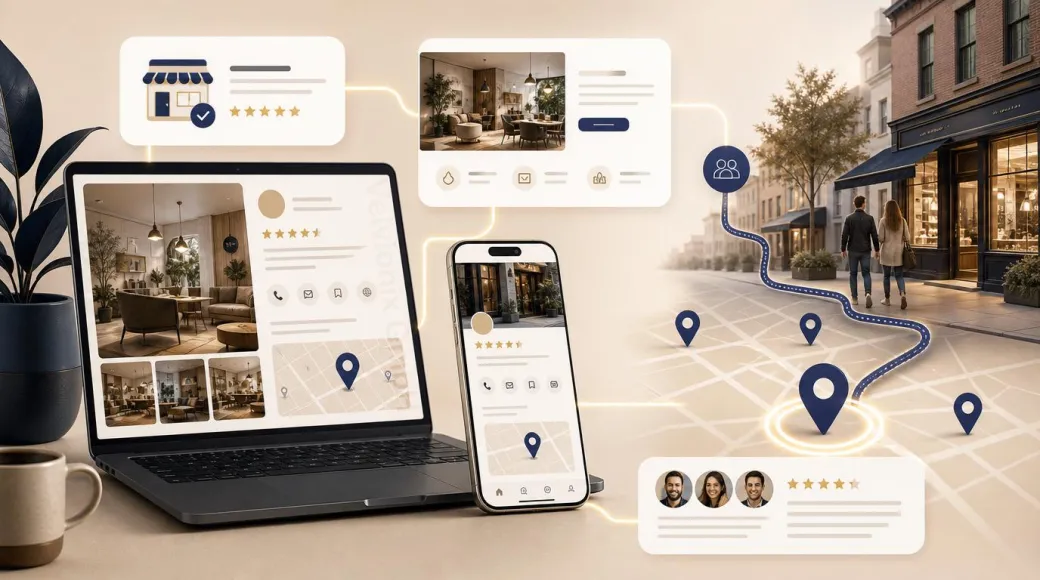
Local visibility that brings inquiries connects three things: a correctly maintained Google Business Profile, an understandable website and credible trust signals. If only one of those works, the effect stays limited. A good profile without a clear website creates follow-up questions. A good website without a maintained profile is discovered too rarely. Good reviews without a current contact path lose momentum.
Google describes local results through relevance, distance and prominence, among other factors. You can influence distance only to a limited extent. But you can strengthen relevance and prominence by explaining precisely what you offer, where you work and why people can trust you.
The Google Profile Is the Entry Point, Not the Whole Solution
A complete business profile helps people check basic information quickly: category, services, opening hours, phone number, website, photos, reviews and directions. If this information is missing or contradictory, uncertainty appears. Locally, one small doubt is often enough for someone to move to the next option.
If you have fixed opening hours, they need to be correct. If you work by appointment only, that should be clear. If you serve a defined area, it should be visible. If you offer several services, the most important ones should be named without stuffing the profile with arbitrary terms.
The most common mistake is passivity. The profile is created once and then forgotten. In reality, daily business changes things all the time: holiday hours, new services, different priorities, current photos, new reviews. Anyone who wants to be found locally does not need a huge marketing plan, but a small routine.
The Website Turns Interest Into Trust
The profile answers quick questions. The website answers the more important ones: Is this really right for me? How does the work happen? Which service fits? Does the provider feel serious? Can I get in touch without friction?
For local service providers, the website is therefore not a replacement for the profile, but the decision layer after it. It needs to show immediately which services you offer and which region you are relevant for. General phrases like “individual solutions” help little when a visitor wants to know whether you solve their specific problem.
If you offer several services, separate them clearly. If a service needs explanation, give it its own page with process, audience, common questions and a clear contact path. If your area is limited, name it visibly. This is not an artificial keyword exercise, but orientation for people who decide quickly.
Reviews Work Only in Context
Reviews are especially powerful locally because they reduce risk. Many people check not only stars but also individual experiences and how businesses respond. If reviews are strong but the website looks outdated, there is a break. If the website is professional but little social proof is visible, one part of trust is missing.
Satisfied customers rarely write reviews on their own. That is why you need a simple, respectful process: ask after a successful appointment, make the link easy to access and respond to new reviews. This should be calm, honest and without pressure.
When a critical review appears, the response matters as much as the rating. A factual, helpful reply shows that you take responsibility. Prospects compare exactly these signals before they call or send an inquiry.
How Visibility Becomes Fitting Inquiries
More visibility is valuable only when it creates fitting contacts. For that, the next step must be clear. If your customers often call spontaneously, the phone number must be immediately usable on smartphones. If appointments matter, the booking path must be obvious. If the service needs explanation, the contact form should say which details help.
If many unsuitable inquiries come in, the issue is often not visibility itself but too little qualification. Helpful details may be missing: service area, focus, typical customers, process or minimum scope. If everything stays open, you get more questions, but not necessarily better conversations.
Three decisions help: If your offer is local and quickly bookable, prioritize call or appointment. If it needs explanation, prioritize a clear service page. If trust is the biggest lever, show real photos, examples, reviews and transparent company information.
Example: A hair salon with few new appointments
Imagine a hair salon that has loyal regular customers but receives hardly any new appointments through the website. The profile exists, but opening hours, services and photos are no longer current. The website uses general copy, and prices, services and the appointment path are hard to find.
A useful revision would bring the profile and website together: current opening hours, a clear service overview, real photos, a visible appointment path and short notes on who each service is for.
The Real Effort: Small Monthly Care Instead of Annual Panic
Local visibility is not a one-time project. It works better as a small routine. Once a month, check profile, opening hours, phone number, website links, current services and new reviews. When offers change, update the website. When wrong inquiries repeat, sharpen copy and contact questions.
That sounds unspectacular, and that is exactly the point. Local visibility rarely fails because of a secret SEO technique. It fails because of outdated data, unclear services, missing trust and a contact path that becomes too difficult at the decisive moment.
What Sabotages Local Visibility
Common Questions About Local Visibility
What does local visibility specifically mean?
People in your region find you, understand your service immediately and can contact you without friction.
Is a Google Business Profile enough?
Rarely. The profile creates attention, but the website often answers the questions that decide whether someone inquires.
What role do reviews play?
They reduce uncertainty. Stars matter, but so do review content, recency and professional responses.
Do I need to run ads for this?
Not necessarily. Ads can amplify visibility, but without a clean profile, clear website and trust, they lose impact quickly.
What is the most common reason for unsuitable inquiries?
Too little qualification: unclear services, no visible service area, missing process or a contact form without guidance.
Does this work without a storefront?
Yes, if it is clear where you work, how appointments or inquiries happen and which service is offered.
Improve local visibility in a structured way
If you want the business profile, website and local search queries reviewed together, the Organic Visibility page shows how Velvionix approaches that foundation.
Sources
Notice: The respective providers or operators are solely responsible for the content of external links.
- [1] Google Business Profile Help : "Tips to improve your local ranking on Google"
https://support.google.com/business/answer/7091 - [2] Google Business Profile Help : "Guidelines for representing your business on Google"
https://support.google.com/business/answer/3038177 - [3] Google Search Central : "SEO Starter Guide"
https://developers.google.com/search/docs/fundamentals/seo-starter-guide - [4] Google Search Central : "Creating helpful, reliable, people-first content"
https://developers.google.com/search/docs/fundamentals/creating-helpful-content - [5] Nielsen Norman Group : "Trustworthiness in Web Design: 4 Credibility Factors"
https://www.nngroup.com/articles/trustworthy-design/ - [6] Nielsen Norman Group : "About Us Information on Corporate Websites"
https://www.nngroup.com/articles/about-us-information-on-websites - [7] BrightLocal : "Local Consumer Review Survey 2025"
https://www.brightlocal.com/research/local-consumer-review-survey-2025/
Comments
No comments yet.
Be the first to comment!
Write a comment
To write a comment, please enable the comment function in your privacy settings.
Write a comment