Multilingual Websites: Build Trust and Make Contact Easier
German and English can lower language barriers before an enquiry. A clear foundation and suitable extensions create an affordable start.
Published: · Updated:
 © Velvionix
 Key Takeaways
When Customers Decide in Two Languages
A second language can create a concrete business advantage. An English-speaking prospect understands your service without relying on someone else to translate it, while a German contact can forward the link internally. Both find the same clear contact option. This does more than improve the first impression. It shortens the path from a recommendation to a relevant enquiry.
For a small business, this does not have to become an oversized web project. Beyond the professional website foundation, additional languages, a protected enquiry form with automatic confirmation and subtle interface feedback can be added to suit the project. Multilingual reach becomes an attainable upgrade when communication and contact need to work together.
The right choice still depends on your business. If your customers almost exclusively use German and phone or email are enough, the compact website scope can be a sensible fit. If customers move between German and English or a structured form enquiry matters, we extend the foundation with those building blocks.
Business Value Comes Before Technology
Multilingual content is valuable when it removes a real barrier from the decision process. A customer does not need to ask whether collaboration in English is possible. A team lead can share your services directly with international colleagues. A prospect can use the form in the language that lets them explain their needs precisely.
If you already receive English-language enquiries, a second language responds to existing demand rather than adding decoration. If you want to serve German and international customers deliberately, the full path to the enquiry should work in both languages, not just the homepage. If neither situation applies, a strong single-language website remains a fair and often better decision.
Both versions also need to represent the same business. Pricing, scope, examples and contact routes should not drift apart unnoticed. The English copy does not need to mirror every German sentence. It needs to communicate the same positioning naturally and completely.
How the Idea Becomes a Working Website
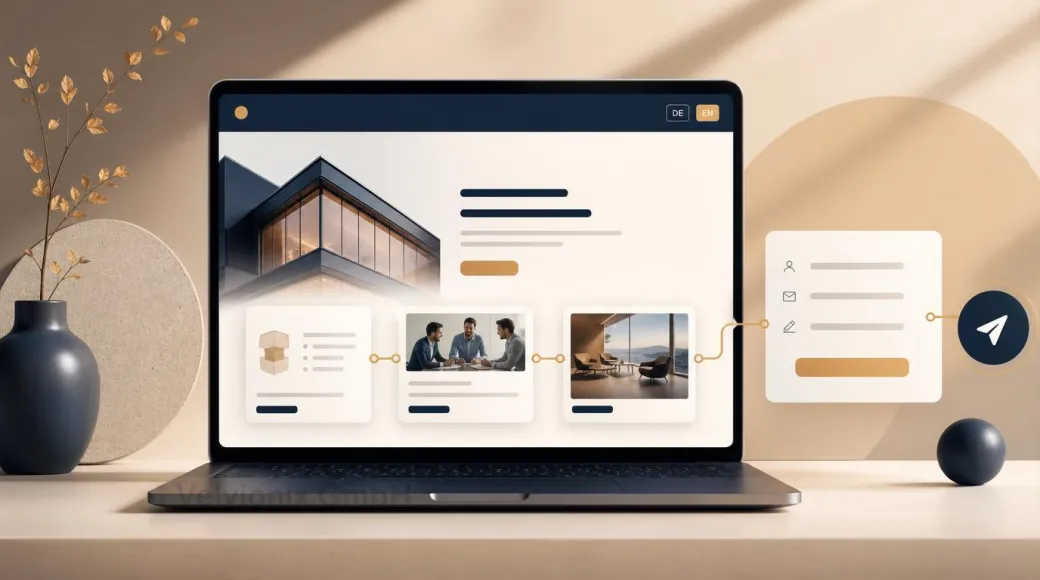
A professional bilingual website needs more than translated paragraphs. Navigation, buttons, form guidance, error messages and automatic confirmations all need to work in the selected language. The language switcher should be visible on every page and lead to the matching page in the other version.
This is where we connect reach and contact. The website can start from the website foundation with a homepage and up to four compact subpages. Where needed, it adds further language versions and an enquiry form that processes submissions securely and forwards them by email. An automatic confirmation tells the sender, in the language they used, that the enquiry arrived. Subtle micro-animations provide guidance without distracting from the content.
The scope stays deliberately compact. A blog, additional pages, more languages, extensive media areas or individual functions are planned separately. This lets you launch with a complete business foundation without funding every possible extension at once.
Example: A Consultant Serving German and International Teams
Imagine a self-employed consultant who works mainly with German companies. In some projects, English-speaking specialists are also at the table. Previously, her German contact had to summarise the offer before colleagues could decide whether a call made sense.
With German and English service pages, both groups can review the same link. The enquiry form asks for the same essential details in both languages. This does not automatically make every enquiry a good fit, but the first exchange starts with shared understanding instead of an extra explanation loop.
Clear Language Journeys Build Trust
Each language version receives its own URL. Specific pages can then be shared, linked and understood clearly by search engines. The versions reference each other so their relationship remains unambiguous.
A visible language switcher lets visitors choose. Rigid automatic redirects can make the wrong assumption because location, browser settings and actual language preference do not always match. If a German page has no English equivalent, the switch should not quietly send the visitor to an unrelated page.
Editorial quality matters as much as technical mapping. Terminology, tone and calls to action need to sound right in each language. Natural English builds more confidence than a formally correct but visibly literal translation.
Synchronized Care Follows the Value
A bilingual website remains convincing only when the offer, pricing and contact details stay current in both versions. Ongoing support therefore covers more than technical operations. Small content updates are also carried across both language versions in sync.
Care and hosting start at EUR 29 per month, with a 12-month minimum term and annual billing in advance, and are aligned with the technical and editorial development of the website. It includes hosting and ongoing operations, protection measures and monitoring, multiple secured project states and small content updates - kept in sync across languages when multilingual content is part of the project. Support billing is described on the pricing page. Larger websites, additional content or individual extensions can require a different care scope, which is clarified in advance.
Business customers only · Prices plus VAT where applicable.
The need for ongoing maintenance does not negate the business value. Ongoing maintenance protects the value already created. Businesses that change services, prices or references frequently should account for synchronised updates. Businesses with stable content benefit from the same reliable website with less ongoing coordination.
What Weakens a Bilingual Website
Common Questions About Multilingual Websites
Do I even need English if I'm based in Germany?
An English version makes sense when customers, teams or co-decision-makers need English information. If your business remains clearly German-speaking, a stronger German website can be the better investment.
What does a bilingual website cost at Velvionix?
Beyond the website foundation, additional languages, a protected enquiry form with automatic confirmation and subtle micro-animations can be added to suit the project.
Can the enquiry form be used in both languages?
Yes. Labels, guidance, error messages and the automatic confirmation are implemented for the relevant language version.
Is an English homepage enough?
Usually not if services, pricing or contact return to German immediately afterwards. The decision journey should remain understandable in both languages.
How do search engines find the right language version?
Separate URLs, an unambiguous page language and reciprocal language references support correct mapping. The language switcher leads to the matching counterpart.
How do German and English stay current?
Ongoing support keeps small content updates synchronised across both versions. The offer and contact details therefore remain aligned.
What does ongoing care cost?
Care and hosting start at EUR 29 per month, with a 12-month minimum term and annual billing in advance, and are aligned with project scope. Larger scopes are assessed individually in advance.
Explore the Right Bilingual Starting Point
The website pricing & options page explains the professional foundation, ongoing support and available ways to expand. See website creation for how that foundation becomes a clear web presence for your business.
Sources
Notice: The respective providers or operators are solely responsible for the content of external links.
- [1] Google : "Managing multi-regional and multilingual sites"
https://developers.google.com/search/docs/specialty/international/managing-multi-regional-sites - [2] Google : "Localized versions of your pages"
https://developers.google.com/search/docs/specialty/international/localized-versions - [3]
- [4] W3C : "When to use language negotiation"
https://www.w3.org/International/questions/qa-when-lang-neg.en.html - [5] Juan Miguel Alcántara-Pilar et al. : "Language as a cultural vessel in online servicescapes: Its impact on consumers' perceived risk, attitudes, and behavioural intentions"
https://doi.org/10.1002/cb.1656 - [6] European Commission : "User language preferences online"
https://op.europa.eu/en/publication-detail/-/publication/7e48e109-2809-4616-b0e5-666a4884af11
Comments
No comments yet.
Be the first to comment!
Write a comment
To write a comment, please enable the comment function in your privacy settings.
Write a comment