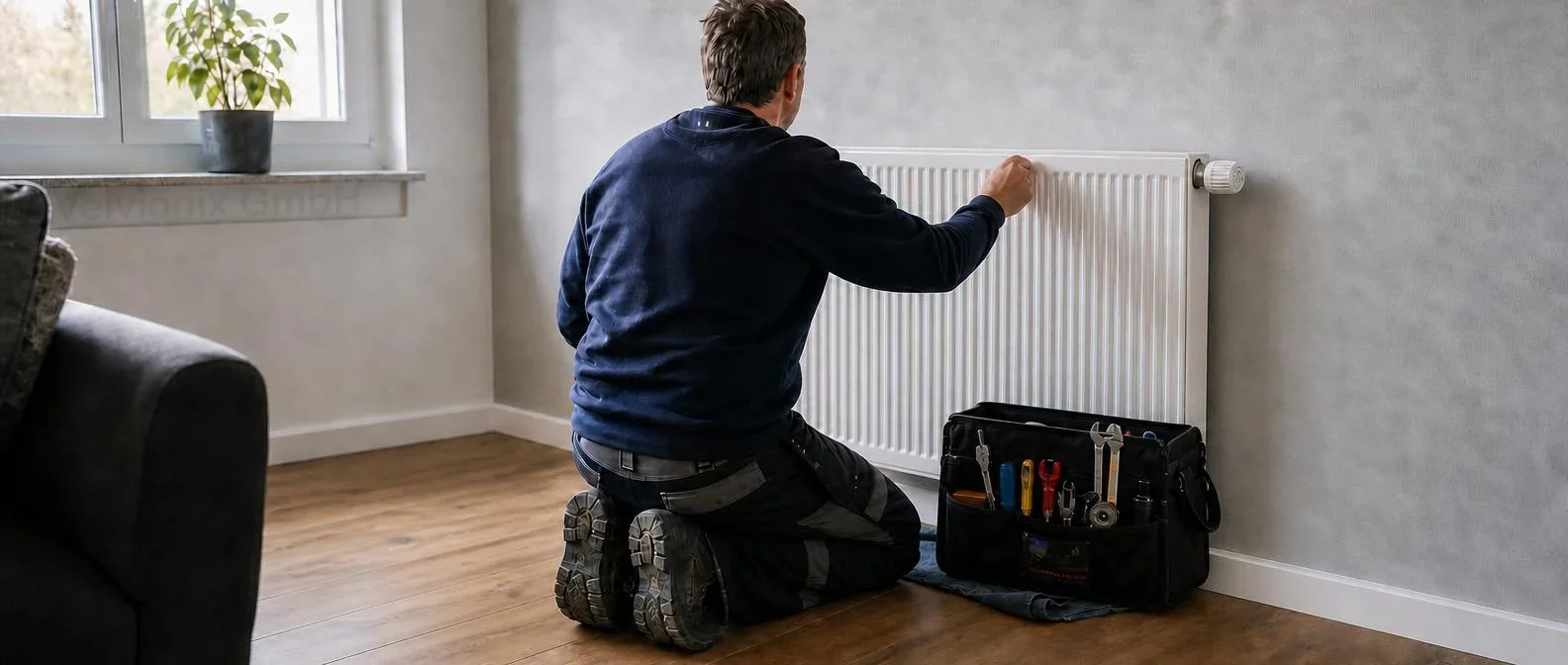
Professional website for plumbing, heating and HVAC businesses
Plumbing and heating is one of the most sought-after trades of the next ten years: energy transition, GEG 2024, heat-pump ramp-up, sanitation upgrades in existing housing stock. Demand is there - but customers compare thoroughly before commissioning a business. We build websites for plumbing and heating businesses that make your master craftsman visible, structure the technology portfolio cleanly, translate the GEG situation and clearly communicate your emergency service - without forcing you as a master craftsman to run an IT project on the side.
Important notice Legal, tax and industry-specific information concerns Germany and expressly identified EU law. It is provided for general orientation and does not replace individual advice. Last review of the cited legal situation: April 2026 Show the full notice
Unless stated otherwise, the legal, tax or industry-specific information on this page reflects the law applicable in Germany and German official and professional practice. Directly applicable EU law and references to other jurisdictions are identified separately. The information was researched with due diligence using sources available as of the stated review date. For binding guidance on your specific project, please contact the competent chamber or a qualified specialist, such as a lawyer or tax adviser. The current statutes and official regulations always prevail.
Why plumbing and heating businesses need websites despite full order books
Plumbing and heating businesses are currently fully booked, and have been for years. That is the trap: those who are fully booked rarely invest in marketing - and thereby lose narrative control over their own trade. Customers google "heat pump cost", "gas heating alternative", "underfloor heating retrofit" and land on guide portals, comparison platforms and lead-generation sites that make their money selling your enquiries on commission. Without your own visible website, you hand the field to exactly these intermediaries.
On top of that, jobs are getting more complex. A heat pump does not simply replace a gas boiler - it requires building envelope, radiator sizing, electrical supply and heat-load calculation. Customers who sense this complexity look for a specialist firm that can advise them, not an installer with a price tag. A website that shows confirmed qualifications and typical projects can help demanding prospective customers assess the business without guaranteeing particular jobs or margins.
What belongs on a modern plumbing and heating website
The homepage communicates in three seconds: what you do (plumbing, heating, HVAC, bathroom renovation, heat pumps), where you work (service area as a map or list), and who you are (master photo, founding year, team size). Generic photos of shiny fittings do not build trust - real photos of your team in work clothes on site do. The same applies to reference projects: two real photos from the basement of an oil-to-heat-pump conversion have more impact than ten manufacturer renderings.
The service pages are structured by technology, not by keyword. "We install heat pumps" is too vague - better to have dedicated pages for "air-water heat pumps" (common, affordable, usually suitable for existing buildings), "brine-water heat pumps" (more complex, more expensive, higher efficiency), "hybrid heating" (pragmatic middle ground), "pellet boilers" (log-wood niche, GEG-oriented), "solar thermal" (hot-water support). Per page: typical use cases, typical costs (price range, not fixed price), funding options with a link to the advisory page, advantages and realistic limits, sample projects.
A GEG information area can be useful depending on the business actual service and advisory scope. The Building Energy Act unsettles many homeowners - "I heard I have to replace my heating in 2028?", "does this apply to my old building?", "what about municipal heat planning?". We build a clear overview: when does what apply, which deadlines are valid in your federal state, which heating fits which building. This area can address questions such as "GEG heating old building" or "heat pump old building possible" and support people who are currently informing themselves - at the start of the purchase decision.
An emergency section is high-margin but only useful with clear rules: availability times, service area, call-out fee, hourly rate during and outside business hours. A lean form can help with planned callback requests as an optional extension; photos are exchanged directly only after first contact. Important: advertise emergency service only if you actually deliver it - customers who call at 2am and reach voicemail leave 1-star reviews that damage your reputation more than two emergency jobs per month earn.
A funding section on BAFA (BEG EM) and KfW (loan 458, subsidy 458) explains the principle and links to official sources without promising specific percentages. An optional, data-sparing enquiry path can support an initial technical consultation (building type, year of construction, current heating, square metres) - without promising a funding amount, approval or consultation outcome.
Legal framework: Crafts Code, master obligation, GEG and advertising law
The plumbing and heating trade is listed in Annex A No. 24 of the German Crafts Code (HwO) as a regulated trade. Only businesses with a registered master craftsman (or equivalent qualification under § 7 HwO) may offer plumbing and heating services independently. On the website this means: master certificate or at least master title and registration in the Trade Roll must be visible - typically in a team or about-us section. We optionally add this to the imprint as well, because chambers of crafts occasionally check the imprint in disputes.
The Building Energy Act (GEG) does not ban gas boilers - it regulates minimum requirements for energy efficiency and the share of renewable energies. Heating topics on the website should therefore not be phrased as blanket deadlines for individual cases. A factual description of the service plus a note that concrete deadlines depend on the building, installation and specialist consultation is the better fit.
Competition law (UWG) remains relevant in plumbing and heating. Advertising with "lowest prices in the region" without proof, unverifiable efficiency figures or blanket amortisation promises is risky. We prepare such claims cautiously, as possibilities rather than guarantees, and refer concrete savings to the individual building assessment.
GDPR topics mainly concern contact and emergency forms (data minimisation, clear purpose binding, no tracking in the form process) and photos of employees and reference projects (written consent required, additional anonymisation for private-customer references).
Local visibility and reviews
The service area depends on location, availability, service and project scale. The website names the places or regions genuinely covered and keeps contact details consistent. Suitable structured data can support technical classification. An external business profile remains independently managed and is linked only where requested.
Understandable reviews can provide orientation. A direct review link or privacy-conscious widget can be added as a separately commissioned integration; no particular review rate or customer acquisition is guaranteed.
Separate Customer Paths for Heating, Plumbing and Climate Work
A heating modernisation often begins with the building condition, existing system and long-term planning. Bathroom work focuses more on use, layout, materials and coordination between trades. Maintenance and faults need clear details about system type, age, symptoms and availability. The website should present these paths separately so prospective customers do not have to infer the right contact route from a general service list.
Funding, energy use and statutory requirements are explained only in general terms. Suitability, savings, deadlines and funding amounts depend on the building, the current programme and qualified professional advice. Detail pages that require frequent updates are commissioned separately. Starter can provide reliable orientation, links to responsible bodies and the next step offered by the business.
References can show the starting situation, selected solution, interfaces and work completed. A plant room, an accessibility-oriented bathroom or commercial climate installation does not require a finished photo archive. Approved images can be added later, while technical key facts and a factual project flow already provide useful depth. Forms, maintenance requests and appointment links remain optional extensions.
Frequently asked questions about plumbing and heating websites
Do I need to display my master craftsman qualification and trade-roll registration on the website?
Yes. In Germany, plumbing and heating (Installateur- und Heizungsbauer-Handwerk, Annex A No. 24 of the German Crafts Code HwO) is a regulated trade that requires a registered master craftsman (Meister). Registration in the Trade Roll (Handwerksrolle) and the master title of the responsible operator belong prominently on the website - not out of vanity, but because customers and insurers look for it. We integrate the master photo, name, chamber registration number and membership in trade associations (ZVSHK, local guild) visibly. This is also unproblematic under competition law: advertising as a "Fachbetrieb" without trade-roll registration can be legally challenged.
How do I communicate the Building Energy Act (GEG) and the new heating rules without confusing customers?
Since 2024 the GEG 2024 ("Heating Act") applies: new buildings must use heating systems with at least 65 percent renewable energy; for existing buildings transitional rules apply depending on municipal heat plans. Customers rarely understand the regulation in detail. Depending on the agreed scope, a dedicated information area or separately commissioned subpage can cover typical situations (heating over 20 years old, defective gas boiler, new build, change of ownership) and provide general orientation on possible next steps. The concrete technical and legal assessment remains subject to the building review and qualified specialist advice. Instead of "this is complicated" the message becomes a clear invitation to an advisory call - that builds trust and generates qualified enquiries.
Should I distinguish heat pumps, pellet boilers and solar thermal systems on the website?
Yes, the clearer the technology distinction, the better the quality of enquiries. We structure the website by system type (air-water heat pump, brine-water heat pump, hybrid heating, pellet boiler, solar thermal, photovoltaics with heating element, condensing boiler) and show per technology: typical use cases, advantages, typical cost ranges, funding options (BAFA, KfW) and sample projects from your business. This attracts customers who already know what they want - and filters out the "just looking for cheap heating" enquiries that cost time without order prospects.
How do I handle emergency requests (heating failure, water damage)?
Emergency service is high-margin in plumbing and heating but organisationally tricky. We plan a clear emergency section with a prominent phone number (not just email), availability hours, a price range for call-out and hourly rate, and an honest boundary "we offer emergency service in the XY region". An emergency form stays limited to contact details, location, damage type and callback request; photos or detailed documents are exchanged directly by email or through your existing dispatch system after first contact. We recommend advertising emergency service only if you can reliably deliver it - otherwise false expectations and avoidable reputation risks can arise.
How do I show BAFA and KfW funding options without running into legal problems?
Funding rules change often (guidelines, rates, programmes), and incorrect information can lead to damage claims. We recommend a funding page that explains the principle (BEG EM, KfW 458, iSFP bonus) and links to the official BAFA and KfW pages - but does not promise specific percentages or EUR amounts. Instead: "Funding options are explained in general terms; binding amounts, applications and an individual renovation roadmap remain with qualified energy-efficiency experts and the responsible funding bodies." This is general orientation and specific statements should receive specialist review.
What does a website for a plumbing and heating business cost?
A compact, professionally developed website starts from EUR 599. Additional pages, languages, forms, media and functionality can be added to match the required scope. Managed hosting and ongoing support start from EUR 59 per month. Our Website pricing & options page explains the professional foundation and the available ways to expand it.
More dedicated services in this industry
Looking for a website for a related profession? These dedicated pages might also be relevant:
Website for Painters & Decorators
Present services, project photos, facade work, interior painting, colour advice, service area and enquiry paths clearly - for painting businesses that want to convince visually and be found more easily in their region.
View painter website →Website for Electricians & Electrical Contractors
Present electrical installation, smart home, maintenance, emergency service notes, qualifications, service area and contact paths clearly - for electrical contractors with planned and urgent enquiries.
View electrician website →Website for Carpenters & Joiners
Present furniture making, interior fit-out, kitchens, doors, windows, materials, project gallery and enquiry paths in a high-quality way - for businesses whose work relies strongly on photos and references.
View carpenter website →Website for Roofers
Present roof renovation, re-roofing, flat roofs, insulation, storm damage, references, service area and contact paths clearly - for roofing companies with a regional focus.
View roofer website →Website for Locksmiths & Door Opening Services
Show door opening, cylinder replacement, burglary protection, service area, availability and transparent contact paths clearly - for reputable providers who must build trust before the call.
View locksmith website →Website for Drain Cleaning & Plumbing Emergency Services
Structure emergency help, drain cleaning, sewer inspection, maintenance, service area, availability and enquiry paths clearly - for businesses with urgent local search demand.
View drain cleaning website →Website for Electrical Emergency & Small Installation Services
Present emergency service, cooker connections, sockets, light fittings, small jobs, service area and appointment paths clearly - for planned and urgent electrical enquiries.
View electrical emergency website →Website for Landscape Gardening
Show garden design, paving, terraces, maintenance, seasonal services, project photos and enquiry paths clearly - for businesses with a strong visual portfolio.
View landscape gardening website →Website for Car Repair Shops
Present inspection, repair, tyre service, MOT, brand expertise, workshop photos, appointment path and location clearly - for workshops with regional customers.
View car repair website →More industries
What We Have Already Delivered
Our reference project shows a custom website with a multilingual structure, animated landing page, interactive map and automatic contact form - built from scratch instead of a website-builder template.
View reference project →Full details about the professional Starter foundation, pricing and flexible extensions are available on our “Website pricing & options” page.
View pricing & options →Ready for your new plumbing and heating website?
In a free initial consultation we discuss your service focus, technology portfolio and competitive situation. You receive a concrete offer that positions your business as a specialist firm - not as an interchangeable installer. Existing images, finished copy or a logo are welcome but are not prerequisites for starting the project.
Discuss your plumbing & heating website