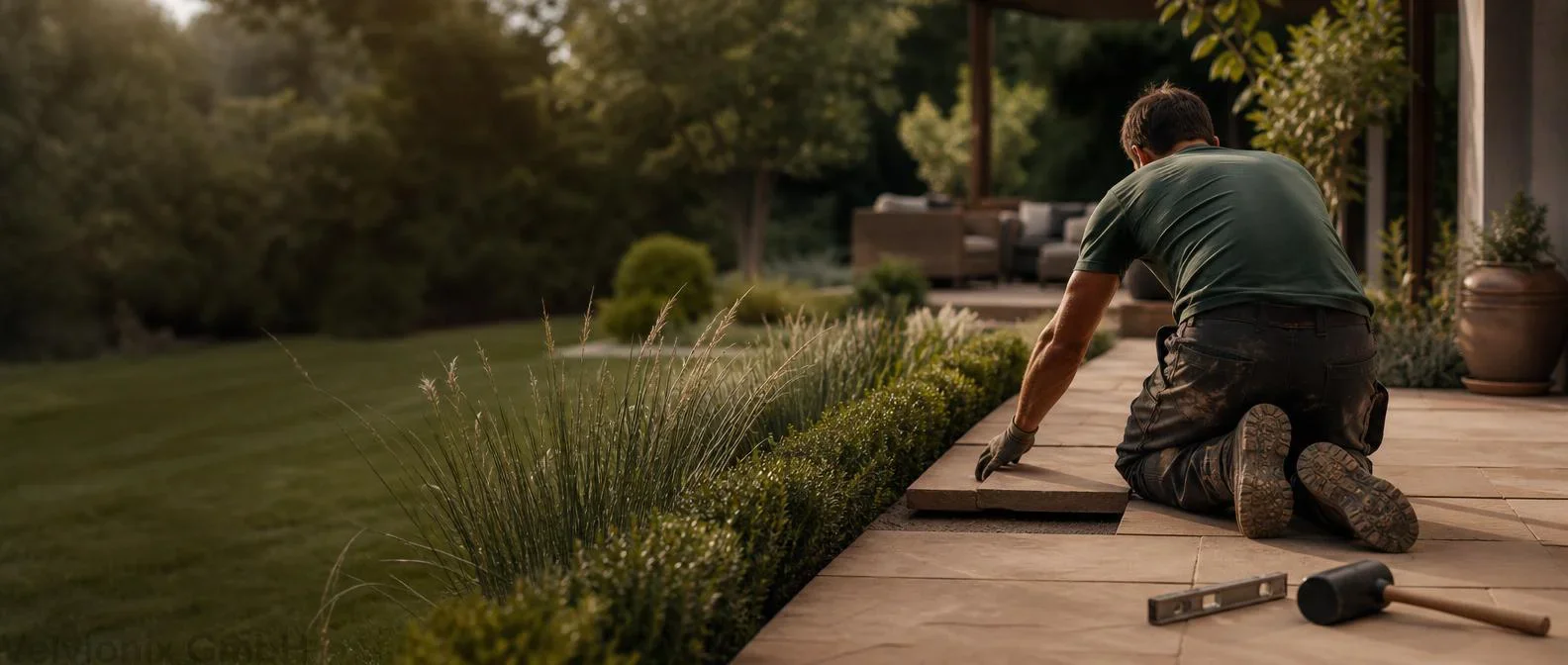
Professional website for landscape gardening companies

Landscape gardening in Germany is a grown, regionally anchored craft with a dense rulebook: HwO Annex A No. 13 (master requirement), FLL guidelines on roof greening, tree inspection and plant quality, DIN 18915-18920 for soil, planting and lawn work, VOB/C ATV DIN 18320 for landscape construction work, and - as a hard seasonal boundary - § 39 BNatSchG with the pruning restriction on hedges and woody plants from 1 March to 30 September. The clientele is changing at the same time: private owners compare businesses on Google Business Profile and Instagram, property managers award maintenance framework contracts after online pre-screening, and municipalities put maintenance and renovation services to tender on e-procurement platforms and via pre-qualification at the ULV (Auftragsberatungs- und Liefer-Verzeichnis). We build websites for landscape-gardening businesses that make your master qualification and your specialist certifications (e.g. SKT-A/B for tree care, Fachagrarwirt Baumpflege, FLL expert assessors for roof greening) visible, structure your craft variety cleanly, communicate the seasonal rhythm between the peak season and winter service transparently and present reference projects effectively - without forcing your business to carry an IT project on the side.

HwO Annex A No. 13 FLL guidelines DIN 18915-18920 § 39 BNatSchG GDPR-aligned

Why landscape-gardening businesses need a high-quality website despite full order books

Landscape gardening in Germany has been structurally fully booked for years. The energy transition and climate adaptation push demand towards unsealing, rainwater management, roof greening and heat-resilient urban gardens; the ageing owner generation drives demand for low-maintenance gardens; urban greening is requested by municipalities and housing companies more strongly than ten years ago. According to the BGL (Bundesverband Garten-, Landschafts- und Sportplatzbau) there are around 20,000 landscape-gardening businesses in Germany with roughly 132,000 employees - a grown craft with strong regional roots and overall robust order books. Exactly this full utilisation is the strategic trap: those who are fully booked rarely invest in their website - and hand the field to lead exchanges such as MyHammer, Aroundhome and regional comparison portals. Enquiries are then bought in on commission rather than won through your own presence.

The projects themselves are becoming both more complex and more valuable. A modern garden installation is rarely just "plants and lawn": it often includes earthworks and level planning, paving in unbound or bound construction, retention and infiltration swales per DWA-A 138, irrigation planning, turf laying per DIN 18917, plant selection aligned with FLL plant-quality recommendations and - frequently - roof greening per the FLL roof-greening guideline, with reference to summer cooling and rainwater retention. Customers who sense this complexity are not looking for a flat-rate gardener but for a technically articulate partner. A website that makes your master qualification, your specialisations (tree care with SKT certification, FLL expert assessors, Fachagrarwirt:in Baumpflege), your typical project sizes and your understanding of FLL and DIN visible wins exactly these higher-value projects.

The third dimension is B2B visibility. Property managers and home-owner-association administrators award grounds-maintenance framework contracts that run for years and that are decisive for utilisation in autumn and winter. Housing companies and municipalities put maintenance, renovation and new-installation services out to tender via e-procurement platforms, often combined with pre-qualification at the ULV (Auftragsberatungs- und Liefer-Verzeichnis) or the Verein für die Präqualifikation von Bauunternehmen. These B2B decision-makers research businesses online before awarding contracts and check: is the Trade Roll entry visible? Are there reference objects of comparable size (sqm, maintenance scope, contract duration)? Are there references to execution per VOB/C ATV DIN 18320 (landscape construction work), DIN 18916 (planting work), DIN 18919 (development and maintenance care) or DIN 18035 (sports grounds, if relevant)? Those who show this information in a clearly structured way qualify as a serious partner even before the first phone call - and land on the shortlist.

In addition there is a strategic opportunity that many businesses underestimate: recruitment. The landscape-gardening sector is looking for journeymen, machine operators, tree-care specialists and trainees in a tight labour market. A careers page with real photos of the team, concrete statements on working hours, the machine fleet, further training (SKT-A/B, Fachagrarwirt:in, FLL expert-assessor courses) and winter work stands out significantly from standard job ads and has in many regions become the most important channel for recruitment. The same website that convinces private customers and property managers thus also handles a second job in parallel - with measurable effect.

What belongs on a modern website for landscape-gardening businesses

The homepage answers within ten seconds: what is your main focus (new private garden installation, maintenance for property managers, tree-care specialist, roof-greening business, paving and paths focus), which service area you cover (map or clear list of districts - landscape gardening is local), who is the responsible master craftsman (real photo, no stock material), and in which seasonal phase the business currently is (spring waiting list active, maintenance rounds fully booked, winter-service contracts being acquired for the next season). The seasonal indication is a specific feature of this trade: it sets enquirer expectations, avoids fruitless enquiries during overbooked windows and at the same time signals technical honesty.

Service pages are organised by craft focus, not by keyword. New garden installation: own page with the design process (on-site visit, concept sketch, planting plan, execution), typical project sizes (front garden, terraced-house garden, garden 500 sqm and upwards), the plant quality used per FLL and a note on the boundary to landscape architecture (on larger projects we collaborate with landscape architects rather than claim the protected title). Terrace and path construction: paving types (unbound construction per TL Pflaster-StB, bound construction, natural stone, concrete stone), typical build-ups, drainage connections and edge restraints. Pond and water features: swimming pond, natural pool, ornamental pond, stream - with a frank note on maintenance effort and winter service. Irrigation: drip irrigation, pop-up sprinklers, controller integration; optional reference to rainwater dependence and rainwater-tank or cistern connection. Turf and lawn restoration: scarifying, aeration, overseeding, turf laying per DIN 18917 with irrigation intervals. Roof greening: extensive (sedum, moss, typical build-up 6-15 cm) and intensive (perennials, lawn, usable gardens) per the FLL roof-greening guideline, with references to retention, summer cooling and maintenance cycles. Tree care: retention pruning, crown care, deadwood removal, tree felling, stump removal - with a mention of the SKT-A/B certification of the climbing crew and, where applicable, a Fachagrarwirt:in Baumpflege in the team. Grounds maintenance for property managers: framework contracts with a fixed rotation plan, typical service elements (mowing, hedge cutting within the permitted window, leaf clearance, path care) and clear billing models. Winter service: clearance and gritting obligations under the municipal street-cleaning bylaws, response times, contract models - an important capacity building block from November to February.

The reference gallery is the strongest trust format in landscape gardening and at the same time the most sensitive from a data-protection perspective. We structure it by craft (new installation, paving, pond/water, roof greening, tree care) and add a short fact box per project: project type, size (sqm), particularities (slope, difficult access, heritage context), construction duration and location as region instead of street address. Before/after pairs are particularly effective; we ensure clean frames without house numbers and name plates, keep neighbouring properties out of focus and obtain written image consents from the clients. Drone shots are aligned with § 21h LuftVO; in tight developments, telescopic-pole cameras or shots from your own property are often the cleaner solution. Faces on site photos are pixelated or covered by a signed model release.

Enquiry handling is the most critical building block. We build a structured enquiry form with clearly defined fields: area size (rough figure), project type (new installation, renovation, maintenance framework contract, tree care, roof greening, other), approximate budget band (to save caller and business time), preferred timeframe (immediate, next season, flexible), site accessibility (detached house, terraced house, rear-yard access, heavy lorry versus only wheelbarrow) and contact details. Deliberately not on the website: an automatic garden cost calculator that publishes prices. The cost balance of a landscape-gardening project depends substantially on soil (cohesive/sandy/rocky), excavation and fill balance, machine access and haulage logistics - a serious calculation only succeeds after an on-site visit. A web calculator implies fixed prices that in the real project are almost always under- or overshot, producing either disappointed customers or calculation imbalances. Instead we offer on-site appointment booking via widget: Calendly, Setmore or Cal.com embedded via iFrame or button link - the contract runs directly between you and the provider, we only embed the widget surface.

A blog or guide area with subject-matter topics (which hedge for which location, the right planting time, what to watch for in roof-greening maintenance, winter-service obligations for owners and property managers, the city X tree-protection bylaws - what is allowed in my garden) builds lasting visibility in Google search and positions your business as a subject-matter source. Factual tone, concrete references to FLL guidelines, DIN standards, § 39 BNatSchG and municipal bylaws - no salvation promises, no comparative advertising against other businesses. That is exactly the tone that builds trust and stays clean under competition law (UWG).

Legal framework: HwO Annex A No. 13, FLL, DIN, § 39 BNatSchG, PflSchG, GDPR and BFSG

The trade "Garten- und Landschaftsbauer" is listed in Annex A No. 13 of the German Crafts Code (HwO) and is therefore regulated - independent operation requires a registered master craftsman or an equivalent qualification under § 7 HwO. In parallel, the training occupation "Gärtner:in, specialism Garten- und Landschaftsbau" exists under the Vocational Training Act (BBiG), with the regional Chamber of Agriculture as the responsible body - an important distinction that must be reflected cleanly in the wording on the website. The title "Landschaftsarchitekt:in" (landscape architect) is protected under the state Architects Acts (§ 1 ArchLG) and reserved for members of the regional chamber of architects; a pure landscape-gardening business does not claim this title. We phrase service and team pages so that your qualifications are named correctly and no chamber-protected titles are grazed.

The FLL (Forschungsgesellschaft Landschaftsentwicklung Landschaftsbau) publishes the specialist rulebook that documents the recognised state of the art in landscape gardening - in particular the roof-greening guideline, the tree-inspection guideline (with relevance for the traffic-safety duties of property owners) and the recommendations on plant quality and tree planting. We refer on the website factually to this rulebook without guaranteeing guideline compliance for every single contract individually - that would be an unnecessary liability shift. In parallel we structure service descriptions aligned with the relevant DIN standards: DIN 18915 (soil works), DIN 18916 (planting works), DIN 18917 (lawn and seeding works), DIN 18918 (bioengineering securing works), DIN 18919 (development and maintenance care of vegetated surfaces), DIN 18920 (protection of trees and plant stock during construction); for sports grounds DIN 18035. For public contracts VOB/C ATV DIN 18320 (landscape construction works) is decisive, complemented by VOB/B as the contractual framework - these references belong on the B2B page and in the reference presentation so that awarding authorities recognise them at a glance.

§ 39 (5) no. 2 of the Federal Nature Conservation Act (BNatSchG) is the hardest seasonal boundary in private-garden work: between 1 March and 30 September, cutting back or coppicing hedges, live fences, bushes and woody plants as well as heavy pruning is prohibited; only gentle shaping and maintenance cuts remain permitted. This is complemented by the general species protection under § 44 BNatSchG (access prohibitions, in particular for nests and reproduction sites) and by municipal tree-protection bylaws, which in many cities (including Munich, Hamburg, Cologne, Berlin, Frankfurt, Stuttgart) have their own versions with permit obligations above certain trunk circumferences, replanting quotas and protection periods. We translate this reality into a seasonal service calendar on the website - transparently communicated, with the clear note that heavier pruning and tree removal take place outside the protection window (1 October - 28/29 February). This is purely general orientation on the regulatory environment; individual-case assessment of a specific measure is handled by the lower nature-conservation authority or by a specialised lawyer, not by your website.

The Plant Protection Act (PflSchG) requires, in § 9, a Sachkundenachweis for the commercial application, advice and sale of plant-protection products and a refresher course every three years. The certificates of the staff members involved belong, as a brief mention, in the team area or on the service page for maintenance; for non-crop land (paving, paths, driveways) additional restrictions under § 12 PflSchG apply, and certain products also fall under the EU Biocidal Products Regulation (EU) No 528/2012. We phrase this part of the website deliberately as a general framing - integrated plant protection first, product choice depending on the case, binding individual information via the federal state plant-protection service - and avoid individual-case clearances.

GDPR topics in landscape gardening concentrate on three fields: contact forms (data minimisation, clear purpose binding, no tracking in the form process - we do not store message content on our systems), reference photos (written consent of the clients, § 22 KUG where neighbouring properties are in the frame, § 21h LuftVO for drone shots) and embedded third-party widgets (Google Reviews, ProvenExpert, appointment booking). Art. 9 GDPR (special categories of personal data - health, social security, biometrics) is typically not relevant in landscape gardening and has no place on such a website; we deliberately build the site so that such data is not collected in the first place. The German Accessibility Strengthening Act (BFSG), in force since 28 June 2025, covers landscape-gardening websites as soon as they offer consumer-relevant digital services - classically via online enquiry and appointment-booking forms. We therefore build across the board to WCAG 2.1 AA: contrast above 4.5:1, keyboard operability, screen-reader compatibility, clear focus visibility. This is a quality and SEO gain at the same time.

Seasonality, local visibility, Google Business Profile and reviews

Landscape gardening has a pronounced seasonal curve: the peak season runs from March to November, with peaks in spring (new installations, planting, turf) and in autumn (woody-plant planting, lawn restoration, heavier pruning outside the BNatSchG protection window); the quiet phase from December to February is traditionally winter-service and planning time. This seasonality must be visible on the website - not hidden in the small print but as genuine orientation. We recommend a seasonal service calendar, a waiting-list mechanic for spring slots (enquiry today, on-site visit in January or February, execution from March) and a clear winter-service section that is actively promoted in the autumn months. This turns the apparent weakness "winter is dead" into a plannable second season and smooths utilisation across the year.

Landscape-gardening jobs are almost always local - private customers and property managers rarely look beyond a 30-50 km radius. Google Business Profile (GBP) with the primary category "Landscape Designer" / "Landscaping Contractor" (and matching secondary categories such as "Gardener", "Tree Service" and "Snow Removal Service", or "Paving Contractor" where the specialisation warrants it) is the single most important local lever. We set up the profile or hand maintenance over to your office so that seasonal special hours (company holidays in the quiet phase, peak weeks in spring, winter-service standby) can be entered directly. Consistent NAP data (name, address, phone) across the website, GBP, the BGL business directory, the chamber-of-crafts directory and regional craft portals is the enduring lever for local search results; blanket premium entries in low-value directories we do not recommend.

Reviews are particularly central in this industry. A garden installation is a four- to five-figure undertaking, a larger renovation a five- to six-figure one - owners research accordingly thoroughly before commissioning. Authentic Google and ProvenExpert reviews with understandable project descriptions have a measurable impact on the quality of enquiries. We recommend a lightweight review collection after acceptance (QR code on the final invoice or on the acceptance confirmation, short direct link in the closing email) and embed a review widget in a GDPR-aligned way on the website. Instagram is in parallel a strong channel - before/after pairs, time-lapse videos of a paving site or documentation of a roof greening perform organically very well; the website remains the conversion point to which social links, not the other way around.

Structured data per Schema.org (LocalBusiness with a landscape-gardening-specific framing, openingHoursSpecification with seasonal specifics, areaServed for the service area, Service entries per craft focus, FAQPage for the guide sections, ImageObject for the reference gallery with clean alt texts) signals the business category to Google and improves placement in local search. Typical search queries we take into account in the site architecture include "landscape gardening + city", "garden design + city", "paving + city", "tree care + city", "turf + city", "roof greening + city" and "winter service + city". The B2B path (property managers, housing companies, municipalities) is served through a clearly recognisable B2B section: maintenance framework models, reference objects with sqm figures, VOB/C reference, winter-service standby and contacts with direct dial-in - qualities that private customers do not actively search for but that B2B decision-makers want to see at a glance.

Frequently asked questions about websites for landscape-gardening businesses

Do I need to show the master craftsman (Meister) qualification and the Trade Roll registration on the website - and where is the boundary to the landscape architect (Landschaftsarchitekt)?

The German trade "Garten- und Landschaftsbauer" (landscape gardener as a craft business) is listed in Annex A No. 13 of the Crafts Code (HwO) and is therefore a regulated trade - independent operation requires a registered master craftsman or an equivalent qualification under § 7 HwO. On the website this means: the master title of the responsible operator, the responsible chamber of crafts (Handwerkskammer) and the business registration number belong visibly into the team or about-us area as well as into the imprint; the Trade Roll entry (Handwerksrolle) and any guild membership in the BGL structure (Bundesverband Garten-, Landschafts- und Sportplatzbau, with regional FGL associations) are additional trust anchors. The clean terminological distinction matters: "Gärtner:in, specialism Garten- und Landschaftsbau" is the training occupation under the Vocational Training Act (BBiG) with the Chamber of Agriculture as the responsible body; "Landschaftsgärtner" is used colloquially as a synonym; "Garten- und Landschaftsbau-Betrieb" refers to the craft business (possibly with a master); and "Landschaftsarchitekt:in" (landscape architect) is, under § 1 of the state Architects Acts (ArchLG), a protected professional title reserved for members of the respective regional chamber of architects - a pure landscape-gardening business does not use this title, not even in derived forms (the label "Gartenarchitekt" is treated inconsistently by chamber case law and tends to be read narrowly). We phrase team and service pages so that your master qualification and certifications are presented correctly without accidentally grazing titles protected by chamber law - clean both under competition law and under the chamber framework.

How do I communicate the statutory pruning restrictions for hedges and woody plants under § 39 BNatSchG transparently on the website?

Under § 39 (5) no. 2 of the German Federal Nature Conservation Act (BNatSchG), cutting back or coppicing hedges, live fences, bushes and other woody plants - and heavy pruning generally - is prohibited between 1 March and 30 September; only gentle shaping and maintenance cuts aimed at removing recent growth or keeping trees healthy remain permitted during that period. This is a hard seasonal boundary that is systematically underestimated - and it belongs openly on the website, because otherwise private customers request services between April and September that you, on nature-conservation grounds, must not perform. We build a seasonal service calendar that shows per craft what you do when: planting and new layout (all year, peaks in spring and autumn), paving and paths (all year, frost-dependent), hedge shaping cuts (gentle, also admissible during the protection window), heavier pruning and tree felling (between 1 October and end of February), tree work and felling (outside the protection window, additionally checked against species protection under § 44 BNatSchG and against the municipal tree-protection bylaws - Munich, Hamburg, Cologne, Berlin, Frankfurt, Stuttgart and many mid-sized cities have their own versions with permit requirements and replanting obligations). Communicating the seasonal legal frame cleanly is doubly valuable: it protects your business from trouble with the lower nature-conservation authorities and at the same time positions you as a knowledgeable partner who knows the rulebook - a strong differentiator against vaguely presented competitors.

How do I present the plant-protection expertise certificate (Sachkundenachweis, § 9 PflSchG) on the website as a trust signal without slipping into individual legal advice?

The German Plant Protection Act (PflSchG) requires, in § 9, a certificate of expertise (Sachkundenachweis) for the commercial application, advice and sale of plant-protection products; certificate holders must additionally attend a recognised refresher course every three years. For a landscape-gardening business, the Sachkundenachweis certificates of the staff members involved in plant protection are a quality signal that belongs visibly on the website - typically as a brief note in the team area ("Sachkundenachweis under § 9 PflSchG, last refresher: [year]") or as a quality bullet on the service page for plant-protection and lawn/meadow maintenance. We keep the wording factual: the certificate describes your ability to select, apply and document products properly - it is not a clearance certificate for every product in every crop, and we phrase the page so that no individual-case approvals are implied. In addition we frame the context: integrated plant protection takes priority, the EU Biocidal Products Regulation (EU) No 528/2012 applies to certain products (e.g. in moss or algae removal), and for applications on non-crop land (paving, paths, driveways) there are additional permit obligations and restrictions under § 12 PflSchG. This framing signals technical competence; binding individual-case advice on whether a specific product is admissible is obtained from the federal state plant-protection service, not from us and not from the website text.

What can I say as a landscape-gardening business about funding programmes (BAFA unsealing, KfW rainwater, municipal "green instead of grey" programmes) on the website?

General information on how these funding programmes work may be presented factually - typical examples are BAFA and federal/state programmes for unsealing sealed surfaces (turning paved areas back into lawn or vegetated surfaces), KfW grants and loans for rainwater infiltration and retention measures, state and municipal programmes for roof and façade greening, and urban "green instead of grey" budgets for front gardens and courtyards. Three things explicitly do not belong on the website: a) concrete funding promises for a specific case ("you will receive X percent") - funding rates change, they depend on municipal rules, and only the respective funding body can make a binding statement. b) A positioning as "your funding advisor" or "energy-efficiency expert" - the formal energy consulting in the sense of the federal Energy Efficiency Expert register (EEE register of dena/BAFA) may only be provided by listed experts, and implying such a status intentionally or inadvertently is open to challenge under competition law. c) Individual legal advice on the eligibility of a specific building project - that would be a regulated legal service under § 2 of the German Legal Services Act (RDG). The line we draw on the website instead: we name the funding categories and logic in general terms, we execute the landscape-gardening measure (unsealing, soakaway, roof greening structured to FLL guidelines) properly, and for binding funding information we refer to the responsible body (BAFA, KfW, city administration, federal state) or to an energy-efficiency expert from the EEE register. We phrase this division of labour positively and visibly - it protects your business and positions it as a serious partner.

How should I handle before/after photos of projects on the website and social media - especially when neighbouring properties appear in the frame?

Before/after photos are the strongest content format in landscape gardening - a freshly paved terrace next to a before shot of the same frame sells without a single word. Under data-protection and image-rights law there are three fields we consider in every publication on the website and on social media: 1) Consent of the client: publication of the project (address or district, photos, project description) only with written consent, ideally embedded as a clause in the order form (purpose, right of withdrawal, duration). We deliberately recommend rough locations instead of street addresses ("front garden of a terraced house, Stuttgart area"). 2) § 22 of the German Art Copyright Act (KUG) in neighbourhood situations: when the neighbouring house, the neighbouring garden, garden furniture, children's toys or persons on the neighbouring property are recognisable in the shot, there is regularly a personal reference and an image right protected under § 22 KUG attached to the depicted surroundings. Rule of thumb: either crop the frame so that the neighbouring property is not identifiable (wide shot, portrait orientation onto your own property, background blur), or obtain additional consent from the neighbours. 3) Drone shots: § 21h of the German Air Traffic Regulation prohibits overflight of third-party properties without consent (with exceptions); in terraced-house or tight-garden situations, telescopic-pole cameras or shots from the eaves of your own building are often the cleaner solution. Faces on site photos are pixelated or covered by a signed model release. This care is what separates a serious business from an "Insta-first" reference page - and it protects you from neighbourhood disputes that can still surface years after publication.

What does a website for a landscape-gardening business cost?

Starter from 599 EUR net one-off plus maintenance from 59 EUR net per month for a website with service pages by craft focus (garden design and new installations, terrace and path construction / paving, pond and irrigation systems, turf and lawn restoration, roof greening, tree care, grounds maintenance and winter service), master and team profile, seasonal service calendar, before/after reference gallery and a blog. Optional add-ons (separate order): Contact form with automatic acknowledgement, a structured enquiry form (area size, project type, budget band, desired timeframe; without file uploads - enquirers send photos directly by email to your mailbox), embedding of an on-site appointment booking widget (Calendly, Setmore, Cal.com) via iFrame or button link, embedding of a review widget (Google Reviews, ProvenExpert) and a funding information block with links to BAFA/KfW and your municipality. We do not build a garden online shop, an automatic garden cost calculator with published prices, a project-management portal with payment processing or a customer portal with property or land-registry documents - serious cost estimation for landscape-gardening projects depends on soil, site access, excavation volumes and material flow and only succeeds after an on-site visit. Quotation, measurement and site-diary management belong in your industry software (pro-bau|s, GaLaBau-Office, ST-HandwerkPlus, HERO, Pebe, PlanRadar), invoicing in a system like sevDesk, lexoffice or DATEV. Details in the 30-minute initial consultation.

More dedicated services in this industry

Looking for a website for a related profession? These dedicated pages might also be relevant:

More relevant industries

What We Have Already Delivered

For a therapy practice, we developed a trilingual website with an animated landing page, interactive map and automatic contact form - features that are not achievable with a website builder or template.

View reference project →

Full details on scope, packages and prices can be found on our Web Development services page.

View packages and prices →

Ready for a website that fits your landscape-gardening business?

In the free 30-minute initial consultation we clarify your business structure (single master with two or three crews, mid-sized GaLaBau combining new installation and maintenance, specialist for tree care or roof greening), your service area, your customer segments (private, property managers, municipalities, commercial), your seasonal capacity and your goal for the website (win new-installation projects, grow maintenance framework contracts, position a tree-care niche, attract skilled staff). You receive a concrete offer for a website that makes your master title and specialist certifications visible, puts your reference projects in an effective frame and generates qualified enquiries - rather than pressing you into an interchangeable landscape-gardening template.

Book initial consultation (30 minutes)