SEO for Small Businesses: How to Improve a Website for Google
SEO for small businesses: how clear pages, useful content, internal links and technical foundations help Google understand a website.
Published: · Updated:
 © Velvionix
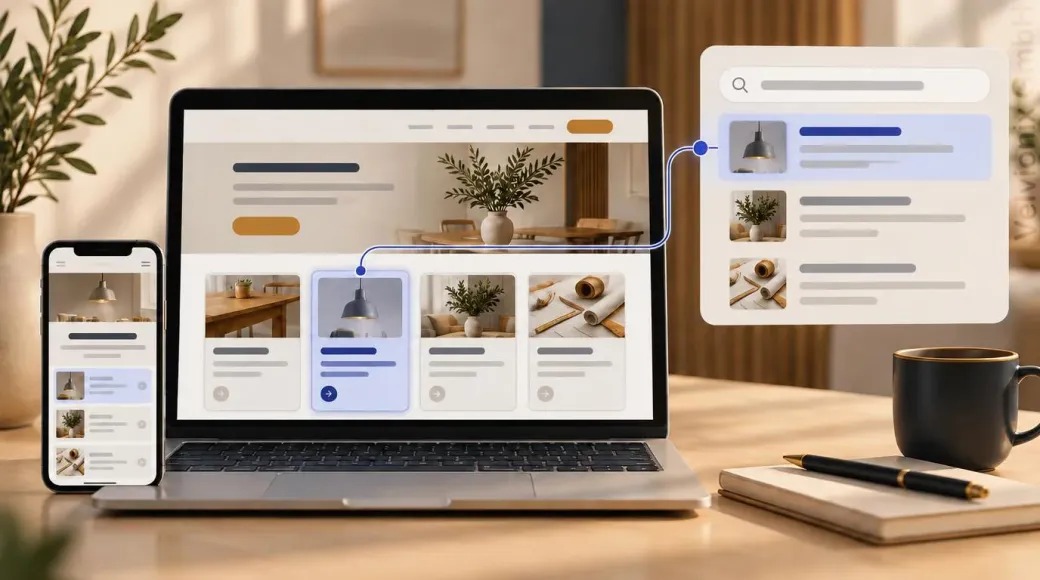
 Many small businesses start SEO with a keyword list or a blog calendar. Both can help later. First, Google needs pages that answer a real question clearly: what the business offers, for whom, and where the next step is.
SEO for small businesses is therefore mostly structure work. Not keyword density, not a fixed publishing schedule and not one article per week simply for the sake of publishing.
Key takeaways
SEO for small businesses does not start with as many keywords as possible
Search intent and the real offer come first. The words belong where they describe the service precisely: in the title, the heading and the first visible paragraph.
Keyword density is not a quality measure. A page that repeats the same word artificially does not become clearer. People-first here means a visitor should be able to tell within a few seconds whether the page matches their question.
Synonyms may appear naturally. They do not replace a separate page when two services answer really different questions.
Important services need clear pages of their own
If a business offers several different services, they should not all be pressed into one homepage. Each important search intent needs a recognizable page with its own title, its own H1 and its own next step.
This is not an invitation to create a separate thin page for every search query. A service page needs substance: who the service is for, what is included, what is not, and how contact or booking works. Pages that only repeat a keyword help neither users nor Google.
Title, main heading and content must answer the same question
The title in the search results, the H1 on the page and the visible text should set the same expectation. Promising one thing in search and another on the page creates exits.
Google describes this in Search Essentials as helpful, reliable, people-first content. For small businesses that means in practice: no separate “SEO language” and no separate customer language. One clear wording is enough for both.
Content comes from real questions, not from a duty to blog
A company blog can be useful when real search questions, audience and offer fit together: comparisons, preparation, decision help or recurring uncertainties.
A company blog is still not a required SEO strategy. An article created solely to keep a fixed publishing schedule creates work without a clear purpose. Less text that really answers an existing question and leads to the matching service page is better.
Internal links connect information to the next useful step
A helpful article should lead to the matching service. A service page can link to a more detailed explanation if it helps visitors make a decision. The anchor text describes the destination instead of only saying “here” or “more”.
Link spam does not help. Five relevant internal links are more useful than twenty repetitions of the same keyword.
Technical foundations must allow crawling and indexing
Google has to find, open and understand important pages. That includes crawlable links, indexable core pages, a readable URL structure and a site that works on a phone.
A sitemap helps discovery. It does not guarantee indexing or ranking. Robots directives, noindex settings or content that is inaccessible to search engines can keep an otherwise well-structured page out of search results.
If you first want a technical reading of an existing public page, the free website check is the right diagnostic path. It does not replace an SEO strategy, but it can often show whether crawling, mobile usability and basic quality factors are in order.
Search Console shows what Google actually assigns to the site
Impressions, search queries and indexing reports replace guesswork with actual data. They show which searches Google already connects to the page and where pages are missing or excluded.
That is not a fast ranking guarantee. It is the basis for deciding from real data instead of from a keyword export.
Local visibility is a separate building block
Anyone who works locally needs more than general service pages. Profile, address, service area and local search intent belong together. The details are in the article Local visibility that brings inquiries. This article only makes the point that local businesses should not treat local visibility as a side note.
What small businesses should prioritise first
A sensible order of priorities is more useful than a rigid formula for success:
First clarify the offer and page structure. Then check technical reachability and indexability. After that, make the important service pages understandable. Add internal links. Add helpful content for real questions. Measure in Search Console and refine.
Anyone who reverses this order and blogs first often creates texts without a destination page.
What SEO cannot promise
SEO cannot promise a number-one position, a fixed timeframe for reaching a particular ranking or guaranteed inquiries. Search demand and competition differ by place, industry and offer.
SEO also does not replace an unclear offer. If the website itself does not say what the business does, Google cannot reliably fill that in.
More pages and more keywords are not yet an SEO strategy
Frequently asked questions
What matters most in SEO for small businesses?
Clear pages for real search intent that match the actual offer. Keywords help only when they describe those pages precisely.
Does a small business have to blog regularly?
No. A blog is useful when real questions, audience and offer fit together. A fixed rhythm alone is not a strategy.
How long does SEO take?
There is no fixed timeframe within which SEO must produce results. Crawling, competition and existing pages all play a part. A sensible approach is to establish the foundations and key pages first and then measure the results.
Can I improve my website for Google myself?
Much of it can be handled in-house: clear service pages, understandable titles, internal links and the use of Search Console. What is often missing is priority, not another tool.
What is the difference between indexing and ranking?
Indexing means Google has included the page. Ranking describes the position at which the page appears for a particular search query. Without indexing there is no ranking.
Do I need local SEO?
If a business operates locally, yes, as a separate building block. General service pages do not replace that.
What can Velvionix take on for organic visibility?
Velvionix can review and further develop the page structure, search topics and existing content together. The organic visibility service page shows the frame. Rankings or inquiries are not guaranteed.
Develop organic visibility in a structured way
If page structure, search topics and existing content should be reviewed together, organic visibility shows how Velvionix frames and develops that work. If the website is not found at all yet, the diagnosis stays in Google cannot find your website.
Sources
Notice: The respective providers or operators are solely responsible for the content of external links.
- [1] Google Search Central : "Google Search Essentials"
https://developers.google.com/search/docs/essentials - [2] Google Search Central : "SEO Starter Guide"
https://developers.google.com/search/docs/fundamentals/seo-starter-guide - [3] Google Search Central : "Creating Helpful, Reliable, People-First Content"
https://developers.google.com/search/docs/fundamentals/creating-helpful-content - [4] Google Search Central : "Google Crawling and Indexing"
https://developers.google.com/search/docs/crawling-indexing - [5] Google Search Central : "SEO Link Best Practices for Google"
https://developers.google.com/search/docs/crawling-indexing/links-crawlable - [6] Google Search Central : "What Is a Sitemap"
https://developers.google.com/search/docs/crawling-indexing/sitemaps/overview - [7] Google Search Console Help : "Performance report (Search results)"
https://support.google.com/webmasters/answer/7576553


Comments
No comments yet.
Be the first to comment!
Write a comment
To write a comment, please enable the comment function in your privacy settings.
Write a comment