One-Pager or Clear Structure: What Fits Your Offer?
When a one-pager is enough and why a compact multi-page website helps visitors compare services, builds trust and supports future growth.
Published: · Updated:
 © Velvionix
 Key Takeaways
Business customers only · Prices plus VAT where applicable.
A Small Website Does Not Have to Be a One-Pager
People considering a one-pager usually want an affordable, understandable start without unnecessary complexity. That is a sensible goal. For a temporary campaign, a single event or exactly one easy-to-explain offer, one long page can be enough.
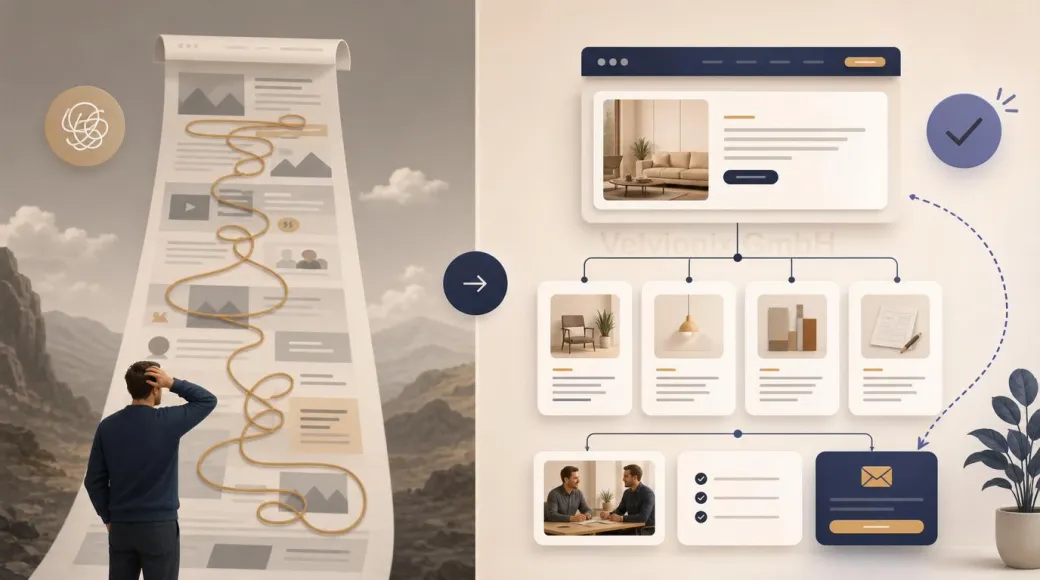
For a lasting business presence, a compact multi-page foundation is often more valuable. Services, trust, contact and one important specialist topic can each have a clear place without turning the result into a large or confusing website.
That separation helps visitors when they want to compare options or gain confidence before making an inquiry. It also saves rebuilding work later: new services or content can be added in the right place instead of rearranging an ever-longer page flow. Velvionix plans this structure from the beginning so the website can launch compactly and grow with purpose.
When a One-Pager Is Still the Fair Choice
If your offer is obvious, your audience is narrow and the desired action needs little explanation, a one-pager can be enough. This is especially true for a time-limited campaign or a temporary page when a full business presence is not yet needed. It should then remain genuinely lean: a clear opening message, few sections, suitable trust signals and an easy contact path.
If you have several services, they should not compete inside one long section. Each important service needs enough room for audience, outcome, process and typical questions. A shared overview can still remain short, while separate subpages are reserved for genuinely different decisions.
If pricing, process or trust need explanation, clear structure is usually the better investment. The goal is not to produce more text, but to divide the decision into useful stages: understand, compare, assess trust and then get in touch.
Whether you should maintain that structure yourself in a site builder or commission a professional build depends on time, responsibility and the level of independence you need. Website Builder or Have a Website Built helps with that earlier decision.
Navigation Is Not Decoration, It Is Orientation
Many lean websites hide navigation because it looks more minimalist. That can feel elegant, but it removes an important anchor. Navigation says: these topics matter, and this is where to find them. It helps not only with clicking, but also with quickly judging what the offer includes.
Clear labels matter. “Solutions” or “More” may sound modern, but they say little. For small business websites, plain terms are often stronger: services, examples, process, about, contact. Concrete words help visitors reach the topic that matters to them faster.
Search engines benefit from clear paths too. Google explains that internal links and navigation help it understand relationships between pages. A structured website can connect important content more deliberately: from the homepage to a service, from the service to a relevant example, from the example to contact. A one-pager has little of that separation because everything shares the same address.
What the Compact Website Structure Provides
A good structure does not have to be large. The described scope provides a homepage plus up to four compact subpages. The homepage gives quick orientation. A services overview shows how you help. A trust or about page adds context. A contact page brings phone, email and, if requested, a messenger link together so visitors can reach your business. The remaining subpage can explain the most important offer or a frequent customer concern in more depth. The imprint and privacy policy are included separately.
The key is the job of each page. The homepage should not explain every detail. It should orient visitors and open the most important paths. A service page should not tell your whole company story. It should clarify who the service is for, which problem it solves and what the next step looks like.
This is practical for ongoing care too. If an offer changes, the relevant page is updated. If a new example becomes available, it is added where it supports trust. If another service becomes important later, the structure can be extended deliberately. With a long one-pager, more additions are likely to require rebalancing the entire page flow.
Practical Example: From a Compact Launch to Focused Growth
Imagine a coach with two clearly different offers. On a one-pager, positioning, methods, both offers, pricing, process, trust signals and contact would all need to fit into one sequence. Someone who already knows which offer interests them would still have to navigate the shared page flow.
With a compact multi-page foundation, the website stays small: the homepage provides context, an overview compares the two offers and one subpage for each answers the relevant questions. Contact and legal pages remain easy to reach. If a third offer is added later, the existing order can be extended without redesigning the whole website as one new long sequence.
Why Good Planning Matters More Than Page Count
Website effort rarely comes from page count alone. It comes from unclear audiences, mixed services, missing priorities and content added later without a defined place. A one-pager can save work for a temporary purpose. If it becomes a lasting business website with several topics, however, the planning saved at the outset may turn into restructuring work later.
A small multi-page website needs a little more order upfront, and Velvionix handles that structure as part of the website project. Pages can then be added, shortened or improved without rebuilding the entire reading flow. This foundation supports visitors, search engines and ongoing care.
So the best decision is not “one-pager or many pages”. The better question is: how many separate decisions does a visitor need to make before they inquire? If there is only one simple decision, a one-pager can fit. If several questions need answers, every important question deserves a clear place.
What Makes a Website Harder to Navigate and Can Cost Inquiries
Common Questions About One-Pagers and Page Structure
When does a one-pager make sense?
When you temporarily need to present one easy-to-understand offer, event or campaign and visitors need only a few facts before getting in touch.
Why do long one-pagers often lose orientation?
Because important answers disappear inside the page flow. Visitors have to scroll, compare and remember where they saw something.
Does multi-page automatically mean bigger and more expensive?
No. Website development begins at EUR 499 and includes a homepage plus up to four compact subpages. What matters is that each page has a clear job.
How many pages does a small website need to start?
A homepage plus up to four compact subpages for services, trust, contact and one important specialist topic is often enough. The imprint and privacy policy are included separately.
Are anchor links in a one-pager not enough?
They can help, but they do not replace clean structure. Especially on small screens, clear pages and clear menu labels are often more robust.
What is the main SEO benefit of clear structure?
Important topics get their own linkable places. That makes content easier to understand for visitors and search engines.
Start Compactly and Grow with Purpose
The website creation from scratch page explains how Velvionix structures and designs a small multi-page presence with future additions in mind. On the website pricing page, you can compare website development, ongoing care and possible extensions transparently.
Sources
Notice: The respective providers or operators are solely responsible for the content of external links.
- [1] Nielsen Norman Group : "Information Scent: How Users Decide Where to Go Next"
https://www.nngroup.com/articles/information-scent/ - [2] Nielsen Norman Group : "Information Foraging: A Theory of How People Navigate on the Web"
https://www.nngroup.com/articles/information-foraging/ - [3] Nielsen Norman Group : "Scrolling and Attention"
https://www.nngroup.com/articles/scrolling-and-attention/ - [4] Nielsen Norman Group : "In-Page Links for Content Navigation"
https://www.nngroup.com/articles/in-page-links-content-navigation/ - [5] Nielsen Norman Group : "Trustworthiness in Web Design: 4 Credibility Factors"
https://www.nngroup.com/articles/trustworthy-design/ - [6] Google Search Central : "SEO Starter Guide"
https://developers.google.com/search/docs/fundamentals/seo-starter-guide - [7] Google Search Central : "SEO Link Best Practices for Google"
https://developers.google.com/search/docs/crawling-indexing/links-crawlable - [8] W3C Web Accessibility Initiative : "Make the Site Hierarchy Easy to Understand and Navigate"
https://www.w3.org/WAI/WCAG2/supplemental/patterns/o2p02-site-structure/

Comments
No comments yet.
Be the first to comment!
Write a comment
To write a comment, please enable the comment function in your privacy settings.
Write a comment