Around the Clock: How an AI Assistant Secures Your Inquiries
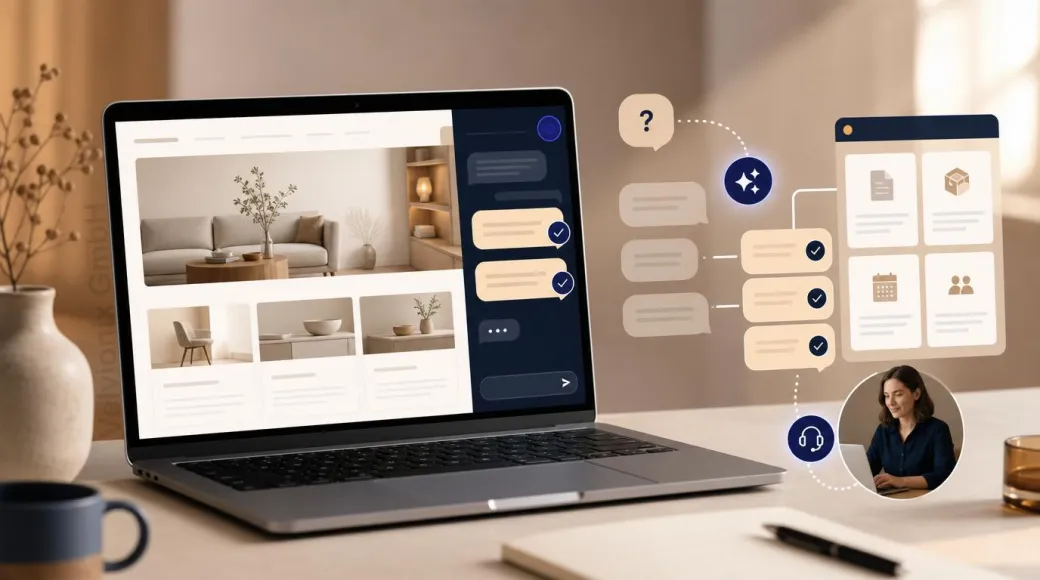
A well-scoped AI assistant answers frequent questions, reduces daily workload, and guides visitors faster to the right inquiry.
Published: · Updated:
 © Velvionix
 Key Takeaways
Why Inquiries Get Lost Despite a Good Website
Many prospects do not arrive during office hours. They search in the evening, on weekends, or between appointments. They have a specific question, do not find an answer quickly enough, and move on. This happens quietly: no complaint, no form drop-off in your inbox, just one less inquiry.
At the same time, recurring questions take a lot of attention in daily operations. What does it roughly cost? How does the first appointment work? Which documents are needed? How quickly will someone reply? If these questions are constantly answered by phone or email, time is missing for the actual work.
An AI assistant can help exactly there. But only if it is not added as a gimmick. It is part of the first impression. If it answers unclearly, evasively, or incorrectly, the whole website feels less professional.
When an AI Assistant Really Makes Sense
A website assistant makes sense when it has a clearly limited task. It should answer frequent questions, make relevant content easier to find, and guide visitors to the next useful step: contact form, appointment page, callback request, or short prequalification.
The starting point is therefore not “we need AI,” but “which questions currently block inquiries?” If the website itself is unclear, an assistant will not solve the core problem. It will only repeat the confusion in chat form. Only when services, process, contact path, and boundaries are clearly written can the assistant reliably build on them.
It is especially useful for businesses with recurring questions, appointment logic, services that need explanation, or many inquiries outside opening hours. It is less useful if there is barely any website traffic or the contact path itself does not work. In that case, the website should be improved first.
Less Chat, More Answer
Many visitors do not want a long dialogue. They want an answer. Good AI assistants are therefore direct, brief, and helpful. They do not ask unnecessary follow-up questions, praise every question, or drift into small talk. They answer the question and show what makes sense next.
That also means the assistant needs clear starting points. What can it answer? What is it not for? Which topics should lead directly to contact? If visitors do not understand what the assistant is for, they will ignore it or be disappointed after the first weak answer.
A good assistant is more like a friendly, well-organized receptionist than an all-knowing consultant. It knows the most important information, does not ask for too much, and knows when a human should take over.
Boundaries, Privacy, and Security
An AI assistant processes visitor inputs. These inputs can contain personal data, sometimes even sensitive information. It must therefore be clear which data is processed, what it is used for, how long it is stored, and which content does not belong in the chat.
Data minimization is practical: do not ask for full contact details immediately if simple orientation is enough. Do not request health, financial, or contract details in the chat if those belong in a personal conversation or a more secure form.
Security boundaries matter too. Modern AI systems can be influenced by manipulative inputs. Prompt injection is a known risk in LLM applications. For small business websites, this means: no confidential system information in answers, no uncontrolled actions, no sensitive data sources, and clear rules for what the assistant must not do.
Case Study: Practice with After-Hours Questions
A physiotherapy practice received many inquiries outside opening hours: prescription yes or no, duration, cost range, available appointments, preparation. Previously, these questions waited until the next phone window or led to incomplete contact forms.
The assistant was not used as medical advice, but as an orientation tool. It explained the process, stated which information was needed, pointed to the appointment page, and handed individual questions to the team. The result was less basic phone traffic and more inquiries that already included the important details.
The Real Effort: Knowledge Base and Review
An AI assistant is not “install and forget.” It needs a knowledge base that stays current. When prices, opening hours, services, responsibilities, or processes change, the answers must be updated as well.
It also needs review. Which questions are asked? Where does the assistant answer too long? Where is it uncertain? Which answer causes misunderstandings? Which question should go straight to a human? This review is the difference between a useful assistant and a risky chat window.
Google evaluates helpful content by quality and usefulness, not by whether it was created with AI. The same principle applies to a website assistant: the answers must help people. Automation is not valuable by itself.
What Makes an AI Assistant Worthless
Frequently Asked Questions About AI Assistants
Is an AI assistant the same as a chatbot?
In everyday use, yes. The difference is less in the name than in the quality: clear task, good knowledge base, limited answers, and clean handoff to a human.
When is an AI assistant worth it?
When recurring questions cost time, many visitors arrive outside opening hours, or inquiries are often incomplete.
Which questions should it answer?
Cost range, process, preparation, availability, service boundaries, and the next step to an inquiry or appointment.
What should it not answer?
Anything that requires individual review, sensitive data, or binding commitments. Those questions should be handed to a human.
How do I prevent wrong answers?
With a limited knowledge base, clear rules, tests using real questions, conversation review, and regular updates after changes.
What about privacy?
The assistant should minimize data, transparently explain what is processed, and avoid asking for sensitive details in chat.
Does this make everything impersonal?
Not if it is used well. It answers standard questions so personal contact can happen where it really matters.
Implement AI Assistant the Right Way
If you want to solve this topic properly, we implement it as part of our services in a structured way - not as a loose individual measure. Please use the contact form and select the appropriate options. We will get back to you with a brief assessment of the most sensible approach.
Sources
Notice: The respective providers or operators are solely responsible for the content of external links.
- [1] Nielsen Norman Group : "What Is Your Site's AI Chatbot for? Users Can't Tell"
https://www.nngroup.com/articles/site-ai-chatbot/ - [2] Nielsen Norman Group : "10 Guidelines for Designing Your Site's AI Chatbots"
https://www.nngroup.com/articles/ai-chatbots-design-guidelines/ - [3] Nielsen Norman Group : "Less Chat, More Answer: Site AI Chatbots Need to Get to the Point"
https://www.nngroup.com/articles/less-chat-more-answer/ - [4]
- [5] OWASP Gen AI Security Project : "LLM01:2025 Prompt Injection"
https://genai.owasp.org/llmrisk/llm01-prompt-injection/ - [6] Google Search Central : "Google Search's guidance on using generative AI content on your website"
https://developers.google.com/search/docs/fundamentals/using-gen-ai-content - [7] European Data Protection Board : "Opinion 28/2024 on certain data protection aspects related to AI models"
https://www.edpb.europa.eu/our-work-tools/our-documents/opinion-board-art-64/opinion-282024-certain-data-protection-aspects_en


Comments
No comments yet.
Be the first to comment!
Write a comment
To write a comment, please enable the comment function in your privacy settings.
Write a comment