Planning an Architect Website: Show Projects, Make Enquiries Easier
How architecture firms select projects, explain services, present imagery on mobile and make suitable enquiries easier.
Published:
 © Velvionix
 The Essentials for Architecture Firms
An Architect Website Should Make Selection Easier
When an architecture firm plans a new website, project imagery is often the first consideration. That makes sense because completed work communicates design and experience more directly than general marketing statements. Prospective clients still need to understand more: Does the firm’s experience fit their project? Which services are offered? Who will work with them? Which region does the firm cover? How does the first conversation begin?
Germany’s Federal Chamber of Architects explicitly advises clients to review completed examples on firm websites and compare expertise, services and firm profiles. That gives the website a clear job. It should not merely collect as much material as possible. It should help a prospective client make a more informed decision before the first conversation.
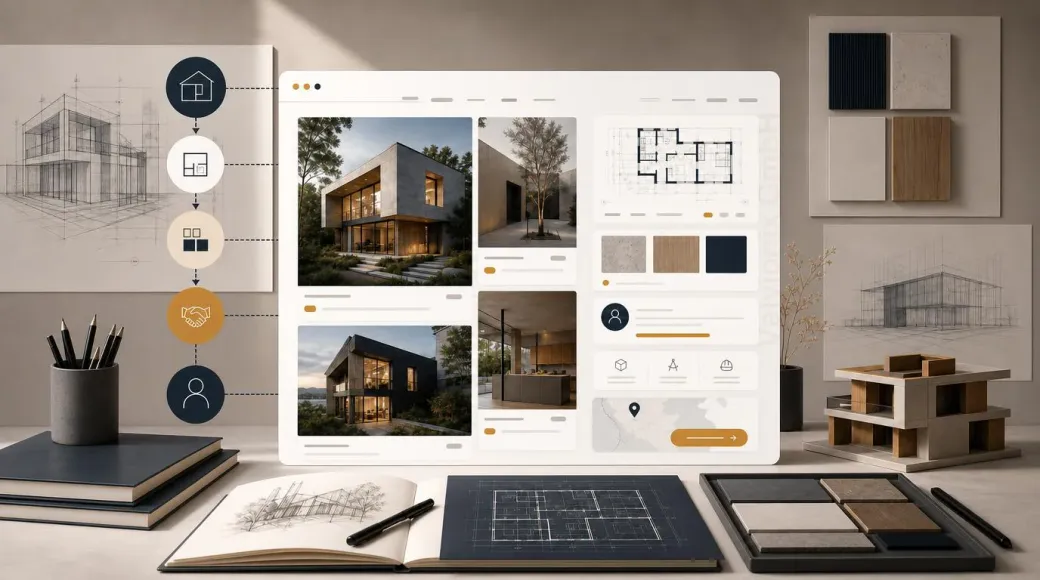
A compact website for architects and architecture firms can therefore begin with selected projects, an understandable service overview, a precise firm profile and a direct contact route. Additional project categories, team profiles or languages can follow when they provide a genuine benefit.
Which Projects Belong in the First Selection?
A complete archive is rarely the best opening. A long sequence of similar projects demands attention without necessarily making the firm’s profile clearer. A curated selection that reflects the work the firm wants to win next is more useful.
If the firm wants to attract more refurbishment work, relevant references should appear early. If different scales matter, the selection might deliberately contrast a residential project, a commercial building and a renovation. If a newly independent architect has only a few completed projects, an honest and well-explained selection is stronger than a portfolio designed to appear artificially large.
Every project needs a reason for being there. An image can communicate atmosphere, but it does not explain the brief on its own. Concise details about project type, location or region, period, the firm’s role and the services provided give visitors useful context. A short paragraph can then explain the challenge and design approach in language a non-specialist can follow. Not every internal detail belongs online. Prospective clients need enough information to judge relevance and working style.
Project Pages Need More Than an Image Gallery
Architecture is visual, but a gallery without context leaves all interpretation to the visitor. A strong project page guides people through the work without reducing the impact of the images. It combines a calm visual opening with a small amount of precise information.
Photography shows the completed result. Sketches, models, floor plans or material studies can add value when they make the idea easier to understand. What matters is a coherent sequence: starting point, design idea, key decision and outcome. This turns a set of polished views into a project story that clients outside the profession can follow.
If only a few strong images are available, a focused page is usually better than a long gallery full of repetition. If plans or diagrams carry important information, they need explanatory copy nearby. If a project is still in progress, the published stage should remain clear so that a visualisation is not confused with a completed building.
Services and Firm Profile Explain the Potential Relationship
Prospective clients do not choose an architect on visual language alone. They want to know whether the firm can support their type of project and what the collaboration might involve. A list of specialist terms often does not answer those questions.
Service pages should explain genuine areas of focus in plain language, such as new build, conversion, refurbishment, interiors, commercial work or selected project stages. Firms do not need to publish the same list. A clear boundary is useful because it reduces unsuitable expectations early and makes relevant enquiries more likely.
The firm profile also has a practical role. It introduces the approach, team, points of contact and regional focus. The Federal Chamber of Architects advises firms to define their core strengths, show the projects that represent them, explain their philosophy concisely and make contacts visible. These details help visitors assess not only the work, but also the potential working relationship.
A Realistic Starting Point for a Small Firm
Imagine a small firm that has worked through referrals for several years. It has strong project photography, but the files sit across different folders. The existing website shows an unstructured gallery, one generic service line and an email address in the footer.
The new version does not prepare every project at once. The firm selects work that represents its current focus. Each reference receives a concise introduction and a clear image sequence. A service page explains the types of projects the firm supports. The profile names its approach, region and points of contact. The contact section briefly states which initial details are useful in an enquiry.
This structure does not make the firm look artificially larger. It makes existing experience easier to understand. More projects can follow later without delaying the first launch unnecessarily.
Project Imagery Must Work on Mobile and Remain Discoverable
Large imagery belongs on architecture websites, but it should not displace speed and orientation. Google recommends high-quality responsive images, descriptive filenames and useful alternative text. W3C guidance also makes clear that informative images need a short text equivalent.
For project pages, alternative text should not be filled with search phrases. It should briefly describe what the image shows in context, such as the refurbished entrance of a cultural building or the timber facade of a residential project. Surrounding copy can explain the design idea and the firm’s role. This keeps the page understandable for more people and gives search systems clearer context.
The order matters on a phone, too. Project title, short introduction and the first meaningful image should sit together without unnecessary detours. Controls should not obscure the architecture, and the contact route should remain easy to reach after a longer image sequence.
Local Discoverability Starts with Clear Information
Many commissions have a regional dimension. That does not mean repeating city names in every paragraph. A clear office location or service area, relevant project locations and a complete business profile are more useful.
Google explains that complete and accurate business information helps local search systems match businesses to relevant searches. The firm’s own website adds the fuller context: which services it provides, which projects demonstrate them and how prospective clients can get in touch. Conflicting addresses, telephone numbers or service details across the website and business profile create avoidable uncertainty.
Organic visibility does not come from one field. It develops through clear project pages, understandable services, sound technical delivery and consistent information. New references can strengthen that foundation when they are properly introduced rather than simply uploaded.
Content Maintenance Belongs in the Project Plan
An architect website does not age only through its technology. New projects arrive, teams and areas of focus change, awards or publications become current, and some references eventually stop representing the work the firm wants to attract.
Before the build begins, decide who selects and approves material, which project details will be maintained and how new references will be added. If the firm changes content only occasionally, managed updates may be more practical than an extensive editing system. If several people publish projects regularly, clear templates and ownership become more important.
The right approach depends on the firm’s real working routine. New content should not stall because the publishing process is too complicated, and additions should preserve the quality of the existing presentation.
What Often Weakens Architect Websites
Common Questions About Architect Websites
Which pages should an architecture firm start with?
A compact first version can include a homepage, selected projects, services, a firm profile and contact. Additional project categories, team profiles or specialist areas are useful when they help visitors make a real decision.
How many projects should the website show?
There is no ideal fixed number. Begin with projects that clearly represent the briefs, scales and working approaches you want to communicate. A small, well-explained selection is usually more useful than a large unstructured archive.
Can the website show projects that are still in progress?
Yes, when the current stage is labelled clearly and the material is intended for publication. Sketches, models or construction images can show the process, but they should not appear to represent an already completed result.
Does every project need its own page?
A dedicated page often makes sense for central references because imagery, brief and service can be explained together. Smaller studies or competitions can sit in a compact overview when a detail page would add little value.
How can an architecture firm improve regional discoverability?
Clear information about location, service area, services and relevant project locations helps search systems interpret the firm. The website and business profile should be complete and consistent, although placement for specific searches cannot be guaranteed.
How much does a website for an architecture firm cost?
The scope depends on factors such as the number and depth of project pages, image preparation, copy, languages, forms and ongoing care. A small firm can begin compact and add more references or functions later.
Plan an Architect Website Around Your Firm
Our website for architects and architecture firms page shows how projects, services, firm profile, mobile presentation and contact can form one clear digital presence. It also provides the next step for discussing your specific project.
Sources
Notice: The respective providers or operators are solely responsible for the content of external links.
- [1] Bundesarchitektenkammer : "Hinweise für Bauherren"
https://bak.de/qualitaet-und-baukultur/hoai-planung-ist-wertvoll/hinweise-fuer-bauherren/ - [2] Bundesarchitektenkammer : "Hinweise für Architektinnen und Architekten"
https://bak.de/qualitaet-und-baukultur/hoai-planung-ist-wertvoll/hinweise-fuer-architektinnen-und-architekten/ - [3] Architektenkammer Nordrhein-Westfalen : "Bauen mit Architekten: So geht das!"
https://www.aknw.de/fileadmin/user_upload/AKNW-Broschueren/bauherreninfo_bauen-mit-architekten_2016.pdf - [4] The American Institute of Architects : "How to work with an architect"
https://www.aia.org/globalcampus/work-architect - [5] Google Search Central : "Image SEO Best Practices"
https://developers.google.com/search/docs/appearance/google-images - [6] Google Business Profile Help : "Tips to improve your local ranking on Google"
https://support.google.com/business/answer/7091 - [7] W3C Web Accessibility Initiative : "H37: Using alt attributes on img elements"
https://www.w3.org/WAI/WCAG21/Techniques/html/H37 - [8] Nielsen Norman Group : "'Contact Us' Page Guidelines"
https://www.nngroup.com/articles/contact-us-pages/


Comments
No comments yet.
Be the first to comment!
Write a comment
To write a comment, please enable the comment function in your privacy settings.
Write a comment