Being Found, Building Trust: Local Visibility That Brings Inquiries
2026-01-28
This image is protected by copyright. Use only with explicit permission.
© 2026 Velvionix
Key Takeaways
Why Local Service Providers Lose Inquiries
Local service providers don’t lose inquiries because they’re bad, but because they’re invisible or unclear. People search quickly, compare briefly, and then decide. If your information is inconsistent, your service isn’t understandable at first glance, or the contact path is annoying, you’re out - even if you’d be better professionally.
Another problem: many rely on “some kind of” visibility. That attracts visitors, but not the right ones. Those who don’t clearly state what services they offer and where lose out to price-comparison requests, unsuitable calls, or people expecting something completely different. That eats time and yields little.
And then there’s trust. Locally, trust is judged particularly harshly because alternatives are only minutes away. A half-maintained web presence, outdated opening hours, or barely any reviews look like risk. Most prospects don’t say it out loud - they just click away.
What Local Visibility Really Means
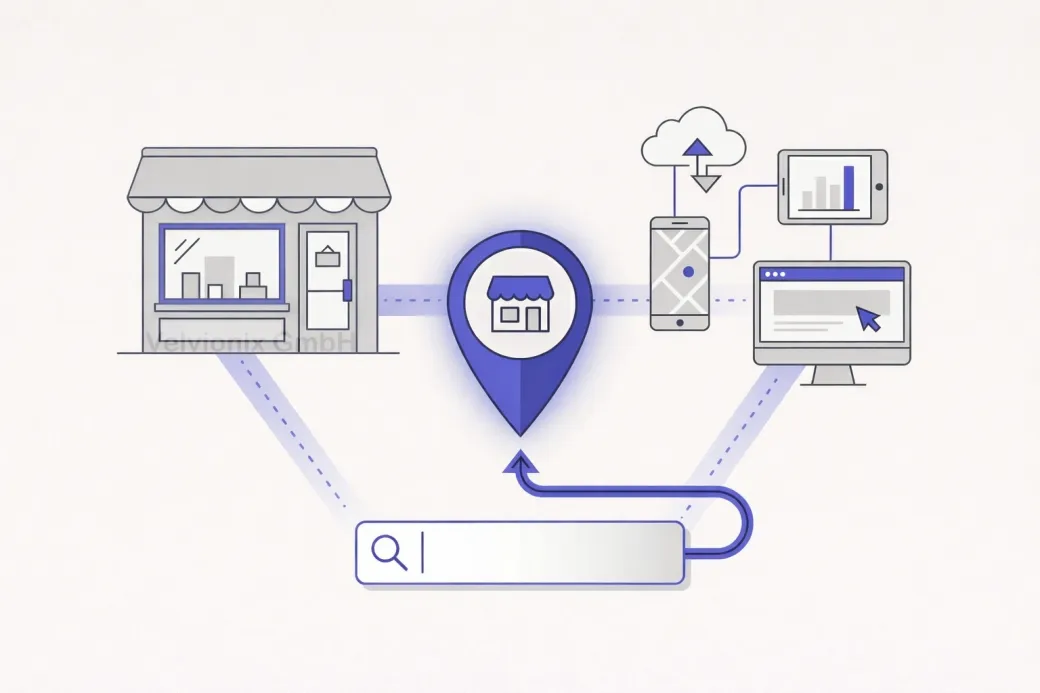
Local visibility that brings inquiries is based on a simple principle: the searcher must immediately understand that you solve the right problem nearby - and that it’s safe to contact you. You don’t need a marketing firework for this, just clean foundations.
The Three Building Blocks for Local Inquiries
The first building block is consistency. Your business data must be the same everywhere: name, address, phone number, opening hours, service description. This sounds trivial but is the most common cause of lost inquiries. Anyone unsure whether the info is correct won’t call.
The second building block is clarity on the website. “SEO” here just means: your website should match the search queries real customers make. If your homepage only contains general statements, you’re wasting the moment when someone is ready to buy. Write clearly what services you offer and in which area you work. This isn’t “ad copy” - it’s orientation.
The third building block is trust, and locally that often means reviews. Many freelancers treat reviews passively: “If someone wants to, they’ll write something.” That’s a misconception. Satisfied customers don’t think of it. You need to ask politely, clearly, and regularly - ideally shortly after the appointment when the impression is still fresh.
How to Align Your Website Locally
If you have a clear service area, name it specifically and repeat it in the relevant places. If you only work in one city or neighborhood, that must be visible, not hidden in the imprint.
If you have multiple services, separate them cleanly so visitors don’t have to guess what fits their problem. And if you no longer offer a service, take it down - nothing destroys trust as reliably as outdated statements.
How Visibility Becomes Inquiries
Now the crucial question: how does visibility become an inquiry? By making the next step maximally easy. People don’t want to search. They want to act.
If your goal is calls, then the phone number must be visible and practically usable on smartphones. If your goal is appointments, then the appointment path must be clear and not disappear between text blocks. If your goal is written inquiries, you need a clear contact area that says what happens and which information is sensible.
Three clear decisions bring order to practice: If your customers typically want to book or call immediately, prioritize call or appointment on every central page. If your service needs explanation, give it its own page with process, typical questions, and a concrete result. And if you live locally from trust, show real insights: real photos, clear information, comprehensible examples.
Case Study: Hair Salon with Few New Customers via Website
A hair salon had good regular customers but barely any new appointments through the website. After a cleanup, opening hours, services, and prices “from” were immediately visible, plus current photos and a clear appointment path on the contact page. In parallel, satisfied customers were actively asked for feedback after appointments. After a few weeks, there weren’t suddenly twice as many visitors, but significantly more fitting appointment requests because orientation and trust finally matched.
The Real Effort - Unvarnished
Local visibility isn’t a one-time action. You need a small routine: briefly check data and opening hours once a month, keep an eye on new reviews, and update the website when offerings change. Add occasional text refinement when you notice inquiries are unclear or often bring wrong expectations. That’s manageable - but only if you keep it consistently small and clean.
What Sabotages Local Visibility
Common Questions About Local Visibility
What does "local visibility" specifically mean?
That people in your region find you when they search for your services, and directly understand whether you fit.
Do I need to run ads for this?
Not necessarily. Many local inquiries come through organic search when profile, website, and trust are clean.
What role do reviews really play?
A big one. For many, they're the shortcut to decision because they reduce risk.
What's the most common reason for unsuitable inquiries?
Unclear service description and missing differentiation, for example regarding location, focus, or target customers.
How do I prevent prospects from bouncing?
By making the next step obvious and keeping information quickly findable: service, price range, process, contact.
Does this also work for providers without a storefront?
Yes. What matters is clearly stating in which area you work and how contact works.
How often do I need to maintain this?
Regularly but briefly. A monthly check and updates when changes happen often suffice if the foundation is clean.
Become Locally Visible Now - With Predictable Inflow
If you want to solve this topic properly, we implement it as part of our services in a structured way - not as a loose individual measure. Please use the contact form and select the appropriate options. We will get back to you with a brief assessment of the most sensible approach.
Sources
Disclaimer: The operators of linked pages are solely responsible for their content. We assume no liability for linked content. This article was created with the assistance of AI-powered research and writing tools.
- [1]
- [2]
- [3]
- [4] Stanford University : "The Web Credibility Project: Guidelines"
https://credibility.stanford.edu/guidelines/ - [5] Google : "Creating helpful, reliable, people-first content"
https://developers.google.com/search/docs/fundamentals/creating-helpful-content
Related Articles

This image is protected by copyright. Use only with explicit permission.
© 2026 Velvionix
Fewer Follow-Ups, More Appointments: FAQ Content That Really Helps
2026-01-30

This image is protected by copyright. Use only with explicit permission.
© 2026 Velvionix
Convincing in Seconds: How Your Website Wins Inquiries
2026-01-28
This image is protected by copyright. Use only with explicit permission.
© 2026 Velvionix
Start Professionally: Email, Calendar, and Files That Build Trust
2026-02-04
Comments
No comments yet.
Be the first to comment!
Write a comment
To write a comment, please enable the comment function in your privacy settings.
Write a comment