Site Builder or Professional Website: The Path That Pays Off
2026-01-29
This image is protected by copyright. Use only with explicit permission.
© 2026 Velvionix
Key Takeaways
Why the Classic Choice Is Often Wrong
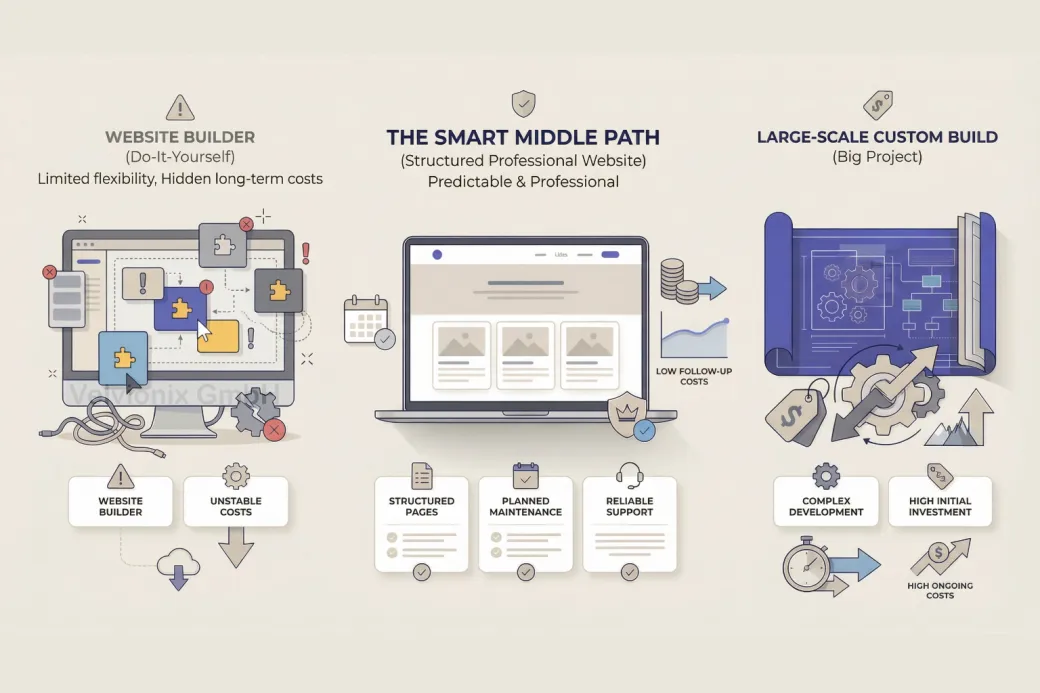
Many freelancers and small businesses face a false choice: either start quickly with a site builder or commission a large website project that feels like “agency work.” Both sound logical, both often lead to unnecessary costs in practice.
Site builders seem cheap and practical until the website needs to do more than “exist.” Then typical symptoms appear: unclear structure, slow pages due to too many integrations, little freedom with layout and content, and an appearance that looks interchangeable. The problem isn’t the start, but getting stuck along the way.
The other extreme is the overcomplicated solution. Many features, heavy infrastructure, constant maintenance, updates, and dependencies. This can make sense if a company has a large editorial team or very much content. For many smaller providers, however, it’s simply too much and constantly draws attention away from what should go into client work.
What the Middle Path Really Means
The middle path that really pays off is professional but deliberately lean. That means: few pages with clear tasks; clean, fast presentation; a reliable process for changes; predictable support for maintenance, security, and backups. Exactly this creates peace in daily operations and trust in acquisition.
The core is a simple truth: Customers don’t evaluate your website by the technology behind it but by feeling and clarity. Do you immediately understand what they offer? Does it seem credible? Is the next step clear? A lean professional website is optimized for this. A site builder is often optimized for you to “somehow manage,” and a large project is often optimized to do maximally everything. Neither is automatically what you need.
Why “Maintaining It Yourself” Isn’t Always the Right Standard
Many fail because of the wrong assumption that a website is only professional if the customer can maintain it themselves. That’s not true. For customers without a technical background, it’s often better when changes run reliably through a fixed contact person: send content, adjustment done, finished. This isn’t a disadvantage but predictability. And predictability is an economic factor because small changes don’t pile up and the website doesn’t become outdated.
If you only rarely change something, then a lean website with clear pages and small, regular maintenance in the background is often enough. You save yourself complexity and still remain professional because the content is right and the technology doesn’t get in the way. If you need regular adjustments but don’t want to make them yourself, then a clear change process is more important than a site builder. Then what counts is: fast responsiveness, clean versions, no side effects, and a result that looks consistent externally. If you think you absolutely need a large content management system, then first check the real need. A CMS is a tool where content is maintained directly in the system. If in the end only a text is adjusted every few weeks, the ongoing effort is often greater than the benefit.
Why the Middle Path Is Economical
The middle path is also economical because it reduces follow-up costs. The most expensive websites are rarely those that cost more at the beginning. Expensive are those that constantly eat time in operation: updates, disruptions, subscriptions, “small” problems that suddenly become mini-projects. Lean means: as few moving parts as possible, but the important things done right.
Another advantage: A clear structure sells better. Not because more pages are automatically better, but because each page has a task. Homepage for orientation; services page for clear offers; examples or references for trust; contact page for the next step. This way, a prospect finds specifically what they need instead of scrolling and guessing.
Case Study: Studio Switches from Site Builder
A studio first had a site builder presence that looked “okay,” but many prospects still asked about basics because offers and process weren’t clear. After switching to a lean, professional website with clear structure, content and adjustments were simply delivered via message and cleanly implemented. Not automatically twice as many visitors came, but the inquiries became significantly more suitable because orientation and trust were clearly better.
The Real Effort - Unvarnished
It’s important to stay realistic: The middle path isn’t “build once and forget.” Even a lean website needs maintenance. Opening hours, offers, references, and texts must stay current, and the technical basis should be checked regularly. The difference is crucial: With a professional, lean website, this maintenance is predictable and small. You don’t end up in a permanent state of tinkering, fixing, and surprises.
What Makes Website Decisions Expensive
Frequently Asked Questions About Site Builder vs. Professional Website
Is a site builder fundamentally a bad idea?
No. For very simple requirements, it can be enough. It becomes problematic when you need to appear more professional or when the website should specifically bring inquiries.
How do I know that the site builder is slowing me down?
When you're fighting against limitations, changes become unpleasant, the page feels sluggish, or the result remains interchangeable despite effort.
Do I need to be able to maintain my website myself for it to be professional?
No. Many small businesses without a technical background do better with a clear process: deliver content, implementation happens reliably, and the website stays consistent.
When does a large CMS make sense?
When many people regularly maintain content or when very many pages and content are permanently growing. Otherwise, it's often overhead.
How many pages does a lean professional website typically need?
Often five to seven pages are enough if each page has a clear task and content really works.
Does lean mean "too little"?
No. Lean means: focus on what brings inquiries and trust, and forgoing ballast that becomes expensive later.
Can the middle path be expanded later?
Yes. A clean, lean base is the best starting point because extensions can be added specifically and without chaos.
Implement the Middle Path the Right Way
If you want to solve this topic properly, we implement it as part of our services in a structured way - not as a loose individual measure. Please use the contact form and select the appropriate options. We will get back to you with a brief assessment of the most sensible approach.
Sources
Disclaimer: The operators of linked pages are solely responsible for their content. We assume no liability for linked content. This article was created with the assistance of AI-powered research and writing tools.
- [1]
- [2] Stanford University : "The Web Credibility Project: Guidelines"
https://credibility.stanford.edu/guidelines/ - [3] Google : "Understanding page experience in Google Search results"
https://developers.google.com/search/docs/appearance/page-experience - [4]
- [5] Google : "Helpful content guidelines"
https://developers.google.com/search/docs/fundamentals/creating-helpful-content
Related Articles
This image is protected by copyright. Use only with explicit permission.
© 2026 Velvionix
Maintenance, Security, Peace of Mind: Why Lean Websites Cost Less
2026-02-04

This image is protected by copyright. Use only with explicit permission.
© 2026 Velvionix
Professional Presence: How to Build a Website That Pays Off
2026-02-03

This image is protected by copyright. Use only with explicit permission.
© 2026 Velvionix
Convincing in Seconds: How Your Website Wins Inquiries
2026-01-28
Comments
No comments yet.
Be the first to comment!
Write a comment
To write a comment, please enable the comment function in your privacy settings.
Write a comment