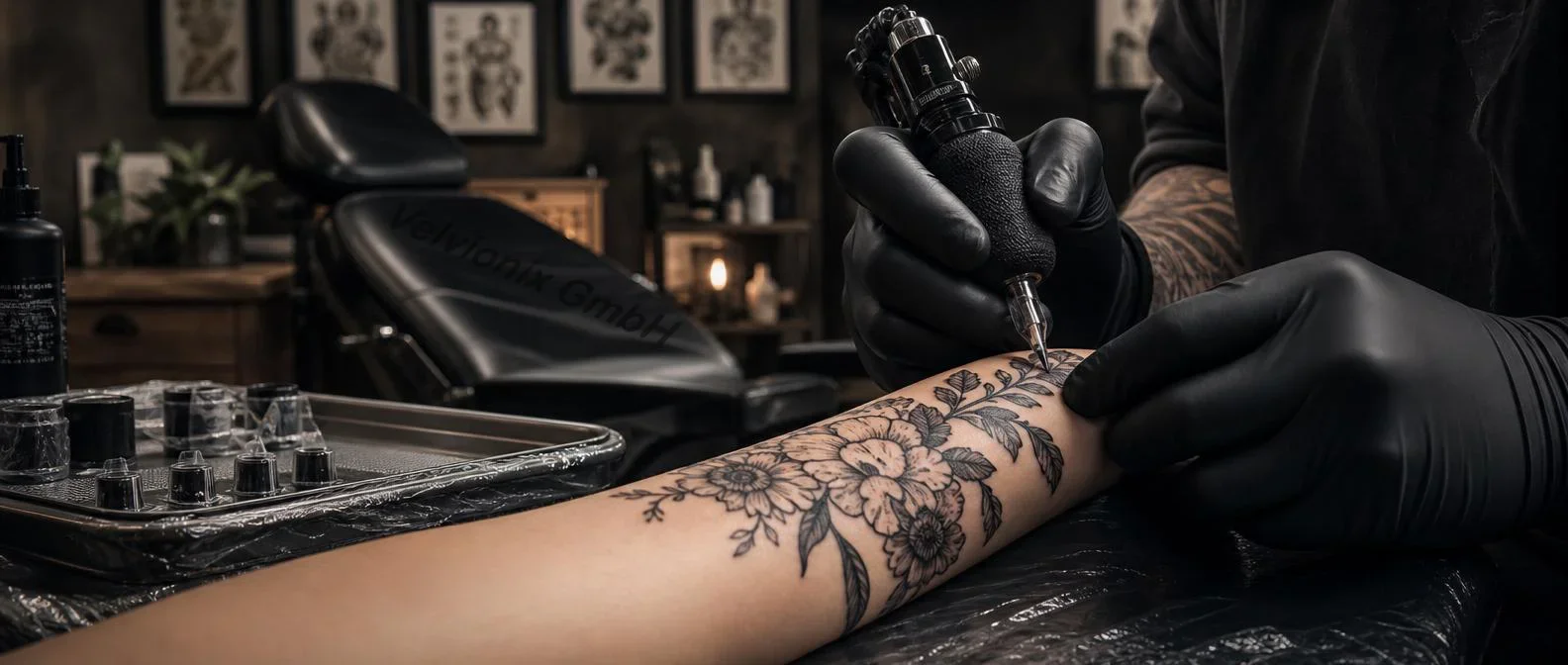
Professional website for tattoo studios
Tattoo studios rely on portfolios, trust and clear communication. Velvionix develops websites that present artists, styles, pricing and operating boundaries factually. Extensive portfolios, artist pages and appointment enquiries are separately agreed extensions; regulatory content is prepared as general orientation for professional and legal review.
Important notice Legal, tax and industry-specific information concerns Germany and expressly identified EU law. It is provided for general orientation and does not replace individual advice. Last review of the cited legal situation: April 2026 Show the full notice
Unless stated otherwise, the legal, tax or industry-specific information on this page reflects the law applicable in Germany and German official and professional practice. Directly applicable EU law and references to other jurisdictions are identified separately. The information was researched with due diligence using sources available as of the stated review date. For binding guidance on your specific project, please contact the competent chamber or a qualified specialist, such as a lawyer or tax adviser. The current statutes and official regulations always prevail.
Why tattoo studios need their own website
A tattoo is a permanent decision, so many prospective clients research artists, styles and operating boundaries carefully. A website can organise this information durably and provide a clear contact path; it complements social media without promising search positions or enquiries.
Social-media feeds focus on current posts. A website can keep older, still relevant work accessible by style and help prospective clients identify a suitable artist without guaranteeing a particular conversion rate.
What belongs on a modern tattoo-studio website
The homepage presents artists, styles and a curated portfolio selection at a scale appropriate to the team. Existing images are not a prerequisite: Velvionix can define the visual direction and remit optional media production or preparation separately.
Artist profiles combine a bio, specialisations and a curated selection of original work. Within Starter this can be a compact team and portfolio area; individual artist pages, extensive galleries and direct enquiry forms are separately agreed extensions. Existing photos are not a prerequisite: Velvionix can define the visual direction with the studio and remit optional production or preparation separately.
An extensive filterable portfolio gallery is a separately agreed extension. Categories, detail views and anonymisation are implemented only with approved material and after documented review.
A lean appointment enquiry form is a separately agreed extension. It can capture artist, motif description, size, body placement, style and timing; reference images are exchanged only after initial contact. Entries are forwarded directly to the studio mailbox and are not stored persistently on our systems.
Price guidance can state an hourly rate, minimum price or typical ranges. Detailed cover-up content and additional shop links are separately agreed extensions; a proprietary online shop with payment is outside our service offering.
Legal framework: REACH, IfSG and GDPR for tattoo photos
The EU REACH regulation (effective 04 January 2022) restricts certain pigments in tattoo inks - in particular Pigment Blue 15:3 and Pigment Green 7 were initially banned and then regulated with restrictions. A note on the website that you use REACH-aligned inks (without necessarily naming brands) is both a quality signal and legal protection. We build this reference as a dedicated section.
The Infection Protection Act (§§ 36, 37 IfSG) requires a hygiene concept, notification to the competent public health office and regular inspections. Single-use materials, CE-certified devices, disinfection protocols are part of daily operations. On the website we show a hygiene information block that communicates this diligence in customer language - without jargon but well-grounded.
Tattoo images require individual review of consent, image rights and privacy. We prepare information areas and, under a separate agreement, a template structure; final approval and documentation remain with the studio and specialist advisor.
Youth protection: Tattooing under-18s is sensitive and handled differently by federal state and studio policy. Many studios refuse under-18s completely; others accept from age 16 with written consent of both legal guardians. We create a clear place for your studio rule; concrete approval remains with the studio or specialist advisor.
Local visibility and community
Tattoo studios have a strong regional bond - nationwide reach is secondary except for well-known guest artists. We implement Schema.org markup (TattooParlor, LocalBusiness, Person for artists with jobTitle) - this helps search engines better understand location, opening hours and artist profiles.
A well-maintained Google Business Profile and consistent contact details can complement local orientation. Reviews can be linked cautiously or embedded as an optional, data-minimizing extension; no particular ranking or enquiry volume is promised.
Guest artist events (guest spots) are a strong traffic driver. We build an event module showing upcoming guest artists, their portfolio and appointment availability. This makes your website the scheduling hub of the tattoo community and drives recurring visits.
Explaining styles, artists and the path to a tattoo
Prospective clients are looking not only for a design but for a studio and artist whose style fits the idea. The website therefore separates styles, artist profiles and process. It presents genuine priorities such as fine line, blackwork, colour, lettering or traditional work only where the portfolio supports them clearly.
An artist profile does not need a long biography. Working approach, preferred subjects, experience priorities, spoken languages and the appropriate contact path are usually enough. Guest artists and limited booking periods receive clear dates. Popularity, waiting time and assumed demand are not presented as proof of quality or promised success.
The process from idea to appointment is explained clearly: initial contact, design discussion, size and placement questions, drawing phase, appointment confirmation and aftercare guidance. Pricing may use a minimum charge, hourly guidance or individual quotation where this reflects the real calculation. Deposits and cancellation terms come from the studio and receive appropriate review.
Portfolio images need clear attribution, good presentation and documented usage rights. Existing material is helpful but not required to begin the website. Velvionix can establish a visual direction and prepare existing work for the web. New photo or video production, extensive galleries and additional artist shoots are agreed separately.
For images of tattooed people, consent, crop, publication period and withdrawal path are clarified in advance. The website avoids unnecessary personal information. Healing and physical reactions are not described as universal. Aftercare guidance comes from the approved studio process and does not replace medical assessment.
Starter can compactly structure a homepage, styles and portfolio, artists, process and contact. An enquiry form, design-file uploads, appointment booking, further languages or a magazine are not automatically included. File uploads are not offered. An existing booking system can be linked or embedded separately. If a specialised system is the better professional fit, we help you choose it, embed it and connect it cleanly to your website.
Address, opening hours, walk-in rules, minimum age, accompanying-person policy and accepted contact channels matter to spontaneous visitors. These details should be easy to find on mobile and consistent with external profiles. Google Business Profile and social media complement the website but guarantee neither reach nor appointments.
Ongoing maintenance covers new artists, changed priorities, convention dates and updated studio guidance. Small changes can be handled through support. A dedicated editing function is agreed separately only where the team frequently updates content itself and has a clear internal process for approving images, copy and rights.
From project idea to approved studio website
At the start, we collect styles, artist priorities, studio process, pricing logic, contact rules and common questions. Existing profiles, social posts and portfolios can serve as working material but are not copied without review. Together we decide which work is representative and which statements should remain on the website long term.
Copy about preparation, minimum age, deposits, cancellations and aftercare comes from the studio’s real rules. It is written clearly and approved before publication. For health-related or legally sensitive points, the website remains general orientation; concrete professional assessment belongs to the studio and qualified bodies.
A strong page is possible without a finished photo series. Existing work is organized by style, artist and subject where rights and consent are clear. New imagery, portraits, video or extensive portfolio preparation can be agreed separately. No fixed number of images is required.
Before launch, each artist reviews their name, profile, work and contact path. The studio checks pricing, rules and required details as a coherent whole. Later changes go through one clear contact so the website, external profiles and direct communication do not present conflicting information.
Directing enquiries to the right artist
Clear style categories and artist profiles help route enquiries to the right person. The website explains which details are useful for initial contact but requests no sensitive information and accepts no file uploads. Design details can then be discussed through the direct path defined by the studio.
Cover-ups, touch-ups and multi-session work are also described only in general terms. Feasibility, time and price follow review and personal discussion; the website gives no blanket commitment.
Aligning portfolios and profiles when things change
When artists change or priorities develop, profile, portfolio attribution and contact path are updated together. Work by former team members remains online only where rights and intended attribution are clear. New pieces are selected for relevance rather than to meet a fixed quantity. The portfolio stays representative without obliging the studio to maintain constant content production.
Frequently asked questions about tattoo-studio websites
Is social media enough for a tattoo studio?
Social media is useful for current work and inspiration. A website complements these channels with enduring, organised information on artists, styles, pricing and contact paths without guaranteeing search visibility or bookings.
What legal requirements must my website communicate?
Three main areas: (1) EU REACH regulation (since 2022) restricts certain pigments in tattoo inks - studios should indicate REACH-aligned inks (brand names not mandatory but credibility matters). (2) The German Infection Protection Act (§§ 36/37 IfSG) requires a hygiene concept and notification to the public health office. A hygiene note on the website (single-use materials, CE-certified devices, disinfection protocol) creates trust. (3) Youth protection: tattooing under-18s only with parental consent; many studios refuse completely - this belongs clearly on the website.
How do I present my artists on the website?
Artist profiles are an important orientation area. Depending on team size, they can be grouped on the homepage or provided as optional additional pages by separate agreement, each with a bio, specialisations, a curated selection of original work and a social-media link. An artist-specific enquiry path can be added optionally; fixed image counts are not required.
How do I handle image rights for client tattoos?
Image rights, privacy and consent need careful review before tattoo photos are published. We prepare suitable information areas and templates as general orientation; final legal assessment and documentation remain with the studio and specialist advisor.
Should I display prices?
Partially. A fixed per-minute rate or hourly rate (typically 120-180 EUR, depending on region and artist reputation) plus minimum price (typically 80-150 EUR) creates transparency and filters out unsuitable enquiries. Motif-based flat rates rather not (too many variables). We build a clearly structured price section with reference to individual calculation for large projects and cover-ups - this is industry standard.
What does a tattoo-studio website cost?
A compact, professionally developed website starts from EUR 499. Additional pages, languages, forms, media and functionality can be added to match the required scope. Managed hosting and ongoing support start from EUR 39 per month. Our Website pricing & options page explains the professional foundation and the available ways to expand it.
More dedicated services in this industry
Looking for a website for a related profession? These dedicated pages might also be relevant:
Website for Hair Salons
Present services, pricing, salon style and appointment options clearly - for hair salons that want a professional online presence and better local visibility.
View hair salon website →Website for Beauty Studios
Present treatments, prices, duration, care notes, photos and enquiry paths clearly - for beauty studios with services that need explanation and high trust requirements.
View beauty studio website →Website for Nail Salons
Make designs, services, prices, photo gallery, care notes and booking paths visible - for nail studios that want to present their work convincingly.
View nail salon website →Website for Barbershops
Show haircuts, beard care, prices, atmosphere, team and booking paths clearly - for barbershops that want to combine style, craft and local visibility.
View barbershop website →Website for hair removal studios
Explain methods, treatment areas, process, prices, notes and consultation options clearly - for studios that want to build trust before the first appointment.
View hair removal studio website →More industries
What We Have Already Delivered
Our practice example shows a custom website with a multilingual structure, animated landing page, interactive map and automatic contact form - built from scratch instead of a website-builder template.
View examples →Full details about the professional Starter foundation, pricing and flexible extensions are available on our “Website pricing & options” page.
View pricing & options →Ready for your new tattoo-studio website?
In a free initial consultation we discuss your artist team, your styles and your positioning. You receive a concrete offer that puts your artists in the spotlight and communicates content aligned with IfSG, REACH and GDPR.
Discuss your tattoo studio website