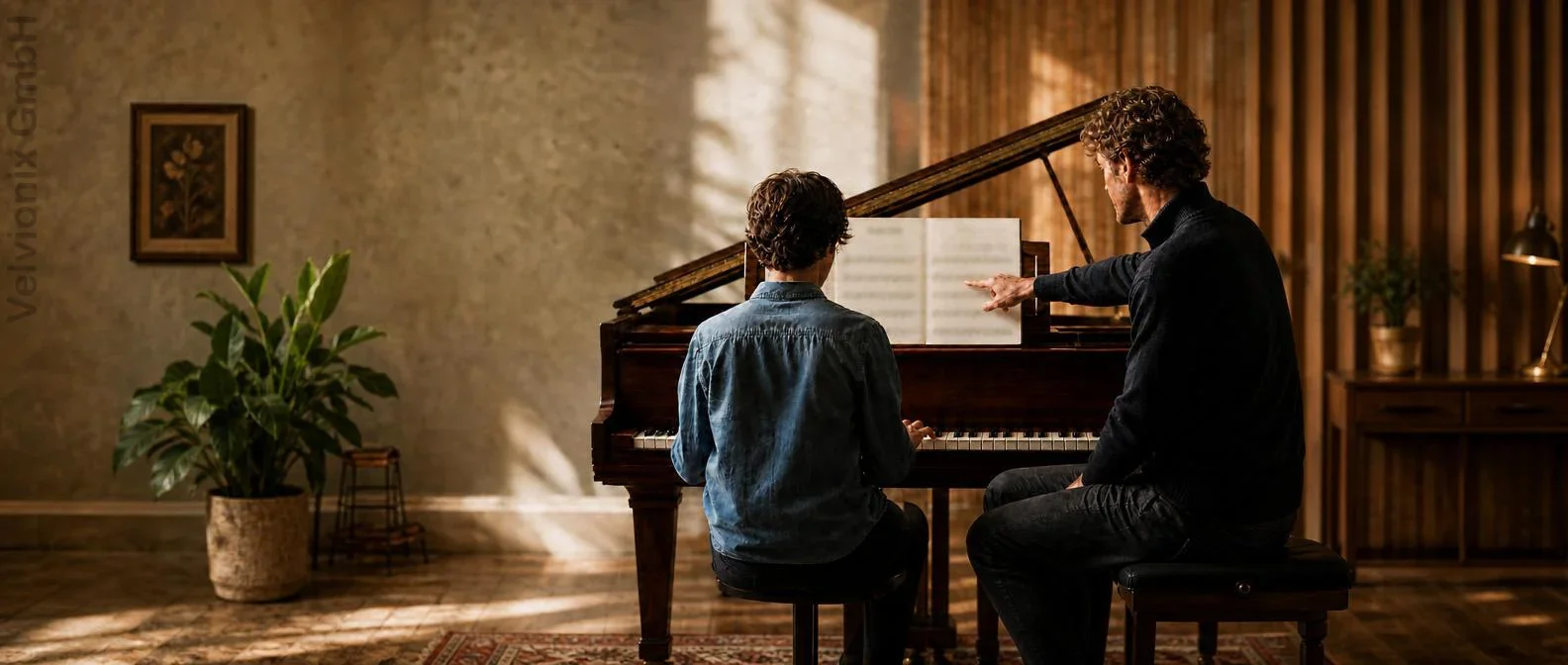
Professional website for music schools & instrumental tuition
Music schools operate in a distinctive field: parents decide, children often learn for many years, teachers carry much of the quality - and enrolments concentrate seasonally around the start of the school year, the mid-year break and the weeks following student recitals and open days. Parents and adolescents today research almost exclusively online (Musikschule [city], Klavierunterricht [city], Gitarrenunterricht Kinder [city], Jugend musiziert Vorbereitung [city]); a regional music school that is not visible loses enrolments to larger providers, to municipal VdM schools or to nationwide online platforms. At the same time the regulatory environment is more differentiated than it appears: § 4 No. 21 UStG certification and the CJEU ruling C-449/17 for VAT, § 72a SGB VIII + § 30a BZRG extended police clearance certificate for teachers with contact to minors, Art. 8 GDPR and § 22 KUG for consent of children and adolescents, GEMA and § 19 UrhG for public concerts, § 24 KSVG for fee-based teachers and the VdM or bdfm structure plan as a quality framework. We build websites for music schools and instrumental teachers that give parents and pupils orientation within seconds - factual, well structured, data-protection-aware and aligned with competition-law-aware marketing.
Why music schools need a professional website today
The German music-school market is surprisingly large and clearly split in two. Around 920 public music schools under VdM sponsorship with municipal ties (city, district, special-purpose association) teach more than a million pupils in Germany according to recent federation figures; alongside them stands an equally colourful private sector with free music schools in civil-partnership (GbR), limited-company (GmbH) or sole-proprietor form, and several tens of thousands of self-employed instrumental teachers working freelance under § 18 EStG (teaching activity or "a profession similar to teacher"). Parents and adolescents orient themselves between these offerings almost exclusively online - local search, Google reviews, website quality and teacher profiles are the four sorting criteria before the first contact is even made. Those who are not visible as a regional music school lose enrolments to larger providers, to municipal VdM houses with strong brand trust, or to nationwide online platforms with performance-marketing budgets.
The purchase decision by parents follows a recognisable pattern. First comes trust in the teacher with whom the child will spend an hour a week - who is that person, which musical and pedagogical qualifications do they bring, how do they engage with children and adolescents, what didactic style shapes the tuition. Second comes the transparency of the offering: which instruments and formats are available, how long is a unit, how often, which rhythms are possible, how does the start work, how can the contract be ended. Only third comes the price - parents know that good tuition costs money, but they want to know what for. A website that answers these three points in this order converts far more first visits into trial-lesson requests than the usual page-builder sites with generic music claims ("music connects people") and generic stock photos.
The second audience are adolescents and adults who decide for themselves. From around the age of thirteen or fourteen adolescents start researching on their own - often with a clear intent (Jugend musiziert competition preparation, music-university entrance, rock or jazz band entry, Abitur in music with advanced- or basic-course focus). Adults register as late starters ("always wanted to learn piano"), as returners after decades of break, as part of a hobby band or for deliberate deceleration after a demanding working day. This group researches on mobile, values scheduling flexibility (evening slots, online option, short blocks) and reacts sensitively to teacher profiles with a face, a career path and artistic references. A website that addresses this group explicitly (dedicated sections on "Adults and late starters", "Returners", "Competition and entrance-exam preparation") opens a second, often undervalued conversion channel alongside the parental enquiry.
Added to this is the regulatory environment, which is publicly underestimated. The VAT exemption under § 4 No. 21 UStG stands or falls with the certificate from the responsible state authority and with a verifiable examination or vocational-preparation character; the CJEU ruling C-449/17 and the subsequent BFH case law have narrowed the interpretation of the directive exemption (Art. 132 (1) (i) or (j) of the VAT Directive). The extended police clearance certificate under § 30a BZRG and § 72a SGB VIII is a standard for teachers with contact to minors at many providers; Art. 8 GDPR and § 22 KUG govern data and images of children, especially at student recitals and concert recordings; § 19 UrhG and the GEMA framework agreements define when public performances are subject to licensing; and providers with fee-based teachers face the KSVG contribution obligation under § 24 KSVG. A website that communicates this frame confidently and factually signals professionalism without drifting into legal advice - exactly the line we keep consistently.
What belongs on a modern music-school website
The homepage answers the essentials within ten seconds: which instruments and vocal subjects are taught, which formats (one-to-one tuition, two-to-one tuition, small group, early musical education from around eighteen months to two years in the parent-child format, basic musical training from the age of six, ensembles, choirs, big band, chamber music, online tuition via video conference), where the main location is, whether there are further teaching sites or school cooperations, and what a first step looks like (a free or low-cost trial lesson as the standard entry). A real photo from a practice room or a teaching situation with consent of those pictured (not the generic "child at the grand piano" stock photo), a short claim in parent language ("Piano, guitar, violin, drums, voice - structured tuition in [city], since [year]"), and three central actions: request trial lesson, view instruments and teachers, see fees. Notes on upcoming student recitals and the enrolment rhythm to the start of the school year appear prominently.
The instrument and vocal-subject pages are the SEO core of the music-school website. One dedicated subpage of 500 to 900 words per instrument: piano (children from age six, adolescents, adults, classical and popular, jazz focus where available), keyboard (delimited from piano, often an entry instrument), guitar with clear differentiation between classical guitar, acoustic guitar (fingerstyle, song accompaniment) and electric guitar (rock, blues, jazz, metal), electric bass, drums and cajón, violin, viola, cello, double bass, recorder (often an entry instrument from age five), flute, clarinet, saxophone, oboe, bassoon, trumpet, trombone, French horn, tuba, harp, accordion, voice (classical, pop, jazz, musical), early musical education, basic musical training, composition and songwriting, music theory and aural training. Each page answers similar questions in instrument-specific form: from what age is an entry meaningful, what instrument and accessories are needed (rental instruments?), what does a typical lesson look like, which repertoire paths are offered, which competition and examination options exist. That is SEO-effective and prevents twenty instruments from disappearing on an undifferentiated "we teach tuition in every instrument" page.
The teacher team page is the most important trust anchor - well ahead of the fees page. Per teacher: a real portrait (consent under § 22 KUG documented), name or initials (depending on privacy preference), instruments or vocal subjects taught, university degree or artistic training (Bachelor of Music, Master of Music, Diplom Musiklehrer:in, Konzertexamen, church music A/B, jazz diploma), study location with the concrete name of the university (Hochschule für Musik Hanns Eisler Berlin, Hochschule für Musik Detmold, HMT Leipzig, UdK Berlin, HMDK Stuttgart, HfMT Köln, Musikhochschule Lübeck, Mozarteum Salzburg), artistic focus and references (orchestra engagements, ensembles, competition successes, CDs, radio recordings), age and experience levels taught (beginners, advanced, Jugend musiziert preparation, music-university entrance preparation), didactic approach in two to three sentences (classical Czerny/Hanon, Suzuki method for string entry, Kodály method with relative solmisation, Orff Schulwerk in early education, play-along approaches for electric guitar and bass), languages (important in mixed metropolitan areas: English, Russian, Ukrainian, Turkish, Polish, Spanish, Italian). This is the point where parents and adolescents make the decision, and it is simultaneously the section that smaller private providers often maintain only in note form - a structural differentiation opportunity.
The fees and trial-lesson page works with clear structure rather than hidden flat fees. Public music schools in VdM sponsorship have a formal fee schedule (municipal statute) with tiers by unit (30/45/60 minutes) and format (one-to-one, two-to-one, group, ensemble, early musical education); private music schools and freelance instrumental teachers calculate freely but the structure remains comparable. We build a transparent overview with one-to-one tuition per unit (typical range 60 to 100 EUR gross per month for four units of 30 minutes), two-to-one and group rates, early musical education per semester, holiday intensive flat rate and annual or semester commitment versus monthly payment (typically ten monthly instalments with two holiday months without charge). Visible in its own paragraph: sibling and family discounts, social discount at municipal music schools (often coupled to the Education and Participation package under § 28 SGB II), combined-instrument discount for pupils taking two instruments. The trial-lesson flow runs in three steps: 1) request via the form (instrument, age of the child, guardian contact email, preferred time window), 2) response with a proposed appointment and teacher match, 3) trial lesson on site or online, followed by a short conversation with a recommendation. Deliberately not in the form: file uploads, sheet-music scans, bank details - these are exchanged later in the actual registration process on paper or via an encrypted channel; the pupil database, ensemble assignment, SEPA mandates and timetable logic live in your music-school administration software.
Legal framework: § 4 No. 21 UStG, § 72a SGB VIII, Art. 8 GDPR, § 22 KUG, GEMA/UrhG, KSVG
VAT is the economically most tangible lever for many private music schools. § 4 No. 21 UStG exempts the turnover of private schools and other general-education or vocational-training institutions if they are either state-approved or if the responsible state authority certifies that they duly prepare pupils for a profession or for an examination to be taken before a public body - the so-called "§ 4 No. 21 (a) (bb) UStG certificate". Application, proof of curricula, teacher qualifications and specifically exam-preparing offerings (Jugend musiziert, music-university entrance, conservatoire examinations, Abitur music in basic or advanced course) run via the respective state ministry or regional government. Since the CJEU ruling C-449/17 and the subsequent BFH decisions (including V R 13/20) the exemption is handled more restrictively: pure leisure tuition without a demonstrable examination or vocational-preparation reference can fall outside the exemption. The website reflects this aligned with § 4 No. 21 UStG - with a visible examination/training profile (competition preparation, university entrance, Abitur music) - and refers individual tax assessment to your tax advisor. We do not make any individual tax assessment.
Child and youth protection is the second frame. § 72a SGB VIII obliges providers of child and youth welfare and comparable institutions with contact to minors to present an extended police clearance certificate under § 30a BZRG every five years. For public music schools and cooperating youth music schools the submission is standard; for private music schools and self-employed instrumental teachers the obligation is not mandatory in every case but is expected in cooperations with schools, kindergartens, all-day programmes or publicly funded projects, and by many parents as a quality expectation. We phrase this on the website aligned with § 72a SGB VIII + § 30a BZRG transparently - as a factual trust paragraph ("All teachers present an extended police clearance certificate under § 30a BZRG before taking up their activity; the documentation is maintained internally and refreshed every five years") - without publishing names, reference numbers or scans, and without promising promotional guarantees that would be legally attackable.
The General Data Protection Regulation is the third frame, with a particular view on minors. Art. 8 GDPR sets the default consent age for information-society services at 16; Germany has kept this threshold via § 25 BDSG. For children under 16, consent must be given or authorised by the legal guardians; for ongoing processing with broader impact, consent of both legal guardians is advisable (§ 1627 BGB). We align trial-lesson and registration forms with Art. 8 GDPR: the guardian contact email is a mandatory field, the Art. 13 GDPR information is prominently linked, separate consent is collected only where actually required (newsletter, photo/video use at student recitals, ongoing learning-progress documentation). § 22 KUG requires consent of the legal guardians for images of children and adolescents; according to BGH case law, from around age 14 cumulative consent of the adolescents themselves is added. The website therefore works with photos of pupils and with concert recordings aligned with Art. 8 GDPR / § 22 KUG - with documented consent, right to withdraw and alternative images without personal reference for visitors who do not wish to consent.
Copyright and performance law and the KSVG form the fourth frame. Pure instrumental tuition is uncritical under copyright; public student recitals and concerts become sensitive, as they qualify under § 19 UrhG as public communication once they go beyond the narrow family-and-friends circle within the meaning of § 52 UrhG. For regular music-school concerts with a wider audience the GEMA flat-rate agreement for music schools (framework contract between GEMA and the sponsoring federations) is the usual route - the flat rate is handled directly between the music-school sponsor and GEMA. For sheet-music copies, § 53 UrhG (private copy) and § 60a UrhG (teaching and research) define the narrow frame; duplication of whole works requires licences via VG Musikedition or individual licences of the music publishers involved. § 24 (1) KSVG captures music-school sponsors who regularly employ fee-based teachers - the artists-social-insurance levy (currently 5.0 percent of the fees paid) must be factored in; self-employed instrumental teachers, conversely, can insure themselves via the Künstlersozialkasse. In parallel, the German Accessibility Strengthening Act (BFSG, in force since 28 June 2025) applies to music-school websites with consumer-relevant digital services; we therefore build WCAG 2.1 AA by default, with sufficient contrast, full keyboard operability and screen-reader compatibility.
Operating forms, quality certifications and teacher profiles
The operating form of a music school significantly decides which content is sensible on the website. A public music school under VdM sponsorship is under municipal responsibility, teachers are often employed under TVöD-SuE (pay grade S2, S4 or S6 with fee surcharges), the fee schedule is a formal statute, and the connection to municipal cultural funding, general-education schools and youth orchestras is structurally in place. A private music school as a GbR, GmbH or sole proprietorship typically works with a mixed model of employed and freelance teachers, its own pricing philosophy and a stronger brand focus. A self-employed instrumental teacher usually teaches freelance under § 18 EStG in a home studio, at the pupil's home or in rented rooms of a music-school cooperation - here the website is a personal portfolio plus enrolment channel. We reflect these three forms differently: with a federation logo and statute reference for VdM members, with a strong owner personality and teacher team for private music schools, and with teacher-centred storytelling and a clear tuition philosophy for individual teachers.
Federation membership is the strongest external quality signal. The Verband deutscher Musikschulen (VdM) with around 920 member schools and the VdM structure plan (subject canon, minimum curriculum, qualification requirements, fee schedule) is the reference frame for public music schools. In the private sector, the Bundesverband deutscher Freier Musikschulen (bdfm) and the Bundesverband Musikunterricht (BMU) play a comparable role: membership signals commitment to a quality and transparency code. We place the federation logo prominently (with the federation approval), add a factual information line ("VdM member since 1998" or "bdfm member since 2015") and link - where provided by the federation - to the public member directory. For public music schools, inclusion in the municipal cultural committees and the cooperation structure with general-education schools (primary school cooperations, youth orchestras, JeKi/JeKits programmes depending on the federal state, brass-instrument classes, string classes) is its own section.
The ensemble, choir and orchestra structure belongs visibly on the website - it is the musical and social heart of a music school. Typical ensembles: music-school orchestra (symphony, chamber, string), big band, jazz ensemble, rock-band ensemble, children's choir, youth choir, gospel choir, chamber music groups, recorder consort, guitar ensemble, percussion ensemble, musical projects. Each group gets a short description with direction, age/level window, rehearsal day and location, admission conditions (open offer vs. audition, minimum playing duration on the main instrument). The student recitals, yearly concerts, Christmas and spring concerts and summer open-air appearances run in a dedicated concert section with date, location, programme focus and - where desired - an external ticketing embed (a specialized ticket platform via iFrame or button link). Importantly: tickets and admission run directly through the ticketing provider; we do not process payments on our systems.
Pupil successes are presented aligned with competition-law-aware marketing. Jugend musiziert is the reference format - regional, state and federal prizes are a strong quality signal but must be named with the consent of the legal guardians (first name plus instrument plus year of competition is usually sufficient). Successful admissions to music universities, music-specialist grammar-school admissions and federal or state youth-orchestra placements can be stated factually without drifting into causality promises. Absolute success promises ("guaranteed admission to the music university") are attackable under § 5 UWG because admission success depends on many factors we do not control - instead we work with factual case examples and teacher quotes on the didactic path.
Local visibility, online tuition and music-school administration software
Music schools are strongly local, with a clear additional channel for "online tuition". The regional catchment of a stationary music school typically lies between five and twelve kilometres in large cities (the parental afternoon driving time) and fifteen to thirty kilometres in small and medium-sized towns. Google Business Profile with the primary category "music school" or "music instructor", matching secondary categories ("concert", "choir", "cultural event") and complete attributes (accessible entrance, parking, online offering, weekend slots) is the strongest local lever. Reviews carry particular weight in the parental decision process - parents read authentic experience reports by other parents far more strongly than marketing copy, and they respond to active but discreet invitations to a Google review after a successful year-end or student recital. We set up the profiles or hand maintenance over to the music-school leadership so the team can enter special hours (holiday intensive courses, open days, concert weeks) at any time.
The keyword structure clearly follows the parent and adolescent search logic. Main groups: "Musikschule [city]" and "Musikschule [district]" as the base, the instrument variants as the second level ("Klavierunterricht [city]", "Gitarrenunterricht [city]", "Geigenunterricht [city]", "Schlagzeugunterricht [city]", "Gesangsunterricht [city]"), the target-group variants as the third level ("Musikschule Kinder [city]", "Musikschule Erwachsene [city]", "Klavierunterricht Kinder [city]"), the examination and competition variants as the specialised level ("Jugend musiziert Vorbereitung [city]", "Aufnahmeprüfung Musikhochschule [city]", "Abitur Musik Leistungskurs [city]") and "Online Klavierunterricht" or "Online Gitarrenunterricht" as the supra-regional level. Each main group gets at least one targeted subpage of 500 to 900 words; online tuition unlocks supra-regional reach especially for rarer subjects (harp, oboe, bassoon, historical instruments, specific jazz styles). Structured data (MusicSchool or EducationalOrganization, Service, FAQPage, Event for concerts, Course for courses) supports Google categorisation.
Online tuition is technically implemented as the embedding of external services, not as an in-house build. We link to a common video conferencing platform (in each case with EU data-processing configuration, standard contractual clauses or Workspace DPA with the respective provider, sometimes via existing school accounts of the pupils) as well as to specialised low-latency music video-conferencing tools for advanced ensemble work and for asynchronous joint arranging. The data-protection logic is clear: the music-school sponsor is the controller under Art. 4 No. 7 GDPR, the video-service provider is the processor, and you conclude the data processing agreement directly with the provider. The website has a dedicated "Online tuition" section explaining how the flow works (appointment arrangement, meeting link sent by email, browser-based participation without app or plugin installation, short onboarding guide for younger pupils), which instruments are especially suited (piano with side camera, guitar and bass with audio interface, voice with microphone setup) and what the limits are (real-time ensemble work is difficult over classical video conferencing). Consciously not built: an in-house pupil learning platform with a sheet-music archive, practice diary, progress history or competition database. For such functions specialist systems exist (specialized sheet-music and beginner learning apps, your music-school administration software for all administrative matters) - we link, we do not replace them.
Music-school administration explicitly does not belong on the website. For pupil master data, teacher timetables, ensemble assignments, fee accounting, SEPA mandates, attendance documentation and federation reporting, your music-school administration software is the standard. Such systems bring their own user permissions, DPAs and backup logic - requirements that a marketing website does not need to replicate. On our website there is at most a link tile to the internal login area of the administration software; otherwise the website remains a brand, information and acquisition channel. The same applies to concert ticketing via a specialized ticket platform via iFrame or button link, to newsletters via your newsletter or CRM tool via widget, and to photo and video galleries from student recitals embedded with documented consent under § 22 KUG. The website stays lean, fast and maintainable.
Frequently asked questions about music-school websites
How do we communicate the German VAT exemption under § 4 No. 21 UStG on the music-school website?
For private music schools, the certificate under § 4 No. 21 (a) (bb) UStG is the standard route to German VAT exemption: the responsible state authority (depending on the federal state: regional government, state school authority or ministry of education) certifies that the institution duly prepares pupils for a profession or for an examination to be taken before a public body - classically Jugend musiziert, entrance examinations at music universities, conservatoire examinations or the Abitur in music (advanced or basic course). Public music schools operating under VdM sponsorship as municipal bodies are usually already VAT-exempt under § 4 No. 22 UStG or § 4 No. 21 (a) (aa) UStG. We communicate this factually on the website in three steps. First: a short note on the fees page ("As an institution recognised under § 4 No. 21 UStG, we invoice our tuition fees without German VAT") as a plain statement of fact, not a promotional claim. Second: reference to the issuing authority and the date of certification in the imprint or in a footnote on the fees page, so that the recognition remains verifiable. Third: no comparative statements against competitors ("cheaper than VAT-liable providers"), as such comparisons can drift into the German Act Against Unfair Competition (UWG). Importantly: since the CJEU ruling C-449/17 and subsequent BFH decisions (including V R 13/20) the exemption is interpreted more restrictively - pure "leisure" tuition without examination or vocational-preparation character may fall outside the exemption. The website should therefore make the examination and training character of the offering visible (Jugend musiziert preparation, music-university entrance exam, Abitur music, conservatoire examinations). The tax assessment in the individual case belongs to your tax advisor; on the website we only reflect the result, not tax advice.
How do we display the extended police clearance certificate of teachers under § 72a SGB VIII / § 30a BZRG transparently on the website?
Music schools work predominantly with minor pupils - in one-to-one settings, in small groups, in ensembles, at student recitals and at concert trips. § 72a SGB VIII requires providers of child and youth welfare and comparable institutions with contact to minors to obtain an extended police clearance certificate under § 30a BZRG from full-time and part-time staff - at the latest when cooperating with schools, all-day programmes, municipal youth music schools or with public funding. For private music schools the submission is not mandatory in every case, but it is increasingly expected by youth welfare offices, school providers or parents - and as a trust signal it is one of the strongest levers on the website. We phrase this aligned with § 72a SGB VIII + § 30a BZRG transparently in a dedicated trust paragraph ("All teachers present an extended police clearance certificate under § 30a BZRG before taking up their activity; the documentation is maintained internally and refreshed every five years"). Names, reference numbers or scans of the certificates are not made public - they remain internal. This line is a tangible quality signal for parents without drifting into promotional guarantees ("absolute protection", "guaranteed safety"), which would be legally attackable and professionally unserious. For freelance teachers who only teach one-to-one in their own studio the obligation does not strictly apply - the statement on the website then reflects the institute-wide standard, not an individual statutory duty.
How do we align the registration and trial-lesson form with Art. 8 GDPR for minor pupils?
The target group of a music school typically ranges from around four years (early musical education) into adulthood - with the core being children and adolescents. The consent logic follows Art. 8 GDPR: in Germany the age threshold of 16 for information-society services applies via § 25 BDSG (as the successor to the opening clause); for children under 16 consent must be given or authorised by the legal guardians. For continuing processing with broader impact, consent of both legal guardians is advisable (§ 1627 BGB, joint parental custody). Practical implementation on the website: the trial-lesson and registration form is deliberately lean and clearly addresses the legal guardians (parent contact email as a mandatory field, note "Please fill in this form as a person with custody"). Art. 13 GDPR information (purpose, legal basis, retention, recipients, data-subject rights) is prominently linked; separate consent is collected only where it is actually needed (newsletter, photo/video use, ongoing learning-progress documentation) - not as a blanket for the contact that is already necessary for contract initiation. The actual tuition contract, the SEPA direct debit mandate and the consent to photo/video recordings at student recitals are not collected online but in the on-site initial or trial consultation on paper or by PDF return email. A pupil database, a grade or progress history and ensemble assignments deliberately do not live on our website but in your music-school administration software - there the provider DPAs, role-based permissions and backup concepts of a dedicated specialist system apply.
How do we handle student recitals, concerts and sheet-music copies on the website (GEMA, § 19 UrhG, § 52 UrhG, § 53/§ 60a UrhG)?
One-to-one and group tuition itself is uncritical under copyright law - the pupil plays live on the instrument and does not produce a public communication under the German Copyright Act (UrhG). Public events are more sensitive. Student recitals and concerts qualify under § 19 UrhG as public communication when they go beyond the narrow family-and-friends circle; the exception under § 52 UrhG only applies to non-commercial events with a small, personally connected circle and without consideration. For regular music-school concerts with a wider audience the flat-rate agreement of GEMA for music schools (the framework contract between GEMA and the sponsoring federations) is the established route - a yearly or event-based flat fee is paid that covers works from the GEMA repertoire. The flat-rate agreement is concluded directly between the music-school sponsor and GEMA, not by us. Sheet-music copies are a separate topic: § 53 UrhG (private copy) and § 60a UrhG (teaching and research) permit copies only within narrow limits; duplication of whole works for teaching purposes is not covered and requires licences, typically via the VG Musikedition framework agreement with the Conference of Ministers of Education (for public schools and music schools) or via a separate flat-rate licence. On the website we communicate this factually in the ensemble and concert section ("Our public concerts run under the GEMA framework agreement for music schools; sheet-music material is used under the VG Musikedition framework agreement or under individual licences of the music publishers involved") - without drifting into individual legal advice. For concrete licensing questions we refer to your federation (VdM, bdfm) and to a specialist lawyer for copyright.
How do we present VdM or bdfm membership, teacher university degrees and didactic approaches as quality signals?
The Verband deutscher Musikschulen (VdM), with around 920 member schools, is the quality indicator in the public music-school sector: VdM membership means commitment to the VdM structure plan (subject canon, minimum curriculum, qualification requirements for teachers, transparent fee schedule). In the private sector, the Bundesverband deutscher Freier Musikschulen (bdfm) and the Bundesverband Musikunterricht (BMU) play a comparable quality role - bdfm membership signals commitment to a quality and transparency code. We display federation membership prominently on the website: federation logo in the header or footer (with the federation approval), a short information line ("VdM member since 1998" or "bdfm member since 2015") and - where available - a link to the federation directory. The teacher team page is the second quality lever, often more powerful than any federation statement: per teacher we show university degree (Bachelor of Music, Master of Music, Diplom, Konzertexamen), studied instruments/subjects, study location (Hochschule für Musik Detmold, HMDK Stuttgart, UdK Berlin, HfMT Köln, Mozarteum Salzburg etc.), artistic focus (competition experience, orchestra engagements, ensemble work), didactic methodology in two or three sentences (classical Czerny/Hanon, Suzuki method, Kodály method, Orff Schulwerk, play-along approaches for electric guitar and bass), grade and age groups taught, languages. This depth turns website visits into trial-lesson requests far more reliably than the usual generalities ("friendly team, lots of experience"). Pupil successes (Jugend musiziert regional/state/federal prizes, successful admissions to music universities) can be presented aligned with competition-law-aware marketing: factually, with consent, without causality promises ("guaranteed prize" or "guaranteed admission" would be UWG-critical).
What does a website for a music school cost?
We offer compact Starter packages for professional websites. All packages, care tiers and optional extensions are listed transparently on our Website pricing & packages page - so you can compare scope and pricing at your own pace, with no obligation. In a no-obligation conversation we clarify which setup fits your online presence.
More dedicated services in this industry
Looking for a website for a related profession? These dedicated pages might also be relevant:
Website for Driving Schools
Present licence classes, prices, theory hours, instructors, registration, intensive courses and contact paths clearly - for driving schools that want to appear modern online and reach new learners more effectively.
View driving school website →Website for Tutoring
Present subjects, year groups, school types, teachers, trial lesson, prices and enquiry path clearly - for tutoring centres, learning support and independent tutoring providers.
View tutoring website →More relevant industries
What We Have Already Delivered
Our reference project shows a custom website with a multilingual structure, animated landing page, interactive map and automatic contact form - built from scratch instead of a website-builder template.
View reference project →Full details on scope, packages, prices and optional extensions can be found on our Web Development services page.
View packages and extensions →Ready for a website that fits your music school?
In the free initial consultation we clarify your sponsorship structure (public music school in VdM membership, private music school, self-employed instrumental teacher), your instrument and format portfolio, your fee philosophy (annual commitment vs. monthly payment, sibling and social discounts), your teacher structure (employed, fee-based, freelance) and your event formats (student recitals, yearly concerts, competition preparation). You receive a concrete offer for a website that gives parents orientation, engages pupils and relieves your team from repetitive phone enquiries.
Discuss your music school website