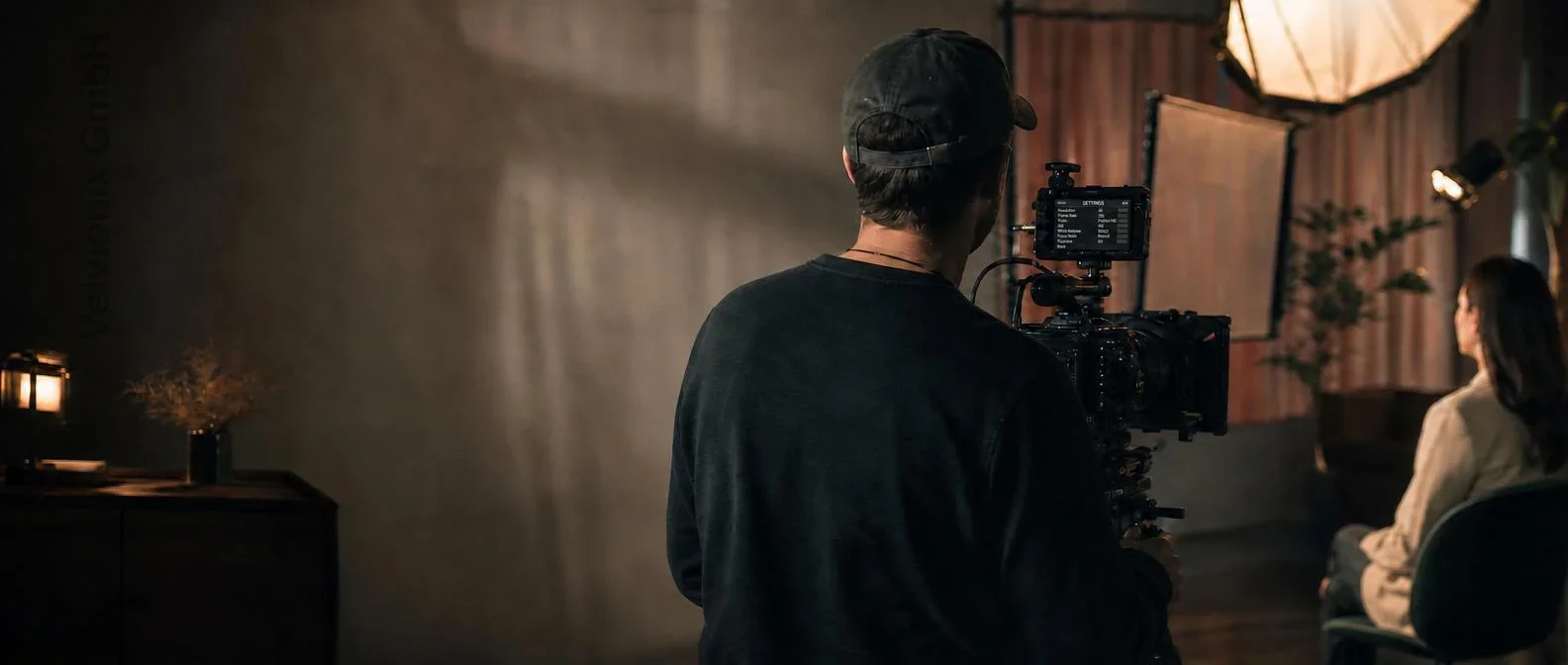
Portfolio Website for Videographers & Video Production
A videographer website does not sell individual clips - it sells a signature, a production standard and reliability. Clients from mid-sized companies, creative agencies and press offices decide on the basis of a handful of case studies whether a project fits: which formats the team masters, how usage rights are communicated, how music licensing, model releases and drone work are handled. We build websites for videographers and small production houses that answer exactly these questions in a structured way, deliver the moving image fast and network-friendly and avoid the generic site-builder or default platform-portfolio look.
Why an own website for videographers - despite Vimeo, YouTube and Instagram
Videographers are already highly visible on the web: showreels live on Vimeo and YouTube, cutdowns on Instagram and TikTok, corporate cases on LinkedIn. These channels all serve a purpose - but they do not replace an own website. Platforms put their algorithm at the centre, not you. Your case studies disappear into the feed after a few days, your showreel comments belong to Vimeo, and your pricing, rights matrix and briefing logic do not fit into any caption. Clients - particularly in B2B contexts with mid-market companies, creative agencies and press offices - expect a calm, factual production site before the first call, one on which signature, format focus and working style are graspable within minutes.
The second reason is performance and presentation control. A videographer site has to deliver heavy assets: hero loops on the landing page, case-study galleries with multiple clips, 4K drone sequences, behind-the-scenes stills, and often vertical reel geometry. If these are not delivered cleanly, not only loading time suffers but also picture quality - a pale Vimeo thumbnail with a buffering spinner does not sell productions. We therefore work with a clean division of labour: the website delivers poster images, short silent loops (MP4, H.265/AV1, under 2 MB per loop) and case-study structure; the actual clips run as Vimeo or YouTube embeds with optimised player configuration. The result: Lighthouse scores beyond 90, even on 4G smartphones, without compromising on cinematic quality.
The third reason is conversion. A portfolio on Vimeo or Instagram generates reach and applause but rarely concrete enquiries. An own website can structure the conversation: instead of a free-form contact page we build a project enquiry form with structured fields (industry, goal, target audience, intended delivery channel, rough reach, budget range, timeline, desired deliverables). This filters fitting from unfitting enquiries right at the start, saves you free concept phases and signals to clients that you work methodically. No payment function, no file uploads - moodboards, briefings and reference links move to email after first contact, keeping the data-protection and security surface small.
Portfolio structured by format - the website as a case-study platform
Videographers today typically combine at least four to eight format classes, and each follows its own logic. Image film and corporate portrait work with interview audio, B-roll layers, controlled lighting and a colour vocabulary that echoes the client\'s brand world. Recruiting video is closer to everyday employee life, requires authentic settings, clear quotes and often a dedicated vertical reel for social. Event aftermovie lives from edit pace, sound design and the compression of a day into 60 to 180 seconds. Product film and commercial demand studio discipline, precise set-dressing planning and frequently a CGI or motion-graphics layer. Music video, documentary and wedding each follow their own narrative economies. The website has to make this differentiation visible rather than smoothing it out.
We structure your portfolio therefore by format and niche, not by chronology. Each format class gets its own overview page with three to six current case studies - this is the layer that has to be found for queries such as "image film production [city]", "recruiting video [industry]" or "drone videographer [region]". Each case study is a standalone, SEO-worthy subpage in a Brief-Insight-Execution-Result structure: what was the brief, what was the core hypothesis behind our execution, which production decisions were taken (team size, shoot days, equipment, drone yes/no, music source, usage rights), and which measurable outcome resulted (views, watch time, candidate pipeline, applications, pitch conversion). This pattern prevents portfolio blindness for new clients and simultaneously delivers the strongest SEO signal a production site can provide.
Within each case study, delivery formats (landscape hero, square social, vertical reel, broadcast version) are either embedded in parallel or deliberately reduced to keep the use case clear. Technical deliverables descriptions - ProRes 422 HQ for the client master, H.264/H.265 for web, DCP for cinema, loudness normalisation per EBU R128 for broadcast - do not belong in the main navigation but in a structured "production standard" block that shows agencies and press offices that you work with broadcast-ready workflows.
A frequently underrated element is the reference gallery. Logos on their own feel interchangeable - we tie each client logo to its case study wherever usage rights and NDAs allow. Where a name mention is not permitted, we work with anonymised case studies ("pharma mid-market, DACH roll-out, 2025"). Testimonials - quote plus role plus industry plus photo - are particularly valuable in the videographer niche, because production quality is rarely decided on price but on the feeling of being able to rely on the team on shoot day.
Legal framework: UrhG, KUG, music licensing, GDPR, EU drone regulation
Videographers work at the intersection of several legal frameworks that apply in parallel. German copyright law treats film as a distinct category of works (§ 2 (1) No. 6 UrhG) and additionally grants the film producer a neighbouring right (§ 94 UrhG). Rights are granted to the client under the regime of §§ 88 et seq. UrhG - and this is where in practice it is decided what is included in the engagement and what is an extra as buyout or extended licence. A website that makes this transparent prevents misunderstandings: clients learn early that "we get the film" does not automatically mean "we get all rights, forever, everywhere". We build for this a factual rights-matrix section with usage types, terms and territories, without replacing the production contract\'s final clause.
Personality rights are the second hard frame. § 22 KUG requires consent for publishing images of recognisable persons as a rule; §§ 23 et seq. KUG contain the narrow exceptions (persons of contemporary history, images from public assemblies, image as an accessory). For corporate films with employees and clients, written consent before shoot day is the production standard - the employment relationship itself is not implicit consent (cf. LAG Köln, decision of 10 July 2009, 7 Sa 2283/08; BAG, decision of 19 February 2015, 8 AZR 1011/13). For minors the consent of both legal guardians is needed; for drone aerials in public space additional GDPR considerations come into play. On the website we present this as a structured briefing checklist for clients - without individual-case assessment, but with a clear indication of which documents a clean production start requires.
Music is its own licensing construction site. Commercials and image films regularly require two parallel rights: the copyrights in composition and lyrics (in Germany usually through GEMA and the respective music publisher) and the neighbouring rights in the recording (master rights with the label). The website explains factually which routes we take: specialised music libraries bundle both rights into a single licence package; custom compositions transfer all rights to the client; GEMA-registered chart music for commercials requires separate synchronisation and master licences that are budget-intensive. This explanation on the website reduces briefing friction and protects both production and client from unrealistic expectations.
Drone work follows EU Drone Regulation 2019/947 in its current form. Commercial-film assignments with common professional camera drones run in the Open Category (A1, A2 with EU competence certificate, A3) or in the Specific Category with operational authorisation or one of the Standard Scenarios. E-ID registration with the German Federal Aviation Office and dedicated aviation liability insurance are mandatory; restricted areas (§ 21h LuftVO), nature and water protection zones, crowds, hospitals and correctional facilities set clear limits. We present on the website, built in line with EU drone regulation, which assignments are feasible and where production planning with the client needs to clarify concrete shoot permissions in advance. Commercial-film drone footage does not fall under the journalistic media privilege under Art. 85 GDPR / § 57 BDSG - the handling of recognisable persons, number plates and private window fronts is addressed transparently, without simulating legal case assessment.
Social security, invoicing and collaboration standards
Self-employed videographers in Germany are typically compulsorily insured through the Künstlersozialkasse (KSK), provided their work is predominantly creative - the classification as "artistic/journalistic" under § 2 KSVG is case-law supported and covers camerawork, directing and editing in the vast majority of cases. For commissioning companies the mirror obligation applies: the artists\' social security contribution under § 24 KSVG, filed annually with the KSK and paid on total fees (2026 rate: 5.0%, per Bundesanzeiger publication). On the website we address this factually - not as an advertising claim but as an informational service for mid-market clients who often only learn of it during their first KSK audit. Concrete contribution calculation, tax questions and audit preparation remain the job of the client\'s tax advisor.
The line between freelance status and commercial trade (Gewerbebetrieb) is an individual-case question for the tax authorities. Videographers whose work is predominantly journalistic, documentary or artistic in the narrow sense tend to be classified as freelancers; those who produce primarily advertising content, lead larger teams or operate as a production house with fixed structures typically end up in commercial-trade status and thus trade tax and IHK membership. There is no master-craftsman requirement because videography is not a regulated trade (Appendix A of the Crafts Code). On the website we do not elevate these distinctions into a main topic, but mention them where they help clients - for example in the FAQ or on the page about collaboration with press offices and procurement departments that may require specific invoice formats (ZUGFeRD, XRechnung in B2G contexts from January 2025).
Making collaboration standards transparent pays off disproportionately. We build a "how we work" page that shows in four to six steps the project triangle of briefing, pre-production, shoot and post-production - including realistic timelines, typical revision loops (rough cut, fine cut, colour, sound, mastering) and a review logic via your project/review tool. Rights transfer and buyout options become visible as organisational topics early; the concrete contract wording remains part of the production contract and specialised advice.
Technology, video delivery and local visibility
Video delivery is the central quality and performance factor in our builds. We do not deliver original clips directly from the website - that cannot be kept reliably fast across all devices and networks - but embed Vimeo or YouTube as players with an optimised configuration (no autoplay with sound, reduced branding overlays on Vimeo Plus/Pro, privacy-enhanced YouTube embed or Vimeo DNT flag where desirable from a GDPR perspective). For hero loops on the homepage we use short, silent MP4 or WebM files in H.265/AV1 with rigorous compression - typically 5 to 15 seconds, under 2 MB, no audio, with a poster fallback for slow connections. Loading stays under a second without giving up cinematic drama on the landing page.
Images - shoot-day stills, crew photos, equipment setups - are delivered in modern formats with appropriate breakpoints for desktop, tablet and smartphone and lazy loading below the fold. Font files are hosted locally; analytics is embedded in a data-minimizing way or linked through your existing BI or analytics dashboard. Hosting, SSL, backups, monitoring and security updates run in the background and are included in the maintenance flat rate.
Local visibility matters more in the videographer niche than many expect. Many clients search with a concrete geo component: "videographer [city]", "image film production [city]", "recruiting video production [region]", "drone pilot [city]". We optimise the Google Business Profile with the primary category "video production", matching secondary categories ("advertising agency", "photo studio" where applicable), clean NAP data (name, address, phone), service tags and a regular post cadence. On the site itself we work with structured data per Schema.org (VideoProductionCompany as a subtype of LocalBusiness, VideoObject markup for hero reels, FAQPage for the FAQ block, review markup where testimonials exist) so Google categorises the case studies correctly.
The project enquiry form is the final but central building block. On request we add our optional contact form with automatic acknowledgement: server-side input validation, honeypot against bots, rate limit, delivery via secure SMTP connection through your own business mailbox; the incoming message lands directly in your mailbox, the sender automatically receives an acknowledgement. No file uploads (moodboards, briefings and reference links move to email after first contact), no message content stored on our systems. If you prefer a scheduling widget, you get a common appointment booking widget as iFrame or button link - the contract and data processing agreement run directly between you and the respective provider. Collaboration and review platforms, i.e. your project/review tool, are linked as login tiles on request, not rebuilt in-house.
Frequently asked questions about videographer websites
How do we communicate usage rights transparently on the website so clients understand what the standard offer includes and what a buyout costs?
Film works (§ 2 (1) No. 6 UrhG) and the film producer's related right (§ 94 UrhG) remain with the author or production company - the client is granted usage rights under §§ 88 et seq. UrhG. On the website we therefore render a structured rights matrix that makes visible in three to five tiers which usage types, terms and territorial scopes are described in the standard offer and where an extra fee applies. The final rights clause belongs in the production contract, not in marketing copy. On request, we link to your contract template or a short rights matrix as a PDF. Individual contract review is the job of a media law firm; our work ends at the structured presentation.
How does the website represent model releases and personality rights for corporate shoots, events and drone aerials?
Whenever people are recognisably in frame, § 22 KUG (right to one's own image) applies, with the exceptions under §§ 23 et seq. KUG (persons of contemporary history, image as an accessory, public assemblies). In practice this means: corporate films with employees and clients require written consent before shoot day; minors need consent from both legal guardians; and the employment relationship alone does not automatically replace consent (cf. LAG Köln, decision of 10 July 2009, 7 Sa 2283/08; BAG, decision of 19 February 2015, 8 AZR 1011/13). On the website we surface this on three levels: a compact briefing checklist for clients (which consent documents need to be ready before shoot day), a generic description of our production standard (release forms, documenting consent in the shoot logistics, clean delineation of the KUG exceptions for assemblies and contemporary history) and a separate notice logic for drone sequences where the circle of persons often cannot be cleared individually in advance. The individual-case assessment stays with the client and their legal counsel - we structure the information architecture, but do not provide legal case assessment.
How do we communicate music licensing on the website without sliding into individual legal advice?
Music in commercials and image films is double-licensed: first the copyrights in composition and lyrics (in Germany typically via GEMA or the respective music publisher), second the neighbouring rights in the sound recording (master rights, usually held by the label). On the website we describe factually the two routes we take by default: first, licensing via specialised music libraries - these bundle composition and master in a single subscription or one-off licence with the rights pre-cleared; second, custom composition for hero productions, where rights transfer fully to the client. GEMA-registered chart or soundtrack music is not part of our default offer because commercials require parallel master and synchronisation licences that regularly reach five- to six-figure territory. The concrete licence negotiation with label and music publisher is not a service we provide - we refer to specialised music supervisors and explain the cost dynamics on the website so clients can set realistic budget expectations.
What can we say about drone production, the EU drone regulation and GDPR on the website - and what belongs in the kick-off discussion?
EU Drone Regulation 2019/947 in its current form splits flights into the Open Category, Specific Category and Certified Category. On the website we describe typical production prerequisites and sensitive points such as restricted areas, proximity to crowds, nature reserves or footage with recognisable persons. Whether and how a given location is feasible is clarified in the production discussion with the client, permit bodies and, where applicable, data protection officers.
Does the website need to reference the Künstlersozialkasse (KSK) contribution owed by commissioning companies?
There is no statutory requirement to flag the artists' social security contribution (§ 24 KSVG) on the website of a video production. A factual note can nevertheless help clients because regular commissions of self-employed creatives can touch KSK topics. We create a neutral information place with a reference to the KSK as the competent authority; concrete checks and filings remain with the client's tax advisor or KSK specialist advisor.
What does a website for videographers and video production companies cost?
We offer compact Starter packages for professional websites. All packages, care tiers and optional extensions are listed transparently on our Website pricing & packages page - so you can compare scope and pricing at your own pace, with no obligation. In a no-obligation conversation we clarify which setup fits your online presence.
More dedicated services in this industry
Looking for a website for a related profession? These dedicated pages might also be relevant:
Website for photographers
Present portfolio, services, photo series, prices or price ranges, specialisation, booking paths and contact clearly - for photographers who want to make style, quality and trust visible quickly.
View photographer website →Website for advertising agencies
Present services, positioning, industry focus, case studies, team, process and contact paths convincingly - for agencies with strategic and creative ambitions.
View advertising agency website →Website for marketing agencies
Organise services, channels, approach, references, expert articles, lead magnets and enquiry paths clearly - for marketing agencies that want to show competence and structure.
View marketing agency website →Website for graphic designers & design studios
Present portfolio, design services, project examples, style direction, process, contact paths and enquiry form in a visually high-quality way - for graphic designers and design studios.
View graphic designer website →Website for social media agencies
Present content services, channels, examples, processes, packages, references and contact paths professionally - for social media agencies with services that need explanation.
View social media agency website →Website for wedding planners
Present planning style, packages, reference weddings, process, supplier coordination, venues and enquiry paths with emotion and clarity - for wedding planners with an advice-led service.
View wedding planner website →More relevant industries
What We Have Already Delivered
Our reference project shows a custom website with a multilingual structure, animated landing page, interactive map and automatic contact form - built from scratch instead of a website-builder template.
View reference project →Full details on scope, packages, prices and optional extensions can be found on our Web Development services page.
View packages and extensions →Ready for a website that presents your production the way it actually works?
In the free initial consultation we look at your existing case studies, discuss your formats (image film, recruiting, social reels, music video, event, drone), your usage-rights logic and your typical pitch structure. The outcome: a clear picture of how your new website should look, load and filter incoming enquiries.
Discuss your videographer website