Predictable Inflow Instead of Chance: Why a Company Blog Pays Off
2026-01-30
This image is protected by copyright. Use only with explicit permission.
© 2026 Velvionix
Key Takeaways
Why Referrals Alone Aren’t Enough
Many freelancers and small businesses live on referrals. That’s pleasant, but it’s also fragile: when referrals slow down, pressure builds immediately. Then comes hectic marketing - ads, discounts, spontaneous social media actions. This can help short-term but often remains unpredictable and costs ongoing time.
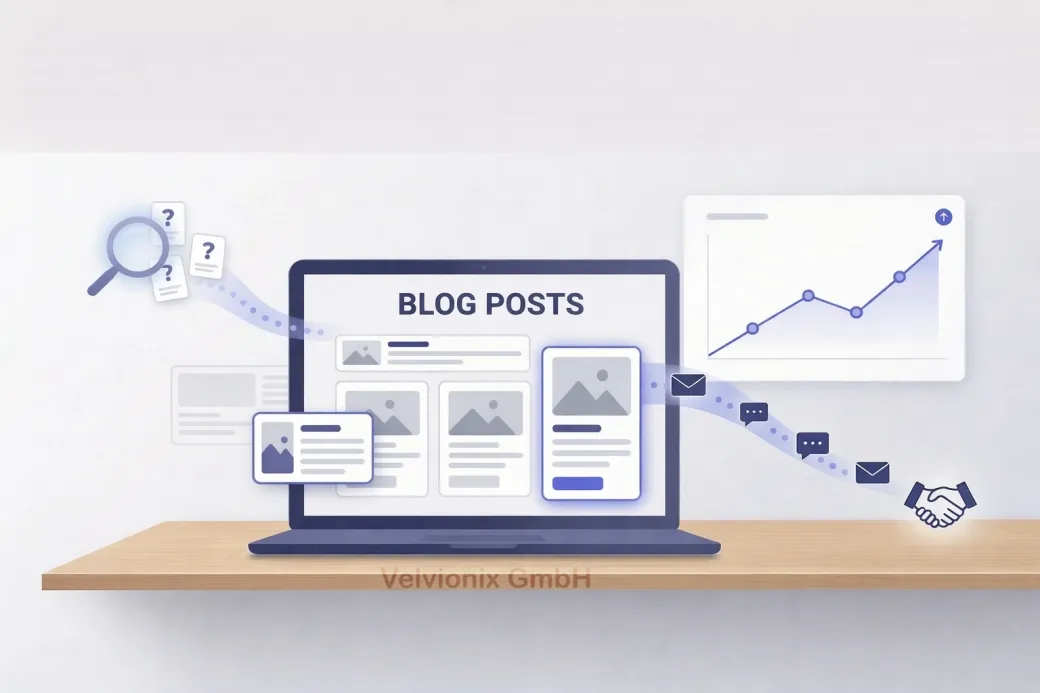
Without a blog, your visibility depends heavily on moments: someone knows you, someone recommends you, someone discovers you by chance. A blog reverses this principle. It ensures you’re found when customers have a problem and actively search for a solution. Search engine optimization simply means: you’re found better when people search for your services and questions.
The misconception: a blog is “nice to have” or only for big companies. In reality, a blog is often the most efficient way for small providers to become less dependent on chance and short-term fluctuations long-term - provided it’s not meant as a diary, but as a strategic part of your website.
What a Company Blog Must Deliver
A company blog pays off when it achieves three things simultaneously: visibility, trust, and pre-qualification. Visibility brings people to your website; trust makes them stay; pre-qualification ensures fitting inquiries come in - rather than random ones.
The most important perspective shift is: a blog isn’t publication pressure - it’s a system that answers recurring questions once and properly. Every question you frequently explain on the phone is a blog topic. Every uncertainty prospects have before inquiring is a blog topic. Every hurdle in the process that leads to drop-offs is a blog topic.
When a Blog Especially Pays Off
If your business depends heavily on referrals, then a blog is a stable additional channel that makes you independent without constantly burning advertising budget.
If you have seasonal fluctuations, then a blog helps build visibility early in quieter phases, instead of only reacting when the phone is already silent.
If your service needs explanation, then a blog is worthwhile because it builds trust before the first conversation and reduces price questions as well as fundamental questions.
Finding the Right Topics
What counts as “good” here is often surprisingly simple for small businesses: few but precise posts that hit concrete search intentions. These are texts like “What does … cost?”, “How does … work?”, “How do I recognize …?”, “What mistakes should I avoid?”, “What do I need to prepare?”. These topics seem unspectacular but bring exactly the visitors who are close to a decision.
A blog shouldn’t be detached from your website. Every post should directly support your services: it explains a problem, shows your approach, and guides the reader cleanly to the next step. The next step isn’t always “buy now.” For many, it’s “request appointment,” “callback,” “quote,” or “briefly check if it fits.” This is exactly where a blog pays off - it doesn’t just deliver visitors but facilitates movement toward inquiry.
Case Study: Physiotherapy Practice with Recurring Questions
A physiotherapy practice regularly received calls with the same questions: “Do I need a prescription?”, “How quickly can I get an appointment?”, “What should I bring?”. Instead of continuing to explain, three short, clear blog articles were published and linked on the contact page. After a few weeks, the number of inquiries didn’t increase, but they became noticeably more sorted - fewer follow-up questions, fewer misunderstandings, more fitting appointment requests.
How to Start Without Overwhelming Yourself
If you barely have time, then don’t publish “something every week” - instead focus on a few core articles that remain valid long-term.
If you offer many services, then prioritize those most important for your business and write about those first.
If you’re just starting out, then don’t write about trends - write about what customers want to know before their first inquiry.
The Real Effort - Unvarnished
A meaningful article isn’t created in ten minutes. Plan time for structure, clear language, checking statements, and clean integration on the website. And more importantly: a blog needs maintenance. Content ages; prices, processes, and conditions change. Therefore, plan to briefly update the most important articles once or twice a year. A blog isn’t a sprint, but it’s also not a monster project if you set it up lean and focused.
What Prevents Blog Success
Common Questions About Company Blogs
How quickly does a company blog bring new inquiries?
This depends on competition and topic choice. Typically, first effects become visible after a few weeks, but stable results need time.
Do I have to constantly write for it to work?
No. Quality and relevance are decisive. A few strong articles that permanently answer questions are often more effective than constant short posts.
What should I write about if my offering "isn't exciting"?
About customer questions. Costs, process, preparation, typical mistakes, selection criteria, differences between options - that's exactly what gets searched.
Do I need social media for this?
Not necessarily. Social media can help but isn't the foundation. A blog works primarily because people specifically search for solutions.
What's the most common reason company blogs fail?
Unclear goals and missing focus. When posts don't support your services and don't offer a next step, it remains activity without impact.
Can a blog also work for local providers?
Yes, especially through questions that are frequently asked locally. People don't just search "near me" - they also search "how does this work" and "what does this cost."
Should I worry about "wrong" visitors?
If you set topics right, not really. Good posts pre-filter because they clarify expectations and thus reduce unsuitable inquiries.
Become Predictably Visible Now
If you want to solve this topic properly, we implement it as part of our services in a structured way - not as a loose individual measure. Please use the contact form and select the appropriate options. We will get back to you with a brief assessment of the most sensible approach.
Sources
Disclaimer: The operators of linked pages are solely responsible for their content. We assume no liability for linked content. This article was created with the assistance of AI-powered research and writing tools.
- [1] Google : "Creating helpful, reliable, people-first content"
https://developers.google.com/search/docs/fundamentals/creating-helpful-content - [2] Google : "Search Engine Optimization (SEO) Starter Guide"
https://developers.google.com/search/docs/fundamentals/seo-starter-guide - [3]
- [4] Stanford University : "The Web Credibility Project: Guidelines"
https://credibility.stanford.edu/guidelines/ - [5] Content Marketing Institute : "What Is Content Marketing?"
https://www.contentmarketinginstitute.com/what-is-content-marketing/
Related Articles
This image is protected by copyright. Use only with explicit permission.
© 2026 Velvionix
Start Professionally: Email, Calendar, and Files That Build Trust
2026-02-04

This image is protected by copyright. Use only with explicit permission.
© 2026 Velvionix
Professional Presence: How to Build a Website That Pays Off
2026-02-03

This image is protected by copyright. Use only with explicit permission.
© 2026 Velvionix
Around the Clock: How an AI Assistant Secures Your Inquiries
2026-02-03
Comments
No comments yet.
Be the first to comment!
Write a comment
To write a comment, please enable the comment function in your privacy settings.
Write a comment