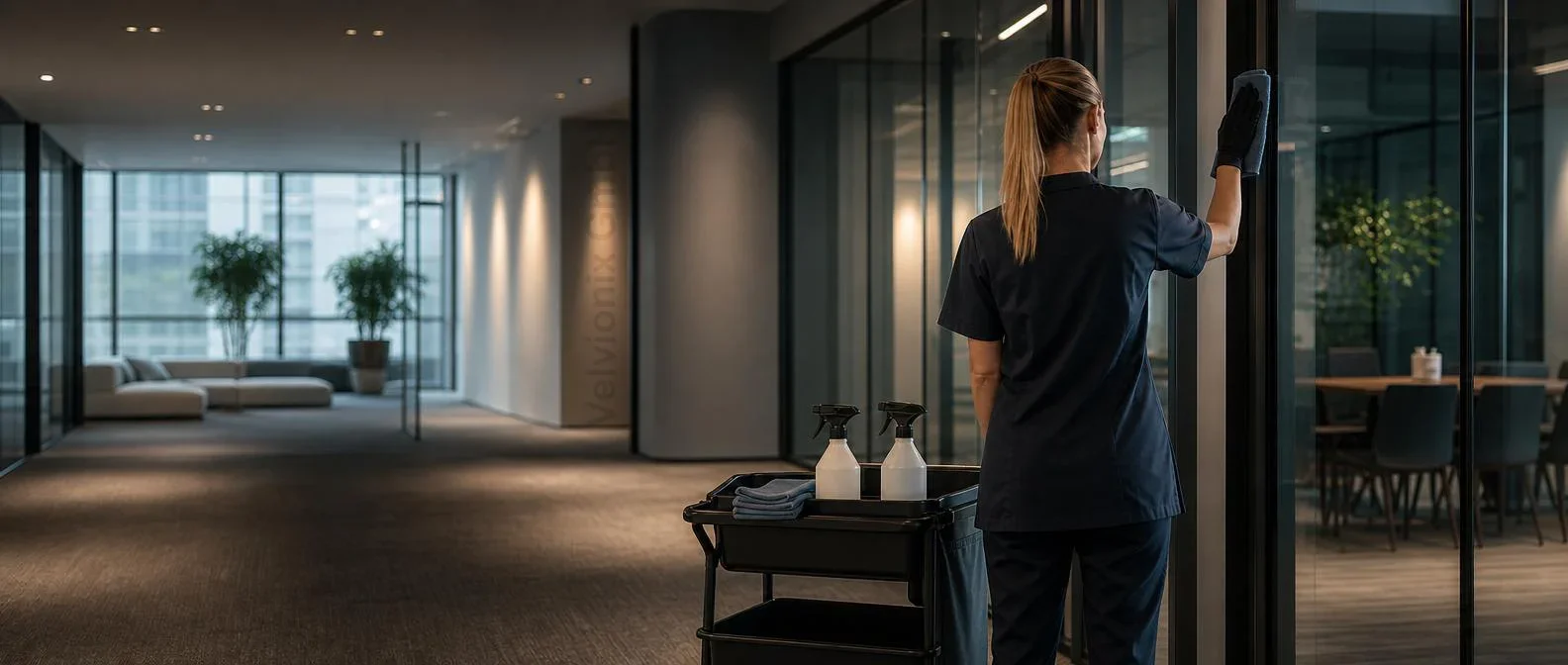
Professional website for building cleaning & cleaning companies
The German building-cleaning sector is a large and varied service market. Website quality can help present scope, qualifications and contact paths in a way that is easy to assess. Facility managers, property administrators, medical practices and developers research before every tender; a website that accurately depicts scope of services, qualification, references and contact paths can support professional pre-screening. A factual, current presentation matters more than blanket comparisons with other website systems or providers. We build websites for building cleaning and cleaning companies that take the trade's collectively agreed quality standards seriously - with a clean B2B/B2C separation, a structure aligned with current requirements and local visibility.
Important notice Legal, tax and industry-specific information concerns Germany and expressly identified EU law. It is provided for general orientation and does not replace individual advice. Last review of the cited legal situation: April 2026 Show the full notice
Unless stated otherwise, the legal, tax or industry-specific information on this page reflects the law applicable in Germany and German official and professional practice. Directly applicable EU law and references to other jurisdictions are identified separately. The information was researched with due diligence using sources available as of the stated review date. For binding guidance on your specific project, please contact the competent chamber or a qualified specialist, such as a lawyer or tax adviser. The current statutes and official regulations always prevail.
Why a strong website makes the difference for cleaning companies today
The building cleaning market in Germany has been growing uninterruptedly for years, driven by the increasing outsourcing of internal cleaning teams (outsourcing quota in offices clearly above 70 percent), the tightening of hygiene expectations since 2020 and a consolidation at the top - a handful of nationwide groups cover a double-digit market share while the rest is carried by around 27,000 small and medium-sized firms. It is precisely this middle layer - between the one-person business with a handful of objects and the regional provider with 30 to 150 employees - that sustains the market and at the same time has the greatest catching up to do in its digital external presentation.
The website is often an important part of pre-screening a new B2B provider. A facility manager, a practice owner or a property-administration clerk starts with a local search ("office cleaning [city]", "medical-practice cleaning [district]", "post-construction cleaning contract"), clicks three to five providers from the organic list and the map area of an external business profile, and forms an initial view within a few minutes of which firms might fit professionally. In this selection process the website does not act as an advertising surface but as a professional test: Are service scopes described clearly and in the correct technical language? Are there plausible references with realistic object sizes? Is the Chamber of Crafts membership visible, are the insurance details tangible? Does a clear, short path to the on-site survey exist - or only a generic contact form without thematic context?
The B2C segment is structurally different but equally digitally dominated. Enquiries for window cleaning, deep carpet cleaning, subscription-based household cleaning or the classic move-in and move-out cleaning almost always emerge from a local search, an external business profile click or a recommendation check ("cleaning company [district] reviews"). Here what counts is speed of first contact, price clarity and the number of credible reviews - and here a clear, mobile-friendly website can simplify first contact without guaranteeing a particular job volume. The same firms that have built high-quality object competence in the B2B strand often fail to exploit their B2C potential because the website throws both worlds into a single, unclear service mash.
On top of this there is a structural cohort effect: building cleaning is one of the crafts sectors with the highest annual founding rates - many one- and two-person businesses start from a niche (medical-practice maintenance cleaning, post-move cleaning of residential property, private-customer glass cleaning) and slowly grow to ten to twenty employees in their first three to five years. For this growth phase, the website is the central cost-neutral acquisition tool - an owned website provides a controllable contact channel alongside referrals, tenders and external directories. Whether and when the investment pays back depends on the business, offer, market and actual order intake.
What belongs on a modern building cleaning website
The home page shows what your firm stands for in the first ten seconds. Existing team or site photos are welcome but are not a prerequisite for starting the project. An image concept and optional media can be developed within the agreed scope or added later. The homepage also needs a clear positioning sentence ("Owner-managed building cleaner with 22 employees, focus on office and medical-practice cleaning in the Rhine-Main region"), two clearly separated entry CTAs ("Request an offer for businesses" / "Private-customer enquiry") and a compact service bar with the four to six main trades. No carousels with alternating assertion sentences, no animated number counters, no pop-ups - the target group is factually oriented and registers marketing tricks as a deduction.
The service pages are the technical backbone of the website. Depending on the actual offer and commissioned page scope, each trade can receive an expressive page (maintenance cleaning, deep cleaning, glass cleaning, facade cleaning, post-construction cleaning, industrial cleaning, carpet and upholstery cleaning, stairwell and common-area cleaning, household cleaning, special cleaning after water damage or cluttered-home situations) built on service-specification logic: what is concretely done (e.g. for maintenance cleaning - dust-binding damp wiping, sanitary cleaning with disinfection, waste removal within the recycling separation, mirrors, handles, switches), in which cycle (daily, three times weekly, weekly, fortnightly), with which cleaning chemistry (low-phosphate, VAH-listed disinfectant, descaler with pH classification), with which protocol. Plus a realistic object example, a rough duration benchmark per square metre or floor and a trade-specific CTA for an on-site survey. These pages are the most important SEO foundation and are often read as reference material during tenders.
The references page is the hardest trust building block. A selection of projects suited to the available material, with an optional site photo (neutral, without recognisable customer logos and without people where no consent exists), object type and size, cleaning cycle, short service description, start of the contract ("customer since 2019") and - where available - a short quote from the object-responsible person. The references cover the full range (small office, medium-sized medical building, industrial hall, multi-storey residential object, post-construction cleaning). Particularly in public tenders under UVgO or VgV, contracting authorities demand references from comparable object types of the last three years - the website is the fastest evidence source here.
The team and careers element is surprisingly decisive in the cleaning industry. The sector has a structural skills shortage - the federal guild association of building cleaners speaks of an open-position gap in the five-digit range. A website that shows the team (object supervisors, lead cleaners, long-standing employees), makes training offers transparent (the three-year dual apprenticeship as Gebäudereiniger, further training to master) and contains a careers page with real job descriptions can provide orientation for both clients and applicants. The careers form works like the contact form: applications arrive via email in your inbox, no upload function for CVs (instead a note that after first contact the PDF documents can follow directly by email) and no storage on our systems.
Enquiry and on-site-survey forms can structure first contact as optional extensions. For B2B interested parties a structured form with object type, area (rough staged buckets), number of floors/rooms, desired cleaning cycle and preferred contact person that routes the input via a secure SMTP connection directly into your company mailbox. For B2C interested parties a leaner form with service type (windows, carpet, move, deep cleaning), living area and preferred appointment. We deliberately do not build an online quote calculator with a binding fixed price, no booking platform with payment and no upload function for floor plans - the object calculation belongs on the on-site survey, where floor covering, level of soiling, accessibility and special surfaces can actually be assessed.
Separately commissioned external tools are embedded as a widget, iFrame or button link rather than rebuilt in house. For workforce-scheduling and deployment-planning software we place a login button in the menu ("Staff login") that leads to the provider URL. The same goes for quality assurance with QR-code-based cleaning protocols. On request, a review widget can show genuine, approved customer feedback. You conclude the SaaS contract and the data processing agreement directly with the respective provider - our role ends at the widget boundary. This keeps the responsibility distribution clean and your costs transparent.
A blog or specialist section is an optional, separately maintained extension that can address additional specialist questions; a particular SEO effect is not guaranteed. Factual posts on cleaning chemistry (What is the difference between alkaline and acidic cleaners?), on concrete object situations (How do you clean PVC flooring in a medical practice in a DIN-aligned way?), on industry topics (What changes with the new TRGS 525?) or on practical customer questions (How often should an office really be cleaned?) can support professional assessment and additional search questions. The crucial point is that the posts emerge from actual technical expertise - from confirmed professional practice and editorially reviewed content.
Legal framework: trade registration, minimum wage, DPA and GDPR
The website shows confirmed business, qualification and insurance details and keeps them separate from general industry guidance. Employment law, collective agreements, site safety, cleaning chemistry and special requirements for individual property types are not presented as legal advice. The provider confirms which rules apply to a particular business or contract with the chamber, association or specialist advisors.
Contact and application paths follow data-minimisation principles. Forms are optional extensions and route details to the agreed recipient without creating a permanent content database of our own. External scheduling, protocol and review services remain independent systems under direct contracts between the business and provider. Accessibility and privacy inform implementation, while case-specific legal review remains with the controller.
Local visibility, B2B acquisition and external business profile
The service area of a cleaning company depends on property type, service cycle, workforce planning and travel logistics. The website therefore names the places or regions genuinely covered rather than using a blanket radius. A consistent local presentation can therefore matter without guaranteeing a particular level of visibility. An external business profile can complement the website but remains a channel managed independently by the business. Setup, ongoing maintenance and review handling are not automatically part of the website service.
Understandable reviews and approved references can provide useful orientation in this industry. A direct link to an external review channel or a separately commissioned widget can be used after actual projects. Responses to critical reviews should be factual and considered case by case. A video or text reference is published only with explicit consent; no particular acquisition effect is guaranteed.
In the B2B segment, organic findability and formal tender routes can both be relevant. For smaller properties, the website supports professional assessment with suitable service content. For medium and larger contracts, it can act as a confirmation point for references, certificates and service descriptions. We do not operate tender platforms or notification services; links are added only on request.
External directories can provide an additional contact path depending on the region. Costs, brokerage terms and benefits differ and should be assessed by the business. The website remains a controllable information channel; neither directories nor organic findability guarantee customers, prices or utilisation.
Structured data per Schema.org can help search systems classify the content technically. We use only types and details that match the actual business and verifiable data. Rich results, ratings and placements are not guaranteed. Basic technical markup is part of implementation; additional data models depend on the agreed scope.
Frequently asked questions about websites for building cleaning and cleaning companies
How are B2B and private-customer services separated?
Both audiences receive clear entry points, suitable service descriptions and different contact paths. Starter can structure this on one page. Additional service or property pages are commissioned separately only where enough original substance exists.
Which details help prepare an on-site survey?
Useful details include property type, approximate area, use, desired cycle, access and contact person. A form is optional and does not create a binding quotation. Calculation follows the actual survey and agreed service boundary.
How are quality and references presented?
The page shows confirmed certificates, approved references and the quality-assurance process genuinely used. Existing images are optional. External review or workforce-scheduling tools are linked only as separately agreed integrations.
How does the website handle hygiene and industry standards?
Standards are explained in general terms only where they match the actual service. Specific hygiene plans, duties and suitability for sensitive premises require professional review for the individual property.
What does a website for a building-cleaning company cost?
A compact, professionally developed website starts from EUR 599. Additional pages, languages, forms, media and functionality can be added to match the required scope. Managed hosting and ongoing support start from EUR 59 per month. Our Website pricing & options page explains the professional foundation and the available ways to expand it.
More dedicated services in this industry
Looking for a website for a related profession? These dedicated pages might also be relevant:
Website for janitorial service
Present property care, minor repairs, outdoor areas, waste bin service, winter service, availability and service area clearly - for janitorial services with recurring contracts.
View janitorial service website →Website for house clearance & estate clearing
Explain services, process, on-site inspection, quote preparation, service area, appointment paths and contact options clearly - for clearance services with time-critical enquiries.
View clearance website →Website for moving service
Structure private moves, business relocations, additional services, on-site inspection, quote enquiry, vehicles, team and contact paths clearly - for moving companies with a regional focus.
View moving service website →More industries
What We Have Already Delivered
Our reference project shows a custom website with a multilingual structure, animated landing page, interactive map and automatic contact form - built from scratch instead of a website-builder template.
View reference project →Full details about the professional Starter foundation, pricing and flexible extensions are available on our “Website pricing & options” page.
View pricing & options →Ready for a website that fits your cleaning company?
In a free initial consultation we discuss your service focus (maintenance, deep, glass, post-construction cleaning), your customer mix between B2B and B2C, your certifications and your catchment area. You receive a concrete offer for a website that structures tender enquiries and private-customer contacts and presents your operation factually. Existing images, finished copy or a logo are welcome but are not prerequisites for starting the project.
Discuss your building cleaning website